Latest update July 31st, 2026 12:35 AM



Latest News
- Bloomberg reports: Oil curse hanging over Guyana’s head
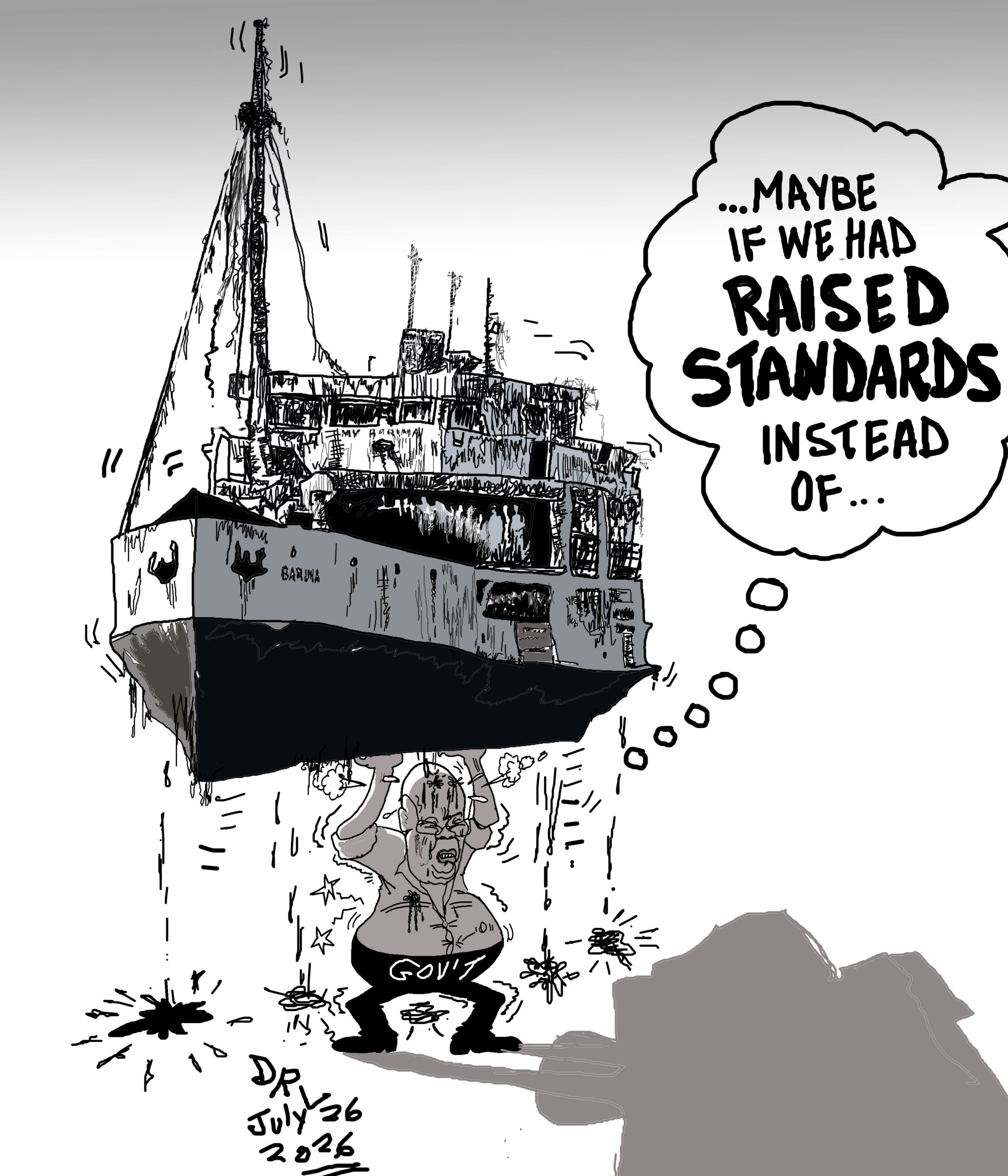
- ‘You can’t have both’ …Todd challenges parallel COI, murder prosecution of MV Barima crew
- Pres. Ali dodges media
- ‘Seaworthiness of MV Barima was MARAD’s responsibility, not charged crew’s’ – Dr. Todd
- ExxonMobil to conclude another exploration well next month
The Corentyne Bridge
(Kaieteur News) – Neville Bissember’s op-ed, posted on Kiskadee Warch, provides a fairly concise historical account of the Guyana-Suriname territorial controversy. But it ultimately advances a flawed premise by implying, in the title, that meaningful cooperation, particularly on the proposed Corentyne River bridge, should await or be conditioned by the resolution of the outstanding border issues.
History points to a different lesson. Territorial disputes can coexist with productive bilateral relations when both states consciously decide that unresolved sovereignty questions should not obstruct cooperation in areas of mutual benefit.
Guyana itself has already demonstrated this principle in its relations with Venezuela. Despite the long-standing controversy over the Essequibo, the two countries enjoyed one of the most constructive periods in their bilateral relationship during the presidency of Hugo Chávez, when both governments explicitly agreed that the border controversy should not impede cooperation in trade, energy, culture and regional integration.
The Chávez years illustrate an important diplomatic reality. Neither Guyana nor Venezuela abandoned their respective legal positions on the territorial controversy, yet both accepted that the dispute could be managed while the wider relationship continued to develop.
Indeed, this approach reflected sound diplomatic practice rather than any weakening of Guyana’s claim. It recognised that territorial controversies are often measured in decades, if not generations, and that waiting for their final settlement before pursuing normal relations would condemn neighbouring states to perpetual mistrust.
That same philosophy has long informed Guyana’s approach towards Suriname. Georgetown has consistently maintained that while the New River Triangle dispute remains unresolved, it should not prevent both countries from cooperating in trade, security, infrastructure and regional integration.
Bissember therefore creates a false linkage between the existence of unresolved territorial issues and the feasibility of the Corentyne bridge. If settlement of the New River Triangle becomes a prerequisite for constructing the bridge, the logical consequence is that the project could remain indefinitely stalled because there is no realistic prospect that such a dispute will be resolved quickly.
International experience demonstrates that many territorial disputes remain unresolved for generations without preventing neighbouring countries from jointly pursuing infrastructure projects. Successful diplomacy often consists not of eliminating disagreements first but of building confidence through practical cooperation while those disagreements remain under negotiation.
Bissember’s argument is further weakened by its treatment of the Corentyne River itself. Guyana has long accepted that sovereignty over the river rests with Suriname under the historical understanding inherited from the colonial boundary arrangements, even while maintaining its separate claim to the New River Triangle.
The bridge proposal therefore does not depend upon resolving the New River Triangle controversy. Since Guyana does not dispute Suriname’s sovereignty over the Corentyne River, the territorial controversy over the Triangle has no direct bearing on whether both governments can negotiate mutually acceptable arrangements for constructing, owning, operating and regulating a bridge across the river.
Many of the practical questions Bissember raises—ownership, tolls, applicable law, policing, customs procedures and operational control—are legitimate matters for negotiation. However, they are engineering, commercial and treaty-design issues rather than consequences of the unresolved territorial dispute.
Cross-border bridges around the world routinely operate under bilateral agreements that clearly allocate jurisdiction, maintenance responsibilities, revenue sharing and security arrangements without requiring complete agreement on every historical or territorial issue between the participating states. The existence of unresolved political differences has seldom prevented governments from negotiating practical solutions where mutual economic interests are strong.
Ironically, the bridge itself could become an instrument for improving bilateral relations rather than a casualty of their imperfections. Shared infrastructure creates regular institutional cooperation, encourages commerce, facilitates people-to-people contact and builds habits of collaboration that can ultimately contribute to a more favourable environment for addressing more difficult political questions.
Bissember is correct to caution against unilateral action and Guyana is entitled to insist that no bridge project proceed without its full participation and consent. However, that principle is entirely consistent with pursuing the project jointly and does not require that the broader territorial controversy first be settled.
The history he recounts therefore supports a conclusion different from the one he reaches. Rather than demonstrating that unresolved disputes make cooperation impossible, the experience of both Guyana-Venezuela and Guyana-Suriname suggests that mature diplomacy lies precisely in separating areas of disagreement from areas where cooperation advances the interests of both peoples.
The objective should not be to postpone cooperation until every historical grievance has been resolved. It should be to build sufficient trust through practical collaboration that the eventual resolution of outstanding disputes becomes more, rather than less, attainable.
The views expressed in this article are those of the author and do not necessarily reflect the opinions of this newspaper
Share this:

Discover more from Kaieteur News
Subscribe to get the latest posts sent to your email.
Similar Articles

Blunt of the day
Sports

Features/Columnists

Sir. Ronald Sanders

The GHK Lall Column

Weekend Cartoon