Latest update October 7th, 2026 10:30 AM


Latest News
- US$214M audit dispute with Exxon now before ICC
- Suriname rejects 384.8 tonnes of Guyana rice over missing import approval
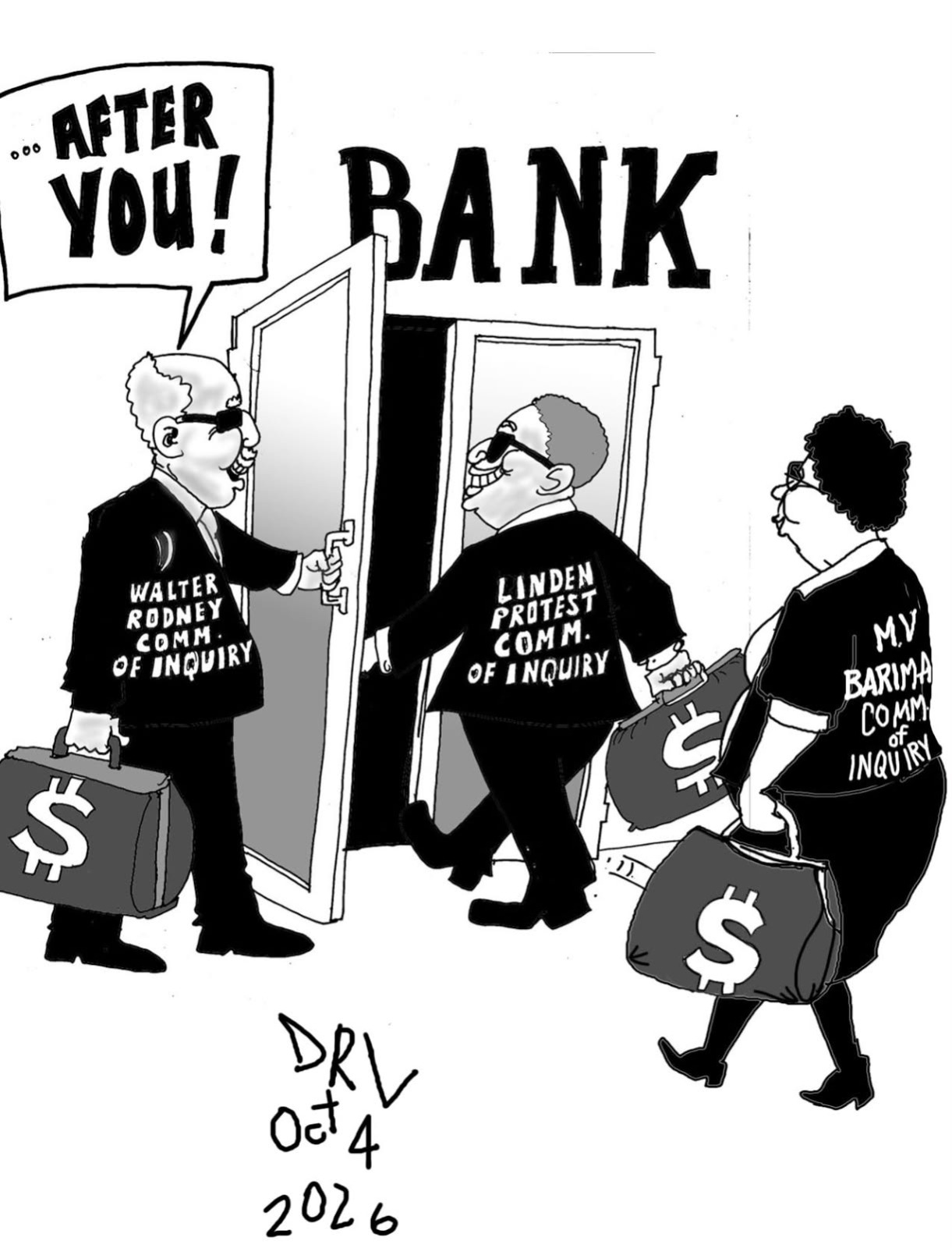
- MV Barima CoI to last 6 months amid boycotts, protest over unsalvaged vessel
- President’s Lawyer admits reporting Opposition Leader’s page before meta suspension
- Rodrigues-Birkett stands by Gaza ‘genocide’ remarks
Parliament is not a playground
(Kaieteur News) – There is a profound difference between opposition and obstruction. One strengthens democracy; the other seeks to paralyse it. One tests governments through argument; the other attempts to silence them through noise.
On Monday, the National Assembly witnessed far more than an unruly protest. It witnessed a calculated assault on parliamentary order itself.
Let us dispense with one convenient fiction immediately. No one needs a commission of inquiry to determine who was responsible. The culprits were not masked. They did not act under cover of darkness. They were captured on live television before the entire nation. Every chant, every shout, every advance into the Well of the Assembly, every refusal to obey the Speaker’s repeated instructions is permanently preserved in countless video recordings.
There are no mysteries here. There are only consequences waiting to be imposed.
Those involved did not merely raise objections to the Government’s business. They deliberately created a din intended to drown out proceedings. They occupied the Well of the Assembly, transforming the floor of Parliament into a stage for political theatre rather than constitutional deliberation. Most troubling of all, they ignored repeated pleas from the Speaker to restore order. That last fact alone elevates the incident from spirited protest to outright defiance of parliamentary authority.
The Speaker is not a ceremonial ornament whose appeals may be ignored whenever Members become sufficiently agitated. In every legislature fashioned after the Westminster model, the authority of the Chair is the cornerstone upon which parliamentary government rests. Remove respect for that authority and Parliament degenerates into little more than a public shouting match.
The British Parliament learned this lesson centuries ago. The institution survived civil war, constitutional crises and political upheaval because it developed one indispensable principle: someone must maintain order, and Members must obey that authority even when they profoundly disagree with its rulings. Without that principle, Parliament ceases to function as a legislature and becomes merely another arena for mob rule.
The authoritative Erskine May: Parliamentary Practice, regarded throughout the Commonwealth as the bible of parliamentary procedure, defines contempt broadly to include acts which obstruct or impede either House in the performance of its functions. Westminster has traditionally relied upon disciplinary procedures—naming Members, suspension and removal—to deal with disorder inside the Chamber. But the underlying constitutional principle is unmistakable. Members have no right to impede Parliament itself.
What occurred on Monday falls squarely within that principle. The objective was obvious. The intention was not to persuade. It was not to debate. It was not even to protest. The intention was to prevent the Assembly from conducting its business. In ordinary language, that is obstruction. In parliamentary language, it amounts to conduct that impedes the House in performing its constitutional functions.
This is hardly unprecedented within the Commonwealth. The British House of Commons has repeatedly suspended Members who refused to obey the Speaker or persisted in disorderly conduct after repeated warnings. Canadian Speakers have named Members who deliberately disrupted proceedings or defied the Chair. Australia’s House of Representatives has likewise suspended Members for gross disorder, while New Zealand has repeatedly enforced lengthy suspensions where Members deliberately frustrated parliamentary business. Caribbean legislatures, drawing from the same Westminster traditions, have not hesitated to suspend Members who ignored the authority of the Chair or physically obstructed proceedings. The lesson is remarkably consistent across the Commonwealth: Parliament cannot be permitted to surrender to organised disorder.
Some will insist that parliamentary privilege protects such conduct. That argument misunderstands the very purpose of privilege. Parliamentary privilege exists to protect free speech, not free-for-all behaviour. It shields Members from external interference so that debate may flourish. It was never intended to provide immunity for conduct designed to destroy debate altogether.
Others will say this is politics. Indeed it is. But there is a difference between hard politics and constitutional vandalism. Democracy requires governments to tolerate criticism, ridicule and fierce opposition. It does not require legislatures to tolerate calculated attempts to shut themselves down.
If such conduct escapes meaningful sanction, Monday’s events will become tomorrow’s parliamentary playbook. Every future disagreement will carry the temptation to occupy the Well, drown out debate and hold proceedings hostage until political demands are met. Parliamentary democracy cannot survive if whichever side shouts the loudest acquires an effective veto over the legislative agenda.
Nor should the Assembly shrink from describing the conduct for what it was. This was not simply disorder. It was a deliberate attempt to impede the work of Parliament. The distinction matters because Parliament exists not for the convenience of politicians but for the service of the people. Every minute lost to orchestrate chaos is time stolen from legislation, oversight, public accountability and the consideration of matters affecting the nation.
The National Assembly therefore has both the authority and the duty to act. Members who participated in this orchestrated disruption should be found to have committed a contempt of the Assembly by deliberately obstructing its proceedings and by openly defying the authority of the Speaker. At the very least, they should face substantial suspension from the service of the House. Such suspensions should be sufficiently lengthy to reinforce the gravity of their misconduct and to deter similar behaviour in the future.
Failure to act decisively would send precisely the wrong message—that organised disruption carries little cost and that parliamentary authority is negotiable. A firm response, on the other hand, would reaffirm a timeless Westminster principle: vigorous opposition is the lifeblood of democracy, but deliberate obstruction of Parliament is an offence against democracy itself.
The views expressed in this article are those of the author and do not necessarily reflect the opinions of this newspaper
Share this:

Discover more from Kaieteur News
Subscribe to get the latest posts sent to your email.
Similar Articles
Website Hits

Blunt of the day

Sports

Features/Columnists

Sir. Ronald Sanders

The GHK Lall Column

Weekend Cartoon