Latest update July 22nd, 2026 12:47 AM



Latest News
- MV Barima Disaster… Death toll now pegged at 103
- Another boat calamity… Several injured, captain critical after boat collision in Canje River
- Opposition Leader calls for Edghill’s resignation
- Pres. Ali declares three days of mourning following capsizing of MV Barima
- ‘US$12.7M MV Ma Lisha still idle’ …embattled Edghill blames shifting soil, failed Port Kaituma wharf
Glenn Lall has opened the eyes of the nation to an injustice
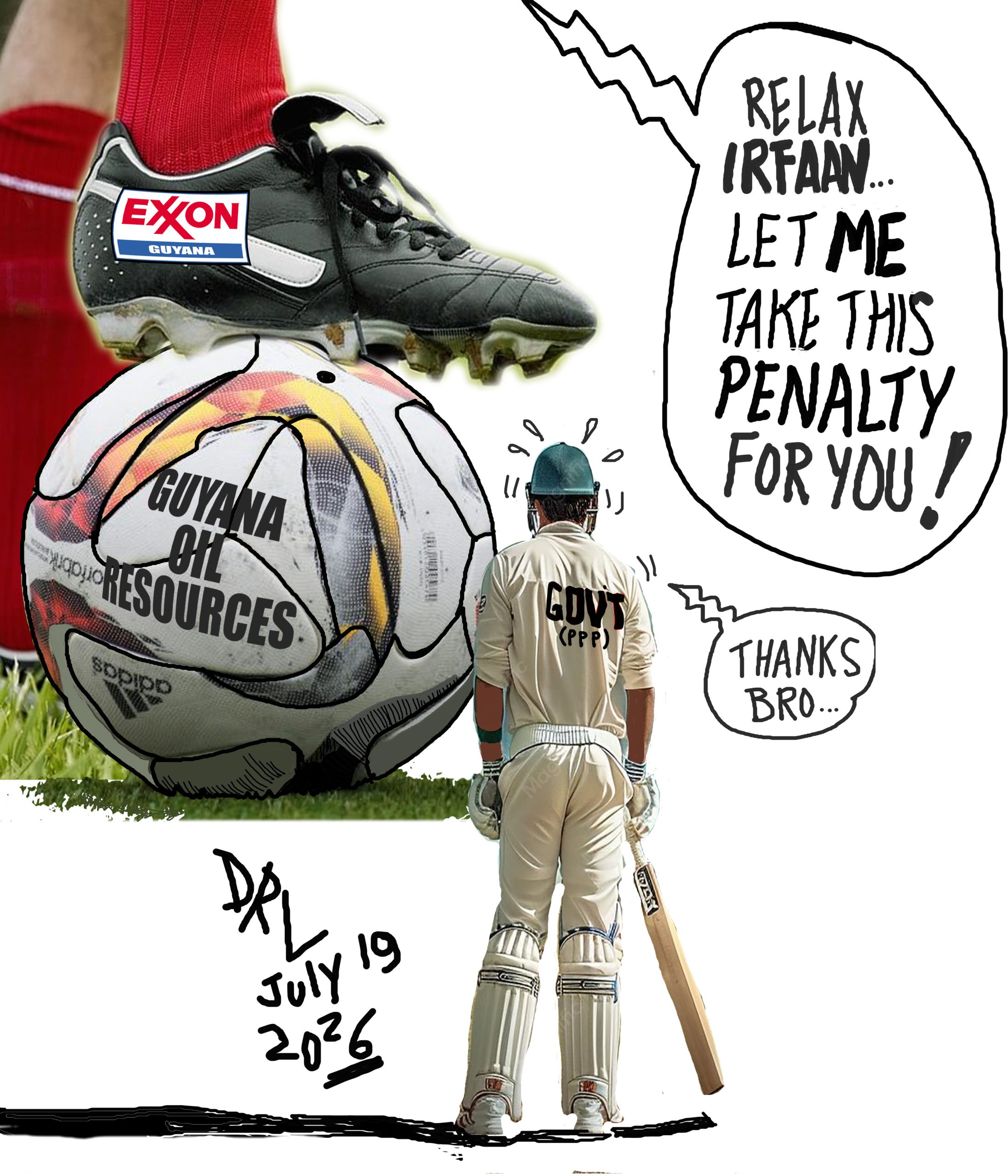
(Kaieteur News) – Guyana’s Production Sharing Agreement (PSA) with ExxonMobil effectively allows the company to de-risk its investment after discovery while shifting the financial burden onto the country—deserves serious and sober scrutiny. This is why poorly structured contracts can transform resource wealth into a mechanism for external extraction rather than domestic development.
In this case, the troubling implication is that ExxonMobil and its partners, despite spectacular oil output – production has risen to more than 1 million barrels per day – may be functioning less as a co-investor and more as a financier of its own resource exploitation.
At the heart of the issue is the structure of cost recovery. Under the PSA governing the Stabroek Block, ExxonMobil and its partners are entitled to recover up to 75% of production as “cost oil.” Only the remaining 25% is treated as profit oil, to be split evenly. This yields an effective share of 12.5% of total production for Guyana during the cost-recovery phase.
While such arrangements are not unusual in frontier oil provinces, the scale and duration of cost recovery in Guyana’s case raise legitimate concerns. Once commercially viable oil was discovered, the fundamental risk profile changed dramatically. Yet the contract did not correspondingly rebalance returns. Instead, it preserved a structure whereby ExxonMobil could fully recoup its sunk exploration costs from production revenues—revenues derived from Guyana’s own resource base.
This is the essence of the de-risking argument. In a typical joint venture, investors bear the downside risk of exploration in exchange for upside profits if discovery occurs. However, when exploration costs can be recovered post-discovery through generous cost-oil provisions, the investor’s exposure is substantially reduced.
In effect, ExxonMobil’s capital outlays are not truly “at risk” over the long term; they are advanced and later reimbursed. This is closer to a reimbursable contractor model. The result, as a recent commentary by Glenn Lall, the publisher of this newspaper, has noted, is that ExxonMobil is producing oil while charging Guyana for the privilege. This is a paradox that undermines the very notion of sovereign resource ownership.
It is here that the intervention of Glenn Lall has been especially valuable. Lall’s persistent and often impassioned critique has pierced the veil of technical complexity that typically shields such agreements from public understanding. His framing of the “50% illusion”—that Guyana receives half of profit oil, but only after a large majority has been allocated to cost recovery—is analytically precise. In so doing Lall has exposed the asymmetry embedded in the agreement.
The absence of ring-fencing provisions further compounds the imbalance. Without ring-fencing, ExxonMobil can charge the costs of new developments—such as successive phases of Liza and projects like Payara and Yellowtail—against the revenues of producing fields. This creates a rolling cycle of cost recovery that delays the transition to a higher profit share for Guyana. In economic terms, it elongates the payback period indefinitely, effectively locking the country into a low-revenue equilibrium despite rising production volumes. Lall’s assertion that “this is our oil paying for their expansion” is a succinct description of how inter-project cost allocation can distort national returns.
Equally troubling is the issue of cost verification. If, as has been suggested, costs are inflated—or even simply weakly audited—the consequences are severe. Every dollar added to the cost ledger translates into more oil diverted away from profit sharing. This creates a structural incentive problem: the operator benefits from higher reported costs, while the host country bears the burden. In such circumstances, robust auditing capacity is not a luxury but a necessity. Yet Guyana, as a new entrant to the oil economy, faces predictable constraints in technical expertise and regulatory enforcement.
But to be fair to ExxonMobil, it has acted in accordance with a contract that was freely signed. The deeper responsibility lies with the government who negotiated and continue to uphold its terms. Natural resource contracts must evolve as circumstances change, particularly when initial uncertainty gives way to proven abundance. Mechanisms such as ring-fencing, cost ceilings, and progressive profit-sharing are not radical innovations; they are standard tools of prudent resource governance.
Guyana oil wealth has the potential to finance transformative investments in infrastructure, education, and public health. But this will not occur automatically. It requires a contractual framework that aligns investor incentives with national interests. In this regard, the critique advanced by Glenn Lall is justified. What is needed now is a recalibration of the PSA to ensure that Guyana is not merely rich in resources, but genuinely prosperous in practice.
(The views expressed in this article are those of the author and do not necessarily reflect the opinions of this newspaper.)
Share this:

Discover more from Kaieteur News
Subscribe to get the latest posts sent to your email.
Similar Articles

Blunt of the day
Sports
Features/Columnists

Sir. Ronald Sanders

The GHK Lall Column

Weekend Cartoon