Latest update August 17th, 2026 10:20 AM



Latest News
- Two Australian firms now hold 770 km² gold lands in Guyana
- Mayor demands answers as Linden grid breaks under industrial weight
- Colombian president asks Trump to suspend tariffs to help earthquake recovery
- $6.6B Bath Hospital must deliver more than ‘grand ceremonies’ – Opposition Leader says
- Fast-growing Guyana still depends on private planes for medevac
Guyana’s forest carbon scheme faces a credibility crisis
Kaieteur News – Vice President Bharrat Jagdeo sounded an optimistic tone at his press conference last Thursday. He said that Guyana was going to COP 28 with ‘credibility’ because of its forests acting as abatement to climate change.
Jagdeo told the press conference these forests are an important abatement solution to climate change. He added that the world cannot achieve net zero, “without tackling a key source of emissions which is forest and land degradation.”
Guyana is hoping to capitalize on its stocks of standing forest carbon. It expects to trade on the carbon markets, earning potentially billions of US dollars, once the markets improve. No wonder, Jagdeo complained that forest carbon is not receiving the required attention because forest carbon is not yet a part of the compliance market.
Jagdeo may be a little too optimistic for his own liking. Like the disappointment he faced at Copenhagen, he is likely to discover that the international community is not as confident about forest carbon offsets as he thinks.
A recent Economist magazine article pointed to a Berkeley Carbon Trading Project study, which found, that there was widespread over-crediting of the level of deforestation being avoided. It also found low estimates of the degree to which deforestation was being displaced to other places rather than stopped. In addition, the study suggested there were exaggerated assessments of the carbon stock in the areas involved.
Jagdeo did not tell his press conference that last year there was a decline in the number of such offsets traded because of concerns about their quality. And these concerns have resulted in some companies even quitting the voluntary markets in which Guyana’s carbon is traded.
The emphasis is now shifting. Instead of carbon credits from avoided deforestation, there is likely to be greater interest in the trade of offsets from afforestation and reforestation.
Jagdeo’s LCDS makes provision for the reforestation of as much as 200,000 hectares, including mined-out lands. But what has Jagdeo and his LCDS office done in relation to promoting offsets for this activity? He likes to talk about projects. Where are the reforestation projects to generate offsets?
Last year, Guyana inked a 15-year deal with Hess Corporation for the sale of US$750M in carbon credits. This is not as lucrative a deal as it appears since the US$750 M is spread over a decade and half. The US$250M Norway deal was spread over 5 years and Guyana faced numerous obstacles to drawing-down of the resources.
Just after the Hess deal was signed, a major controversy erupted over the calculation used for Guyana’s sale of the carbon credits. In April of this year, a report raised concerns about the accounting used in this carbon credit scheme.
That report was published under the title, “Questions over accounting and inclusion mar Guyana’s unprecedented carbon scheme.” It highlighted that one climate activists had contended that the methodology used to calculate the carbon storage of forests and generate corresponding credits for entities seeking to compensate for (“offsetting”) their emissions was vastly overstated.
Guyana is one of those countries which brags about its high forest cover (estimated at more than 85% of the country’s land mass) and its low rate of deforestation (estimated at less than 0.1% per annum). Guyana’s carbon credits are generated from the country avoided deforestation.
But if the country already has a low level of deforestation and a high forest cover, then it means that its forests are intact. Therefore what degree of deforestation is being avoided to generate such a high volume of carbon credits?
The report explained that carbon credits issued for REDD+ efforts (reducing emissions through deforestation and degradation) estimate emissions cuts by comparing historical levels of deforestation in a region with imminent deforestation. It noted however that regions with high forest cover and low rates of deforestation (HFLD) allocated additional carbon credits that go beyond this baseline. “By crediting and counting the protection of what already exists as carbon reductions, it jeopardizes the math on true global carbon emissions, reductions and meeting climate goals.”
The report argues that about 84% of the 33.5 million jurisdictional ART credits issued between 2016 and 2020 to Guyana result from an HFLD adjustment. “Without the HFLD adjustment, emissions reductions would have totaled 5.3 million [credits], based solely on avoided emissions for forests under more imminent threat.”
This is the background against which Guyana is going to COP28. It is not one of credibility but rather one in which serious question marks are hanging over the country’s forest carbon offsets. The evidence suggests that in terms of forests the emphasis is now less on keeping standing forests intact and more on reforestation. And second, there are major concerns about the calculation used in determining the jurisdictional carbon credits sold by Guyana.
(The views expressed in this article are those of the author and do not necessarily reflect the opinions and beliefs of this newspaper and its affiliates.)
Share this:

Discover more from Kaieteur News
Subscribe to get the latest posts sent to your email.
Similar Articles

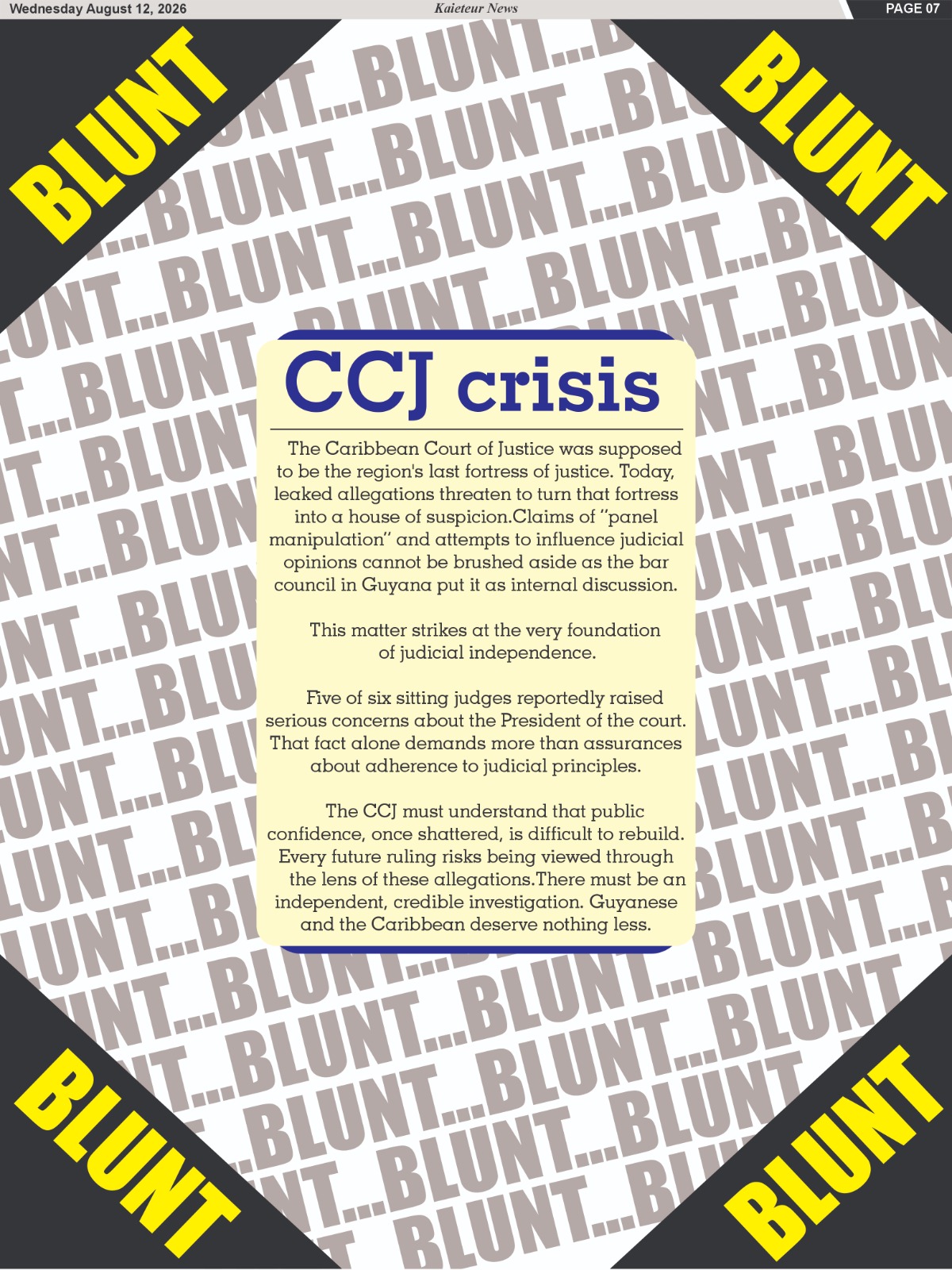
Blunt of the day
Sports

Features/Columnists

Sir. Ronald Sanders

The GHK Lall Column

Weekend Cartoon