Latest update September 25th, 2026 10:30 AM


Latest News
- ‘Visa restrictions, acting appointments are modern pressures on judicial independence’ — Justice Abel
- Pres. Ali makes direct appeal to P5 for Rodrigues as next UN chief
- Delegates walk out on Netanyahu at UN
- Teen drowns while crossing Siparuni River
- Criminal networks now operating like corporations – INTERPOL chief tells Guyana confab
Burnham weaponised ethnic divisions
(Kaieteur News) – It is deeply misleading to present Forbes Burnham primarily as a tragic nation-builder whose ambitions were constrained by Guyana’s ethnic divisions. That interpretation reverses the relationship between cause and consequence.
Guyana’s ethnic divisions were indeed real, deeply rooted and historically produced. But Burnham did not merely inherit them. He also successfully converted those divisions into an instrument of political power.
The convenient mythology is that Burnham confronted a divided society and struggled, paternalistically but sincerely, to bring it together through the power of the state. The harder historical truth is that Burnham helped to create the political architecture of the very division that supposedly limited him.
The 1955 rupture in the PPP did not emerge independently of the ambitions of Burnham and the support of the imperialists. Burnham helped to trigger the split in the nationalist movement.
When the struggle for leadership within the original nationalist movement did not produce the outcome he wanted, Burnham established the PNC. But Burnham did not simply discover an ethnic political constituency waiting for him. He helped to build one.
From thence onwards, political competition increasingly became organised along racial lines, with the PNC becoming predominantly identified with Afro-Guyanese political aspirations and the PPP with Indo-Guyanese ones.
So, the claim that Burnham was simply a victim of ethnic division is backwards. He was both a product of Guyana’s divided society and an active political entrepreneur of that division.
That does not absolve the PPP of its own failures, nor does it erase the colonial manipulation that profoundly aggravated Guyana’s racial tensions. The British suspension of the constitution in 1953, the Cold War and subsequent foreign intervention all played major roles in distorting Guyana’s democratic development. But that is not an excuse for absolving Burnham of agency.
The more disturbing contradiction is that Burnham’s supposed project of national cohesion ultimately depended upon the concentration of power in the very state he controlled. The state was not a neutral instrument through which all Guyanese could participate equally in nation-building. It increasingly became the instrument through which the ruling party entrenched itself.
By the 1970s, the distinction between party and state had become dangerously blurred. Elections were increasingly discredited; state institutions were subordinated to the ruling political order; and the 1980 Constitution concentrated enormous authority in the office of executive president.
Under Burnham, the PNC asserted power over the civil service, military, judiciary, economic sector and other areas of Guyanese society. This was authoritarianism.
A government does not create national unity by teaching citizens that the state knows what is best for them. It creates unity by convincing citizens that the state belongs to them.
Burnham’s record increasingly demonstrated the opposite. His government nationalised large sections of the economy and expanded state control over productive activity. Whatever the ideological justification, the economic consequences were devastating. The economy contracted, foreign exchange became scarce, shortages intensified, infrastructure deteriorated and Guyana entered a period of profound economic decline. The historical record notes that the economy, after initially growing following independence, began to contract as nationalisation expanded, while mounting foreign debt eventually coincided with Guyana’s inability to secure further external financing.
It is therefore not enough to point to free education, cooperative development or other social programmes and conclude that Burnham was pursuing a benevolent national project. Governments must be judged not only by the intentions they proclaim but by their democratic credentials, the economy they leave behind and the treatment they accord to those who oppose them.
The Burnham years were marked by political repression, intimidation and violence against opponents. Opposition meetings and activists faced state pressure as resistance to the government intensified. The political system itself was progressively closed to genuine competition. Most damningly, the murder of Dr. Walter Rodney cannot be airbrushed out of any serious assessment of Burnham’s legacy.
The Commission of Inquiry into Rodney’s death found that Rodney’s killing was a state-organised assassination carried out with the knowledge of Burnham.
Burnham’s great historical failure was that he possessed the intellect, charisma and political imagination to pursue a different path. But he did not.
Burnham was a consequential and formidable Guyanese political figure. He was also a man of extraordinary ambition who helped fracture a once multiracial nationalist movement, constructed a political machine around that fracture, concentrated power in the state, presided over a disastrous economic experiment and ruled through increasingly authoritarian methods.
To acknowledge that is to refuse the historical dishonesty of turning a deeply consequential political career into a morality tale in which Burnham is principally the victim of circumstances beyond his control.
Guyana’s ethnic division constrained Burnham. But Burnham also weaponised that division. That is the uncomfortable part of the history that a serious examination of his legacy cannot afford to varnish.
(The views expressed in this article are those of the author and do not necessarily reflect the opinions of this newspaper.)
Share this:

Discover more from Kaieteur News
Subscribe to get the latest posts sent to your email.
Similar Articles
2 thoughts on “Burnham weaponised ethnic divisions”
Website Hits

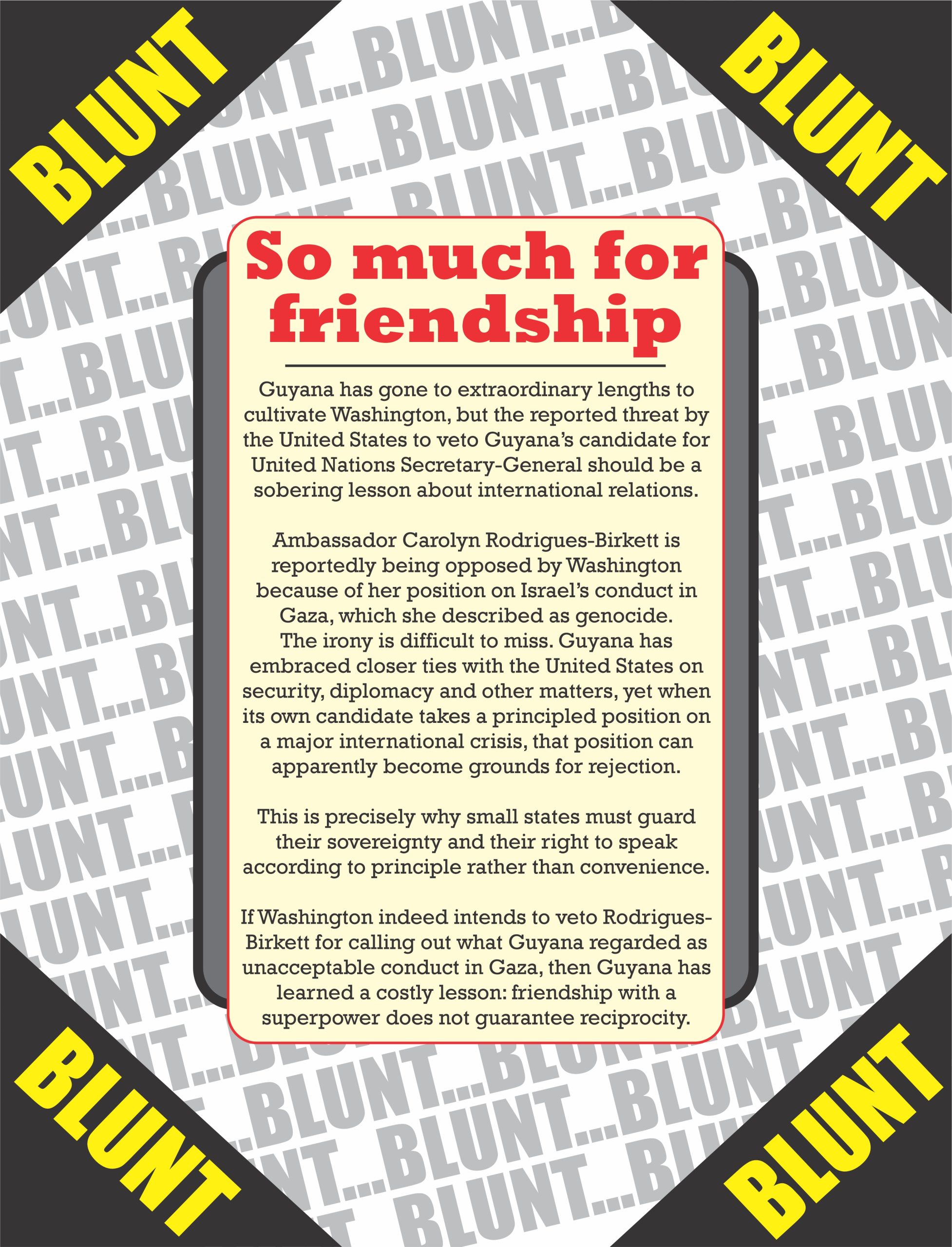
Blunt of the day
Sports

Features/Columnists

Sir. Ronald Sanders

The GHK Lall Column

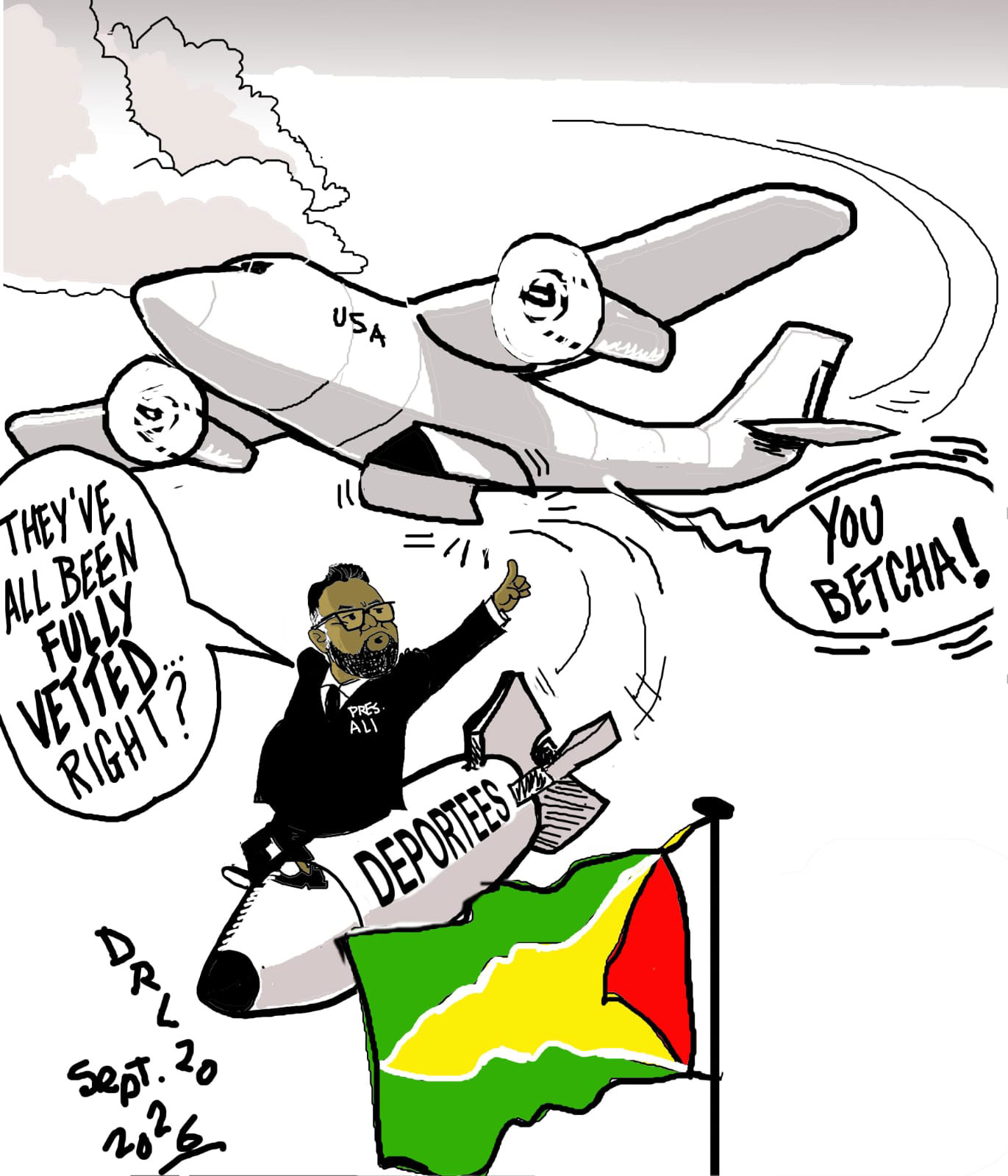
Weekend Cartoon


Very accurate
Forbes Burnham: History Must Be More Than an Indictment
By Rannie Whyte
There is a legitimate case to be made against aspects of Forbes Burnham’s record. There is evidence of electoral manipulation, increasing authoritarianism, excessive concentration of political power, serious economic mistakes and the dangerous blurring of the distinction between party and state.
But acknowledging these facts does not require accepting a version of Guyanese history in which Burnham becomes the principal architect of virtually every political, racial and economic problem that confronted the country.
That is not balanced history. It is history written as an indictment.
The argument that Burnham inherited a multiracial nationalist movement, destroyed it because of personal ambition, deliberately constructed racial politics, wrecked the economy and then used an authoritarian state to maintain himself in power contains elements of historical truth.
Its weakness is what it leaves out, minimizes or interprets differently depending upon which political actor is being judged.
Burnham Did Not Create Guyana’s Racial Problem
Perhaps the most serious distortion is the suggestion that Burnham essentially manufactured Guyana’s racial political divide.
Guyana’s racial difficulties did not begin with Forbes Burnham, nor with Cheddi Jagan.
Their foundations had been laid through centuries of colonial rule: African slavery, Indian indentureship, separate economic and residential patterns, competition for employment, different relationships with the plantation economy and a colonial structure that frequently benefited from divisions among the people it governed.
Burnham and Jagan entered a society in which those tensions already existed.
They initially demonstrated that something better was possible.
The original People’s Progressive Party was a remarkable multiracial nationalist movement. Burnham, Jagan, Janet Jagan, Ashton Chase and others came together around demands for political freedom, working-class advancement and independence.
That coalition eventually fractured.
Burnham certainly bears responsibility for that split. His ambition and leadership rivalry with Jagan cannot simply be dismissed.
But the history is considerably more complicated than the proposition that Burnham became dissatisfied because he could not control the PPP and therefore created an African political party.
The historical record shows a bitter personal and ideological struggle between Jagan and Burnham. Even after the 1955 division, the factions were not completely separated by race: prominent Indo-Guyanese figures supported Burnham while important Afro-Guyanese radicals remained with Jagan. (Country Studies)
That inconvenient fact matters.
It demonstrates that the split cannot simply be reduced to Burnham deciding to mobilize Black Guyanese against Indian Guyanese.
Eventually, however, both major political movements increasingly depended upon ethnic constituencies. Historical studies describe both the PPP and the PNC as making racial appeals as Guyana’s politics became dangerously polarized. (Country Studies)
Burnham must therefore accept responsibility for exploiting racial politics.
But why should Jagan and the PPP be removed from that same historical examination?
There cannot be one standard of political accountability for Burnham and another for everyone else.
Colonialism and Foreign Intervention Cannot Be Treated as Footnotes
Another major prejudice in this interpretation is the tendency to acknowledge colonial and American interference and then treat it almost as background noise.
It was anything but background noise.
In 1953, the British suspended British Guiana’s constitution only months after the PPP had won the country’s first election under universal adult suffrage. British troops were deployed and the elected government was removed.
Whatever criticisms one may have of the PPP government’s policies, this was an extraordinary colonial intervention into the country’s democratic development.
Then came the Cold War.
Today we do not have to speculate about American interference. Declassified United States government documents tell the story.
Official U.S. State Department records acknowledge that approximately US$2.08 million was approved for covert operations in British Guiana and Guyana between 1962 and 1968.
Those same records state that the United States successfully pressed Britain to impose proportional representation, opposed Cheddi Jagan’s return to power and provided money and campaign expertise to Burnham’s PNC and Peter D’Aguiar’s United Force. (Office of the Historian)
That is an astonishing intervention in the democratic development of a small colony approaching independence.
It does not absolve Burnham.
Burnham accepted the political advantage that intervention provided, and history has every right to judge him for it.
But intellectual consistency demands something more.
If powerful foreign governments helped reshape Guyana’s electoral system specifically to remove Jagan and strengthen his opponents, then those governments helped shape the political order that followed.
You cannot place Burnham at the centre of responsibility while placing Britain and the United States somewhere in the footnotes.
The Economic Story Is More Complicated Than “Burnham Destroyed Guyana”
The same selective reasoning appears in discussions of Burnham’s economic policies.
Yes, Guyana suffered terribly during the later Burnham years.
There were shortages, currency problems, declining production, deteriorating infrastructure, mounting debt and massive emigration. State ownership became extraordinarily extensive, and serious mistakes were made in management and economic policy.
The IMF’s historical assessment is particularly critical of the consequences of excessive state control, poor implementation and economic distortions. (IMF)
Those realities should not be hidden.
But neither should the other half of the story.
Burnham did not wake up one morning and arbitrarily decide to nationalize Guyana’s major industries.
He inherited an economy constructed under colonialism in which much of the country’s most valuable productive capacity—particularly bauxite and sugar—was controlled by large foreign interests.
The political question throughout the developing world during that period was straightforward:
How could a country claim political independence while much of its economic wealth remained controlled abroad?
One may criticize Burnham’s answer.
But the question itself was legitimate.
Nationalisation was occurring throughout the developing world as newly independent states attempted to acquire control over their natural resources and economies.
Even more importantly, Guyana’s economic decline cannot be attributed to nationalisation alone.
World Bank historical analysis shows that the economy actually experienced significant real growth during the first half of the 1970s. Conditions subsequently deteriorated as sugar prices fell, international demand for bauxite weakened, borrowing increased and Guyana’s external position deteriorated. (World Bank)
Again, none of this excuses bad economic decisions.
It simply establishes something that should be obvious: economic history has multiple causes.
Burnham’s policies were part of the problem.
They were not the entire problem.
Development Achievements Cannot Simply Be Dismissed
There is another form of selectivity involved in reducing Burnham’s social programmes to ideological window dressing.
Free education from nursery through university was not meaningless.
The expansion of educational opportunities to children from poor and working-class families was not meaningless.
The development of technical education, national institutions, infrastructure, Caribbean integration and Guyana’s strong international identification with African liberation and the anti-apartheid struggle were not meaningless.
One may argue about their effectiveness or sustainability.
But to mention these achievements almost apologetically while describing every failure in great detail produces a predetermined conclusion rather than a balanced assessment.
Burnham was attempting to construct a postcolonial state in circumstances in which political independence had arrived before genuine economic independence.
Some of those efforts succeeded.
Others failed badly.
Both belong in the history.
Burnham’s Authoritarianism Should Not Be Denied
A credible counterargument must also resist the temptation to transform Burnham into a faultless hero.
He was not.
The doctrine of the “paramountcy of the party,” under which the ruling PNC was elevated over institutions of state, represented a dangerous departure from democratic governance. Historical accounts describe the increasing interchangeability of party and state during the 1970s. (Country Studies)
Electoral manipulation was real.
Indeed, declassified American documents that reveal Washington’s assistance to Burnham also record concerns about his willingness to manipulate the electoral machinery. One U.S. record states that Washington learned Burnham intended to use fraudulent absentee ballots in 1968 and advised him against it, although it did not attempt to stop him. (Office of the Historian)
Those facts should be confronted.
A historical defence becomes intellectually dishonest when it denies evidence merely because that evidence is uncomfortable.
But the opposite is equally true.
Burnham’s authoritarianism cannot become a licence to attribute every Guyanese failure before, during and after his rule to Burnham personally.
Walter Rodney Cannot Be Avoided
No serious assessment of the Burnham period can ignore the June 13, 1980 death of Dr. Walter Rodney.
The Walter Rodney Commission of Inquiry made extremely grave findings.
It found that Gregory Smith was responsible for Rodney’s death, that he acted as an agent of the State and that individuals occupying leadership positions in State agencies assisted him.
The Commission ultimately concluded that Prime Minister Burnham knew of the plan and was part of the conspiracy. (National Security Archive)
That finding deserves to be stated clearly.
But historical precision is still required.
The Commission reached its conclusions using the civil standard of a balance of probabilities; it was a Commission of Inquiry, not a criminal trial determining guilt beyond reasonable doubt. The Commission also acknowledged difficulties created by the premature termination of its work, which prevented some persons implicated by evidence from appearing before it to challenge allegations. (Stabroek News)
Saying this does not diminish the seriousness of the Commission’s conclusions.
It simply describes them accurately.
History is best served by precision, not exaggeration—regardless of whose reputation is involved.
The Real Prejudice Is Selective History
This is ultimately where the argument against the original interpretation becomes strongest.
There appears to be a predetermined framework.
When Burnham demonstrates ambition, ambition becomes evidence against him.
When Jagan demonstrates ambition, it is national leadership.
When the PNC appeals to ethnicity, Burnham is weaponising race.
When the PPP increasingly consolidates an Indo-Guyanese electoral base, it becomes merely the consequence of circumstances.
When Burnham embraces nationalisation, the economic consequences belong to Burnham.
When international commodity prices collapse, oil prices rise, foreign exchange disappears and a small vulnerable economy suffers, those factors become secondary.
When Britain suspends an elected government and the United States covertly spends money and manipulates the political environment to prevent Jagan from governing an independent Guyana, colonialism and the Cold War become context rather than active causes.
That asymmetry is the problem.
It produces not history, but prosecution.
Burnham Must Be Judged in Full
Forbes Burnham was neither saint nor monster.
He was one of the most intelligent, ambitious, charismatic and consequential political figures Guyana has produced.
He made decisions that strengthened Guyanese nationalism and others that damaged Guyanese democracy.
He expanded educational opportunity while presiding over increasing political authoritarianism.
He challenged foreign economic domination while creating a state-controlled economic system that eventually became inefficient and unsustainable.
He championed Caribbean integration, African liberation and Third World solidarity while political opponents at home complained of repression and electoral injustice.
Those contradictions are Forbes Burnham.
We should not erase any of them.
Guyana’s tragedy is much bigger than one man.
It includes Burnham.
It includes Jagan.
It includes the PNC and PPP.
It includes British colonialism.
It includes documented American intervention.
It includes the racial insecurities inherited from slavery and indentureship.
It includes political leaders on both sides who discovered that racial loyalty could be converted into electoral power.
And it includes generations of Guyanese who were encouraged to fear that the victory of the other political party represented a threat to their own community.
That history is uncomfortable.
But it belongs to all of us.
We gain nothing by replacing the mythology of Forbes Burnham the heroic nation-builder with an equally simplistic mythology of Forbes Burnham the architect of everything that went wrong.
History demands something better.
Burnham should be held accountable for what Burnham did.
But he should not be made responsible for what colonialism created, what foreign powers manipulated, what his political opponents contributed to, and what forces beyond Guyana’s shores helped to produce.
That is not an attempt to varnish history.
It is an insistence that history be told in full.
By Rannie Whyte