Latest update August 17th, 2026 10:20 AM



Latest News
- Two Australian firms now hold 770 km² gold lands in Guyana
- Mayor demands answers as Linden grid breaks under industrial weight
- Colombian president asks Trump to suspend tariffs to help earthquake recovery
- $6.6B Bath Hospital must deliver more than ‘grand ceremonies’ – Opposition Leader says
- Fast-growing Guyana still depends on private planes for medevac
“One foot in the grave”: The problem of maternal mortality

(A response to the death of Karen Shondell Reid of Sheet Anchor, East Canje, Region Six (East Berbice-Corentyne), and her baby)
DEAR EDITOR,
Many women in Guyana think about pregnancy and childbirth as a blessing and a curse. A common thread in stories of pregnancy and childbirth told by our mothers, grandmothers and siblings, especially from working-class backgrounds, frame the process of bringing children into the world as “having one foot in the grave.”
Their stories illustrate that pregnancy and childbirth are matters of life and death, a risk women (must) take to bring life into the world. This leads me to ask the question: What is the worth of a woman’s life in Guyana? What value do we place on women’s rights and capacities to guide and control their own reproductive lives in this country? Regardless of location of residence, class, race or religion, women should not have to envision pregnancy as a risk to their lives, and Guyanese should not accept Guyana’s high maternal mortality rate as a reality or unsolvable problem.
Maternal mortality is defined by the World Health Organization (WHO) and the Ministry of Public Health (MoPH) as death during pregnancy or within 42 days following birth due to causes directly or indirectly associated with pregnancy or at the termination of pregnancy.
While maternal mortality ratios are decreasing worldwide, Guyana continues to experience the highest maternal mortality ratio (MMR) in the Latin American and Caribbean region. The MMR measures the number of maternal deaths per 100,000 live births, and the risk of death once a woman has become pregnant.
In the case of Guyana, the country’s MMR has been fluctuating upwards from an average of 171 deaths per 100,000 live births each year in the early 1990s to 229 in 2015 and which remains constant in 2019.
Reports from the MoPH state that both healthcare providers and women are to blame for occurrences of maternal deaths, and result from malpractice, malfunction and/or refusal to take necessary precautions. To address the issue of women dying during their pregnancy or childbirth, the current government has launched a Maternal Mortality Review committee in an effort to investigate deaths and injuries related to pregnancies so as to take proactive steps to prevent maternal deaths in the country.
The review committee thus far has claimed that maternal deaths are linked to three problems: performance of medical personnel; system failure of medical institutions, and non-compliance of patients. While medical technologies in obstetrics care do contribute to the problem, this is a myopic description of the influencing factors.
The fact is that the pattern of maternal deaths and injuries in this country is a result of unaddressed issues of gender-inequality and the poverty of women. What we are witnessing with maternal deaths and injuries is a manifestation of the gendered violence women experience.
The statistics on maternal mortality are a grave reminder of the systemic nature of this issue, and the continued disregard of the injustice that women, pregnant individuals, families and communities experience. Let us not forget that each number within the statistic represents a person with their own dreams and desires that will never be realized, who come from families and communities irrevocably affected.
The approach of the MoPH and the government casts blame on individuals, whether doctor or patient. This individual-blame approach has been embedded in the health sector for over 25 years, and therefore the sector has not been able to provide sustainable remedies for the problem of maternal mortality.
Further, there is little research that provides a comprehensive description or explanation of why women are still losing their lives every year from preventable causes related to pregnancy and childbirth. The MoPH and the government’s response to maternal deaths does not give adequate attention to the many economic, social, cultural and political environmental factors that influence the level and kind of risks associated with pregnancy and childbirth for a woman in Guyana, and the harmful gender biases that are ignored or go unchecked in policy planning by policymakers and public health practitioners.
Like the families of women who have died from pregnancy related-causes, I call for justice that includes a review of the institutionalized sexism that frames maternal deaths as an individual, unfortunate occurrence, and subordinates the interests and lives of women.
There is need for a gender analysis of healthcare policies and programs, and an analysis on how economic, political and social environments in Guyana affect women’s reproductive health and rights. I recommend that the government be prepared to implement more aggressive gender planning into public health policies and programs. Finally, I recommend comprehensive research to be conducted that aims to describe how the experiences and needs of women are positioned and valued in maternal healthcare planning in Guyana. Such research can contribute to bottom-up strategies articulated to reduce and prevent maternal mortality.
Additionally, such research can contribute to dialogues on the status of women where inequalities stemming from gender norms are addressed in relation to reproductive health, rights, and justice for different groups of women.
There needs to be an approach to health planning for families, and most importantly women whose desires are to have child/children that takes into consideration the existing challenges women experience on a daily basis.
Pere DeRoy, Guyanese
PhD Student, Women, Gender and Sexuality Studies, & Public Policy & Administration
The University of Kansas (KU)
Share this:

Discover more from Kaieteur News
Subscribe to get the latest posts sent to your email.
Similar Articles

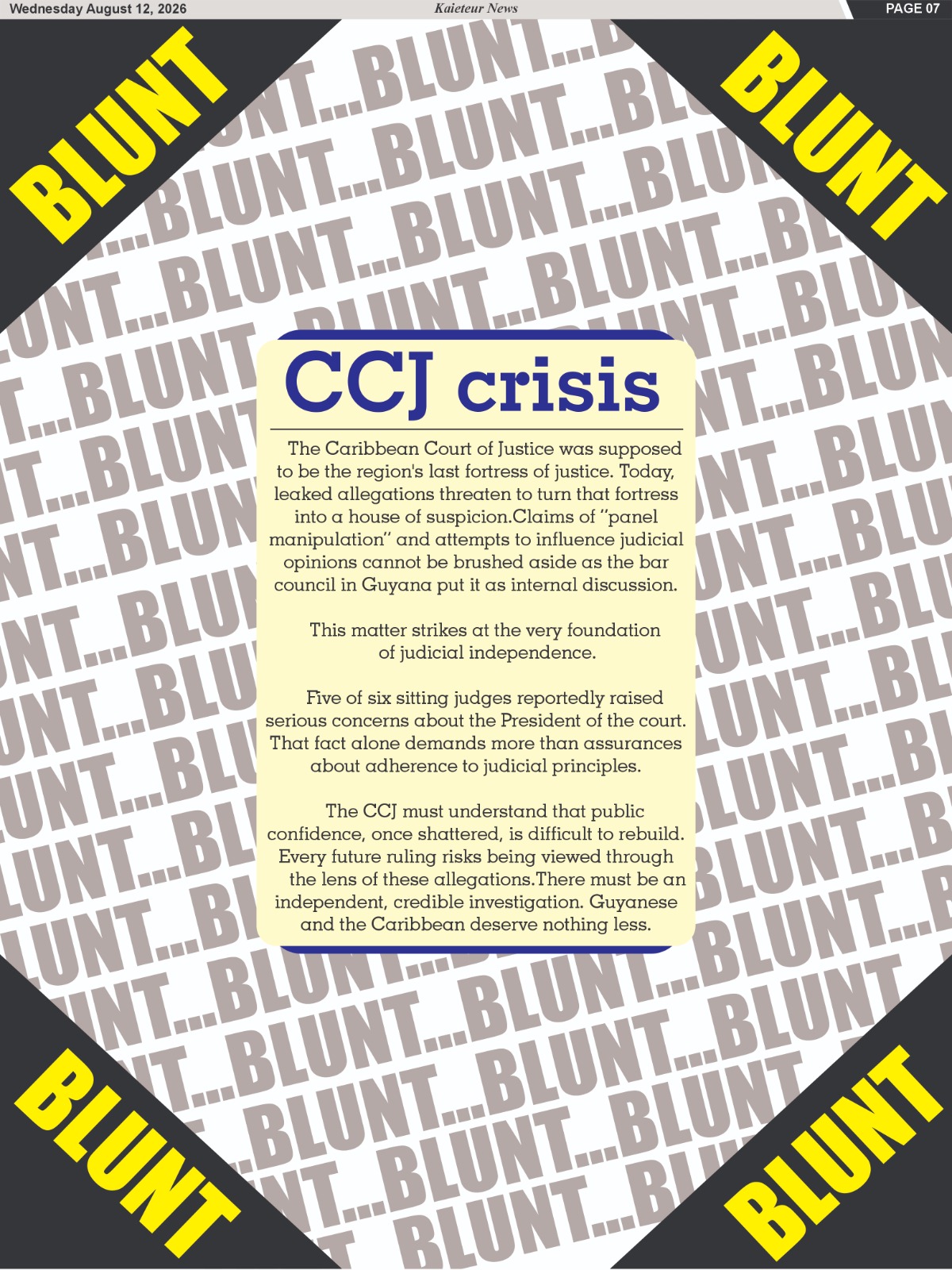
Blunt of the day
Sports

Features/Columnists

Sir. Ronald Sanders

The GHK Lall Column

Weekend Cartoon