Latest update August 17th, 2026 10:20 AM



Latest News
- Two Australian firms now hold 770 km² gold lands in Guyana
- Mayor demands answers as Linden grid breaks under industrial weight
- Colombian president asks Trump to suspend tariffs to help earthquake recovery
- $6.6B Bath Hospital must deliver more than ‘grand ceremonies’ – Opposition Leader says
- Fast-growing Guyana still depends on private planes for medevac
Mohamed, the U.S. and PPP: Who holds the cards now?
Dear Editor,
I have written previous letters on the Mohameds/US/PPP controversy regarding the U.S. request for the extradition of Azruddin and his father, Nazar Mohamed, to the USA to face an 11-count indictment related to gold trading and financial crimes. Now that Azruddin Mohamed is the leader of the opposition and his WIN party is the major opposition party in parliament, there is no denying that his extradition has become a political matter for Guyana and the U.S. governments. In my previous assessment of this matter, I contend, and continue to do so, that the Mohameds/PPP conflict is a consequence of U.S. foreign policy and its desire to reconfigure the political architecture in Guyana going forward in the context of oil and the inevitable rise of younger-generation politicians.
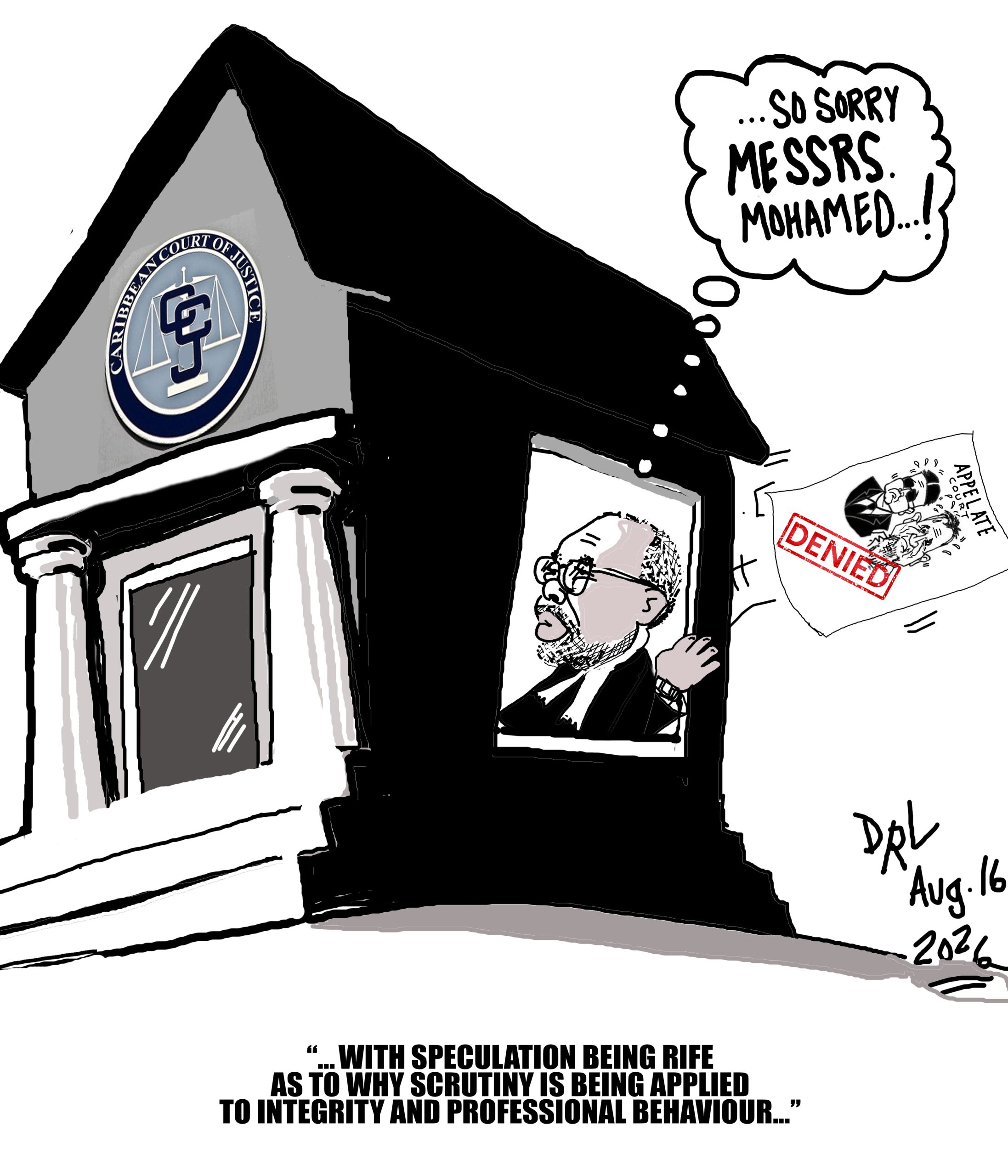
Now that the Caribbean Court of Justice (CCJ) has ruled against the Mohameds and the extradition case is back in the local courts, it is necessary to revisit this matter with an objective political lens.
The faith of the Mohameds from the start rested in the hands of the Americans, and that will determine whether they would be extradited. If they are, their chances in the U.S. court will largely depend on what importance the U.S. administration is putting on a conviction. The last utterances of the U.S. Ambassador on the matter a few months ago left the country with the impression that the U.S. views the charges against the Mohameds as serious and have spent U.S. taxpayers’ dollars on the matter. While the Ambassador’s statements at the time reflected the Trump administration’s position, one is not sure if there has been a rethinking in Washington on this issue. I have taken the position that Mohamed’s meeting with the Americans before he decided to enter the 2025 elections was the green light for him to do so. I had contended that the Americans were faced with a dilemma as they attempted to reconfigure Guyana’s political reality. Mohamed became a useful tool after they failed to get Indian defectors from the PPP to do what the African defectors did to the APNU and, by extension, the African community.
The goal of the Americans was the rise of a third force led by younger generation politicians and a hung parliament after the elections, furthering the U.S./ Western push to reconfigure the politics in the country. My take is that the U.S. wanted to deny both the APNU and the PPP/C from controlling both the presidency and the parliament. From an American point of view, Azruddin was allowed to enter the election as a last-ditch attempt by the U.S. to pull away Indian votes from the PPP to achieve its plan to reconfigure Guyana politics. If my analysis is correct, objectively Mohamed and WIN were extensions of U.S. policy in Guyana. As things stand, Mohamed has kept his side of the bargain by entering into the elections. The question is whether the U.S. is satisfied and will keep its end of the agreement now that Mohamed has emerged as a beneficiary of his election sojourn and has failed to attract Indian votes away from the PPP, causing the U.S. “Grand” plan to fall on its face. The much-desired hung parliament did not materialise. Instead, the result was an entrenched PPP/C with three additional seats, serious damage to the APNU, and a divided and weakened opposition, with Mohamed emerging as opposition leader. These were among the unintended consequences of the U.S. policy.
They succeeded in breaking the back of the APNU and, by extension, seriously weakening the political position of the African community, while strengthening the PPP/C and, by extension, the political position of the Indian community. The rise of Mohamed as opposition leader objectively adds another dimension to the already significant concentration of economic and political power within the Indian community. I don’t think this was the intended goal of U.S. policy. Nevertheless, both the United States and those African collaborators bear a moral and political responsibility to confront and help correct this dangerous racial and political imbalance in the country.
The above view in no way premised on the idea that the Trump administration wanted to remove the PPP from office but instead wanted to weaken the PPP/C. A hung parliament would mean that the U.S. and its Western allies would have more control of both the old and new forces in the parliament and, in that environment, tighten their control over the politics in the country – in the context that none of those forces are anti-U.S. or possess any ideological threat to U.S. interests. While the Americans were satisfied and supportive of the PPP/C in government, I judge that they would have preferred to be dealing with a weakened PPP/C, which would allow it to exert more leverage going forward. It should be obvious to both PPP/C and WIN that now that the U.S. is in control of Venezuelan oil, Guyana’s importance in the U.S. plans in that country has ceased to be important. The logic that caused the U.S. to oust the Granger ( APNU+AFC) administration is no longer an important issue for the Americans. They solved their problem without the use of Guyanese territory. In relation to Guyana, the U.S. has all the cards in its hands. This must be troubling to both the PPP/C and WIN leadership. In their quiet moments, they must be asking whether the Americans are playing both parties. The PPP/C in government is in a stronger position in this equation relative to WIN as the major opposition. There is talk in political circles that the U.S. has decided to allow the fate of Mohamed to be resolved at the domestic level, and the bargaining between the Mohameds and the PPP/C has begun in earnest. This is a plausible proposition.
From a geopolitical and regional perspective, the way that the Mohameds’ extradition matter unfolds has potentially significant implications. The U.S. Ambassador’s statements expressing the seriousness with which the U.S. administration views the matter, combined with the Mohameds apparent defiance, have placed the U.S. in a difficult position. Having expended considerable political and diplomatic capital, Washington risks appearing powerless if the matter ends without a meaningful resolution. Such an outcome would also set an uncomfortable precedent for U.S. hegemony and credibility in the region. Having engaged the issue so forcefully and publicly, The U.S. can’t easily walk away from the present engagement empty-handed.
I will conclude by saying that going forward there is likely to be a deal on the matter between the three parties (the Mohameds, the U.S. and the PPP/C) with each saving some face. If this happens, the obvious question is whether the Mohameds and the PPP/C can be reconciled and what will be the future of WIN. Can the PPP/C and WIN coexist?
Yours sincerely,
Tacuma Ogunseye
Share this:

Discover more from Kaieteur News
Subscribe to get the latest posts sent to your email.
Similar Articles

Blunt of the day
Sports
Features/Columnists

Sir. Ronald Sanders

The GHK Lall Column

Weekend Cartoon