Latest update September 21st, 2026 2:51 PM


Latest News
- Three killed in Baramita clash
- Defense accuses Police of misrepresenting court testimony, Magistrate says court unfazed by media
- Mohamed alleges political hand behind review of Justice Persaud’s U.S. visa
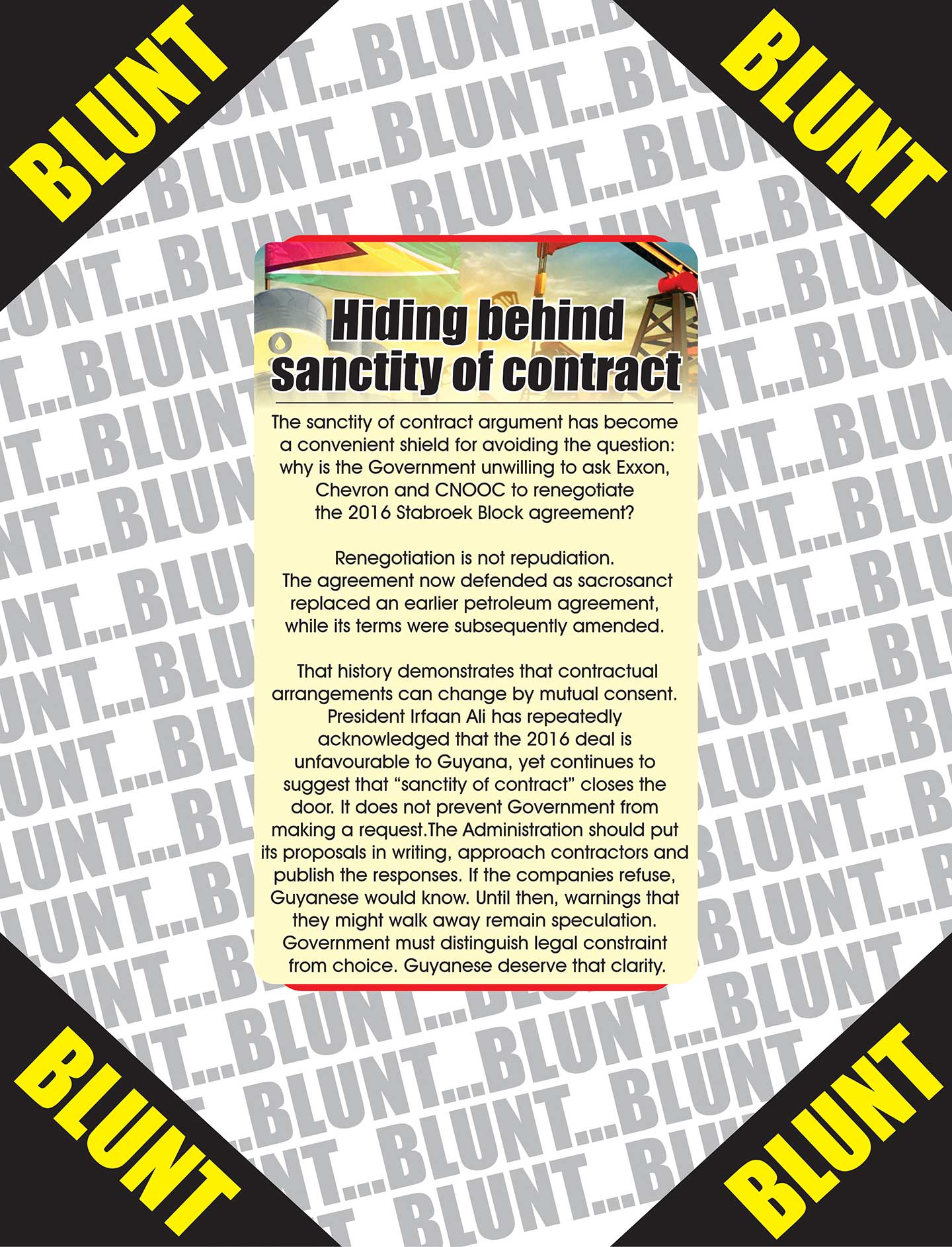
- ‘Stop blaming ‘sanctity of contract’ for keeping 2016 oil deal – Chris Ram tells Pres. Ali
- Iran and U.S. trade threats after Houthi attacks escalate regional conflict
Same plantation, new overseers
(Kaieteur News) – There was a time when Guyana was spoken of, not entirely jokingly, as Bookers Guyana. Bookers was not a man. It was the giant foreign-owned sugar concern whose influence stretched so wide that if you sneezed in Georgetown, someone in a London boardroom probably approved the tissue. Sugar estates, shipping, commerce, employment, social life—Bookers seemed to own everything except your grandmother’s pepperpot recipe, and even that may have been under review.
Then along came Forbes Burnham. He looked at this arrangement and understandably decided that an independent nation should not function like an annex of a foreign corporation. He wanted to end external domination. He wanted to build a proud, state-led economy. The commanding heights would be commanded by us… or rather by him. We would own the sugar, own the bauxite, own the future. It was a thrilling vision. Also, like many thrilling visions, it came with a practical difficulty: reality.
Nationalisation sounded simple—take over the machinery and continue operating it. But running a modern economy is not the same as inheriting the keys to the building. Guyana did not then possess unlimited reserves of managerial depth, technical expertise, marketing networks, or that rarest of resources: competent people.
So, the State acquired assets but also inherited headaches, payrolls, rusting equipment, and invoices that reproduced at night.
Worse still, Burnham changed ownership, but not necessarily control. Sugar and bauxite had to be sold on the world market, where prices were set not in Linden or Enmore but by global forces that regarded Guyana as technically present but not decisive. The multinational trading houses, refiners, shippers and financiers still dominated supply chains. We owned the cow, but someone else owned the pasture, the milk truck, the supermarket and the customer.
The result was that Guyana replaced one dependency with another. Only now we were also responsible for maintenance, managing the industry, supplying the markets on demand. Everything else except setting the price. And on top of that Burnham spoke of nationalisation but effectively paid for the nationalised industries, thereby plunging the country into debt.
Fast forward to today, and Guyana under the PPPC has enthusiastically joined the global neoliberal order. This meant privatisation, opening the economy to foreign capital, trade liberalisation and giving incentives to businesses.
Some commentators speak dramatically of an ethnic oligarchic class seizing the State, as if oligarchy only arrived recently carrying luggage. But the State in Guyana has long been entangled with elite interests—during PNC years, PPP/C years, during APNU+AFC years, during whichever acronym was fashionable at the time. Power here has always had friends, cousins, contractors, and suspiciously lucky associates.
And today, the commanding heights are once again rather crowded with foreign interests.
At the summit of our economy sits ExxonMobil, whose offshore production now dominates the country’s exports. Oil accounts for the overwhelming majority of Guyana’s export value, with Reuters reporting crude exports as the principal engine of growth. It is believed that oil is now close to 90% of the value of total exports. Government withdrawals from oil revenues are also deeply embedded in public spending; for 2026, oil funds were projected to finance about 32% of the national budget.
Then come the quieter empires. Notwithstanding GUYOIL, foreign interests hold major positions in fuel imports. Brazilian, Canadian, Chinese and Australian players are deeply involved in gold and other mining. Chinese firms have become increasingly visible in commerce and construction. Trinidadian businesses entered early and secured a substantial footprint in services for oil and gas. Large American and international contractors captured many of the prime upstream and support contracts before local content became fashionable.
Locals, meanwhile, are invited to participate in the economy the way peasants were once invited to a royal banquet: by inhaling the aroma from outside.
To be fair, there are roads, hotels, hospitals, warehouses and other opportunities. Some Guyanese businesses have grown impressively. But too often the broad structure remains familiar: foreign capital takes the lion’s share, a connected local class gathers what falls from the table, and ordinary citizens are told to be patient because prosperity is “trickling down”.
So, we have traveled full circle. From Bookers Guyana to Burnham’s Guyana to Exxon’s Guyana. Different flags, different speeches, different letterheads—but the old question remains unchanged: who truly controls the economy, and who merely poses for photographs beside it?
We once had a sugar plantation economy run from abroad. We then had a state plantation economy run locally but constrained globally. Now we have a petroleum plantation economy administered from Texas.
The names change. The dependency remains.
(The views expressed in this article are those of the author and do not necessarily reflect the opinions of this newspaper.)
Share this:

Discover more from Kaieteur News
Subscribe to get the latest posts sent to your email.
Similar Articles
Website Hits

Blunt of the day
Sports
Features/Columnists

Sir. Ronald Sanders

The GHK Lall Column
Weekend Cartoon