Latest update August 17th, 2026 10:20 AM



Latest News
- Two Australian firms now hold 770 km² gold lands in Guyana
- Mayor demands answers as Linden grid breaks under industrial weight
- Colombian president asks Trump to suspend tariffs to help earthquake recovery
- $6.6B Bath Hospital must deliver more than ‘grand ceremonies’ – Opposition Leader says
- Fast-growing Guyana still depends on private planes for medevac
Catfish ban to US a ‘big blow’ to trade Changes to Fisheries Act will help Guyana comply with export requirements – Ministry

Dr. Ozaye Dodson, Veterinary Public Health Director
“A big blow” is how Veterinary Public Health Director within the Ministry of Public Health, Dr. Ozaye Dodson, has described a ban on various catfish species to the United States [US].
He noted that while the banning of Guyana’s catfish species from the US export market is just a temporary technical barrier to trade it is very impactful.
Dr. Dodson said the move by the US Department of Agriculture [USDA] is a “protectionist measure” by that country’s public health system and the catfish farmers who have invested heavily to develop the industry there.
Guyana’s Veterinary Public Health Department has been mandated, under the 2002 Fisheries Act and the Fish and Fishery Product Regulations of 2003 with guidance of the inspections manual, to monitor, inspect and certify vessels, landing sites, fish processing establishments and fishery products for the local and export markets.
According to Dr. Dodson, there are daily inspections and certification of the catfish products to guarantee their “wholesomeness for human consumption.”
For this purpose, the US Food Safety Inspection Services [FSIS] has requested of Guyana to provide relevant documentation to verify its inspection system is equivalent to the US standards or that its public health system is an equivalent degree to that of the US.
Guyana, Dr. Dodson said, complied with this request. However, the country fell short of the US standards in three areas.
Firstly, there was the short fall on the issue of the presence of inspectors; secondly, there was insufficient documentation detailing verification of each step in the sanitation and Hazard Analysis Critical Control Point [HACCP] process, and thirdly, there was insufficient documentation specifying how the industry manages adulterated catfish products.
Moreover, new US standards for import of catfish species demands the presence of inspectors on plants for one-hour during an eight-hour shift, Dr. Dodson explained, even as he revealed that Guyana inspection pursues a “risk-based approach” which is in fact a European Union [EU] standard.
But the Veterinary Public Health official disclosed that Guyana’s HACCP and documentation of its inspection frequency will be upgraded to satisfy the new US standards.
“Our [Fisheries] Act is broad covering all species of fish. The US has specific regulations for the catfish species [and] there have been no changes to the local Act since 2003. There will have to be some adjustments to the Fisheries Act Inspection Manual and Regulations to bridge the gaps,” Dr. Dodson said.
He said changes to the country’s Fisheries Act and Regulations will be taken shortly to the Attorney’s General [AG] Chambers and published in the official Gazette.
When this is accomplished, US officials will conduct an audit of the local fisheries department and other relevant agencies “to pave the way for the country’s likely re-entry into the American catfish export market,” Dr. Dodson said.
Guyana was among several countries which were banned recently from the US catfish export. Others were Bangladesh, Canada, Dominican Republic, El Salvador, Mexico, Myanmar, Nigeria and Pakistan.
Only China, Thailand and Vietnam met the new requirements demanded under the new standards outlined for the export of Catfish, Cuirass, Gilbacker and Hassar, Dr. Dodson revealed.
He said the Public Health Ministry’s, Veterinary Public Health Department is working assiduously with the Fisheries unit of the Agriculture Ministry to realign Guyana’s legal framework with new US fishery export demands. As such, he urged, “Let us not panic because of the new changes [by the USFDA] it is just a temporary technical barrier to trade.”
Guyana was notified in November 2015 of the new requirements regulating the export of all Siluriformes fish and fish products [catfish species], according to a US Embassy spokesperson based in Georgetown.
The USDA has instituted a ban on catfish species from Guyana, inclusive of hassar, cuirass and gilbacker that took effect on March 1 after Guyana failed to comply with the new requirements.
Amanda Cauldwell, Public Affairs Officer at the U.S. Embassy in Georgetown told Kaieteur News that the U.S. notified the Government of Guyana of the pending changes in November of 2015, more than 18 months before they were to go into effect.
“We even gave Guyana an extension until February 3, 2018 to comply with the new regulations,” Cauldwell explained.
According to the embassy official, the U.S. offered technical assistance to the Government of Guyana to help fishermen and women to comply. “Our offer still stands, but it cannot be accomplished overnight,” Cauldwell stated.
She pointed out that the U.S. Government takes very seriously the protection of the world’s waterways and marine life and is constantly updating regulations and processes to ensure that waterways and marine life are protected. According to Cauldwell, most countries in the hemisphere have now complied with the regulations. She believes that Guyana eventually can and will comply as well.
Share this:

Discover more from Kaieteur News
Subscribe to get the latest posts sent to your email.
Similar Articles

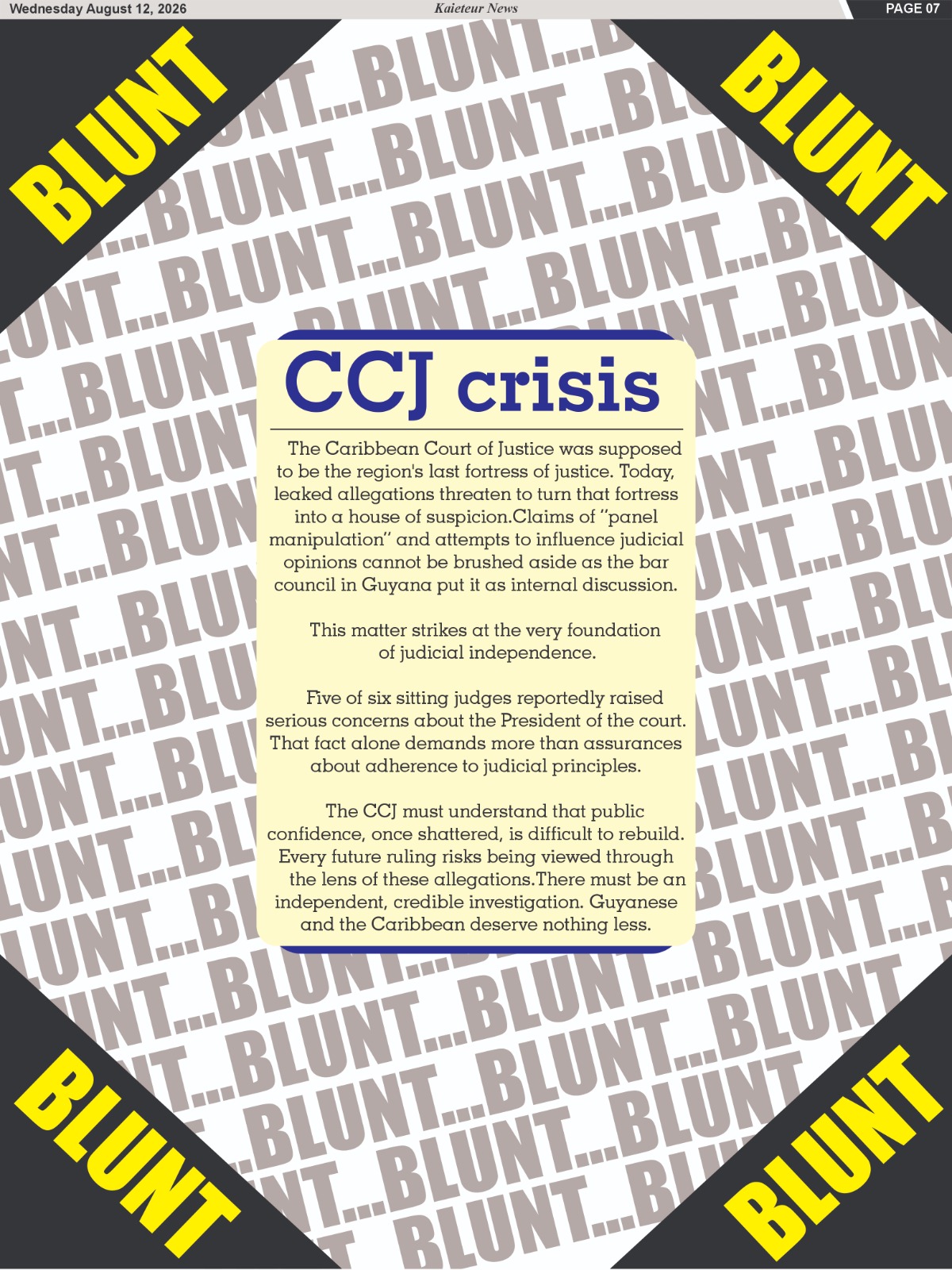
Blunt of the day
Sports

Features/Columnists

Sir. Ronald Sanders

The GHK Lall Column

Weekend Cartoon