Latest update August 15th, 2026 10:49 AM



Latest News
- Wales project to startup by year end but no 50% promised reduction in light bills until plant reaches full capacity – PM
- Blackouts will continue until all power lines, substations fixed – Indar
- Two slicks appear in Gulf as huge oil spill off Oman threatens disaster
- Newly built $208M school to get another $384M to build dorms
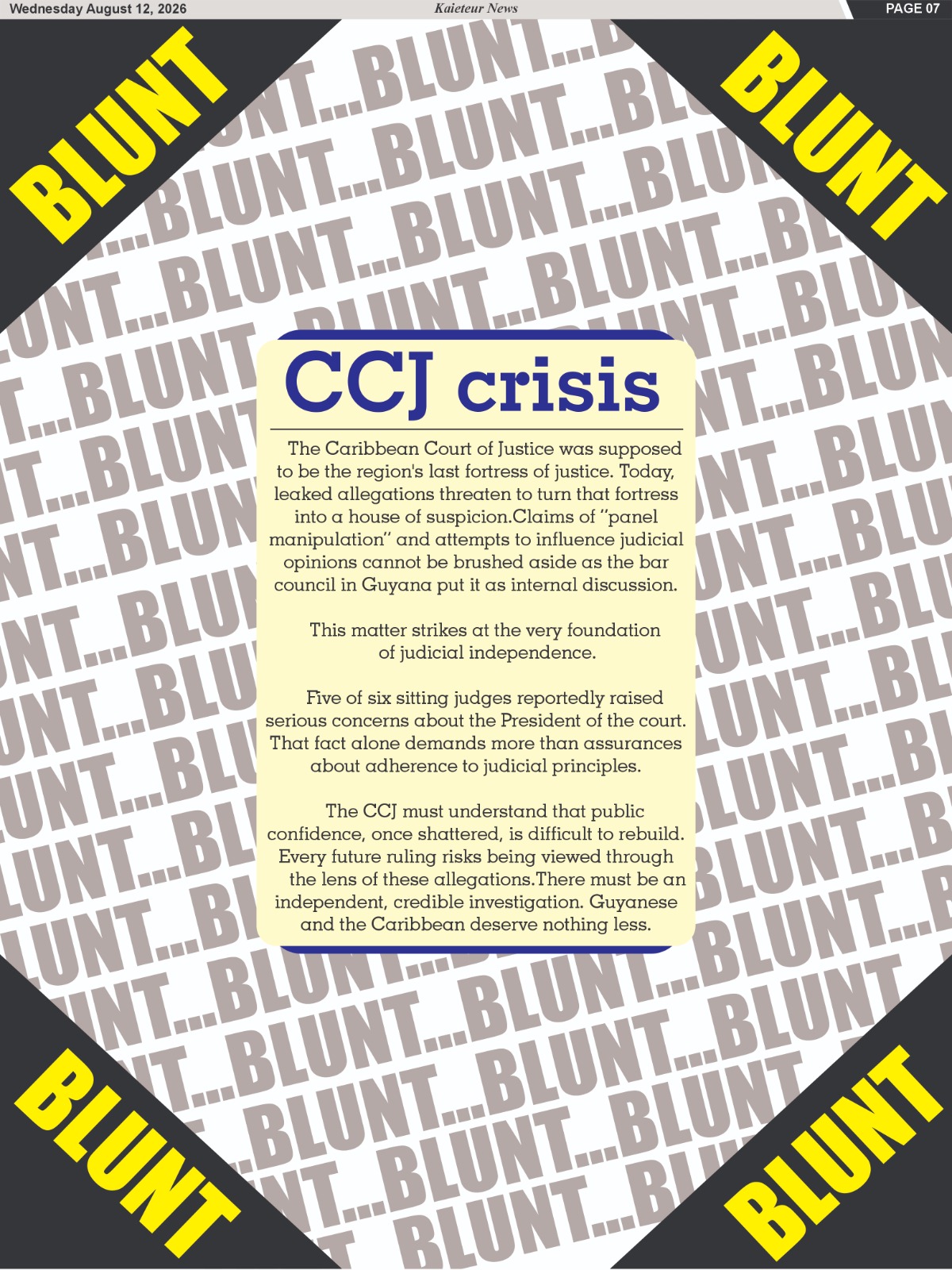
- CCJ President Anderson breaks silence on misconduct allegations
Lopsided Exxon deal underscores need for all PSAs to go through Parliament – Ram

WPA Executive Member, Dr. David Hinds
Given the damning flaws contained in the oil deal Guyana signed with ExxonMobil, local commentators believe that Parliament needs to have increased oversight of the oil and gas sector and related contracts.
Specifically making this comment recently was Chartered Accountant, Chris Ram.
During an interview with this newspaper, Ram noted that the ExxonMobil agreement should have been tabled and approved in the National Assembly. The anticorruption advocate said that this should have been the way forward for all Production Sharing Agreements (PSAs).
Ram said, “These contracts have long term effects. So what you have is a Minister binding a Parliament or a country for decades. The practice of having Production Sharing Agreements go through the Parliamentary process can be seen in places like Tanzania, Ghana and Nigeria. That is how it should be done, because there are long term effects with these contracts…”
The Chartered Accountant said, “What we have before us is proof that this is what should be done. But in addition, I think even the scheme in which the Executive negotiates should be revised…”
Also in agreement with the need for the role of Parliament to increase in the oil sector is Executive Member of the Working People’s Alliance (WPA), Dr. David Hinds.
The political commentator said that the Parliament should always have an important role in these matters—it is the only elected branch of government. Dr. Hinds noted that the oil and gas sector is a defining one and as such, he would recommend that Parliament set up a standing committee on energy.
He said that such oversight is necessary, given how much is at stake. Perhaps as a start, the University Professor said, there should be a select committee to look at what has transpired thus far in relation to the contract and other related issues. He emphasized that such a committee should hold hearings, so that it gets to hear from government operatives and other expert witnesses.
UNFAIR DEAL

Chartered Accountant, Chris Ram
Local commentators have also expressed concern over the lopsided deal Guyana signed with ExxonMobil, especially when it is compared with the agreement Exxon Mobil signed onto with the African country, Ghana. The glaring disparities between the two contracts also underscores the need for the Guyana-ExxonMobil contract to be scrutinized by Parliament, critics say.
According to Ghana’s oil agreement, ExxonMobil is not allowed to recover pre-contract costs. Yet, the oil company managed to entrap Guyana with a US$460M bill which dates back to 1999.
In Ghana, ExxonMobil agreed that there would be no limit to the audit to be conducted by the Government and its authorities. But in Guyana’s oil contract, the APNU+AFC Administration is limited to conducting one audit per calendar year.
Additionally, the African country made it very clear that all records in relation to the oil operations there must be kept at a specific location in the country. The Government of Ghana said that this sort of arrangement was necessary to ensure that there is a smooth flow of the audit process which can be initiated at any time.
Guyana, on the other hand, opted to give up its right to access ExxonMobil’s records in relation to operations here, when such records are held in nations with nondisclosure laws.
The Ghana oil deal also features a 10 percent royalty, while ensuring that ExxonMobil would be subject to paying all taxes, duties, fees, and other imposts that shall be imposed by the State or any entity or any political subdivision of the State in respect of any of its operations.
In the case of Guyana, ExxonMobil gets off with paying a mere two percent royalty while enjoying tax exemptions galore.
ExxonMobil has also agreed to give Ghana quarterly and annual financial statements and summaries of petroleum costs incurred under that agreement.
In the Guyana contract, ExxonMobil is not obligated to do this.
The Ghanaian contract has an entire section dedicated to procurement laws which ExxonMobil must follow at all times. Those provisions are in place to ensure that a significant number of the local companies are able to benefit from the nation’s oil sector.
On the other hand, Guyana’s contract mentions nothing about procurement laws.
Share this:

Discover more from Kaieteur News
Subscribe to get the latest posts sent to your email.
Similar Articles

Blunt of the day
Sports

Features/Columnists

Sir. Ronald Sanders

The GHK Lall Column

Weekend Cartoon