Latest update October 18th, 2026 10:40 AM



WIN cannot break the PPP/C’s political stranglehold unless it first weakens the PNCR
(Kaieteur News) – The results of the 2025 general and regional elections were a shocker. And anyone who now claims that they predicted the performance of We Invest in Nationhood (WIN) coming should seriously consider going into the fortune-telling business.
WIN did not merely emerge from the election with a good showing. It emerged as a formidable electoral force, securing a level of support that few serious observers would have predicted before the ballots were counted. That is precisely why WIN should be celebrating its achievement while simultaneously studying it with a cold and unsentimental eye. The danger for a new political movement is that an extraordinary first performance can easily be mistaken for the beginning of an unstoppable march to power when it may instead prove to be a political high-water mark.
There is a cautionary tale sitting right in front of WIN, and its name is the Alliance for Change (AFC). The AFC once appeared to have broken the traditional political mould, attracting support from across ethnic and partisan lines. It established itself as a permanent third force. But after entering into political partnership with the APNU its fortunes steadily declined until, in the 2025 elections, it was effectively wiped off the electoral map.
That history should be studied very carefully in the present circumstances, particularly as talks have commenced between WIN and the APNU. History demonstrates that a smaller party can sometimes lose its identity, momentum and independent appeal by joining forces with a larger political formation..
There is another uncomfortable question that WIN must confront: was 2025 the beginning of a political realignment, or was it a one-hit wonder? The answer will not be known until 2030, and there is even the possibility that WIN’s present leader may not be available to contest that election.
WIN certainly made inroads into the PPP/C’s support base in 2025, but those incursions were not of such magnitude as to hobble the governing party. Its more consequential achievement was the damage it inflicted on the APNU’s traditional base, particularly the constituency around the PNCR, which remains the principal political force within the APNU. And there lies the strategic lesson that WIN ought to understand. If its ambition is eventually to take political power, however remote that prospect may presently appear, its immediate objective should not be to strengthen the APNU but to weaken it.
That may sound paradoxical, but elections are contests for votes, and WIN’s most accessible reservoir of additional votes may be the electorate that once supported the PNCR. If, over the next four years, WIN succeeds in taking a substantial portion of the PNCR’s support and converting those voters into permanent WIN supporters, it would be in a far stronger position to make a serious assault on the PPP/C’s electoral base in 2030.
The arithmetic is therefore fairly simple: WIN cannot defeat the PPP/C merely by nibbling at its margins. It must first establish itself as the principal alternative political home for voters who presently look to the PNCR and APNU, because only then will it possess the numerical strength necessary to challenge the governing party.
This is why an agreement between WIN and APNU is self-defeating for WIN. Every concession WIN makes to the APNU potentially preserves the very political structure whose support it needs to capture, while every arrangement that strengthens the APNU could ultimately strengthen the PNCR at WIN’s expense. The PPP/C understands this dynamic better than anyone. The governing party has reason to fear WIN precisely because WIN represents something different from the traditional opposition. A strong PNCR has historically been useful to the PPP/C because it helps galvanise and consolidate the governing party’s own support.
That does not mean the PPP/C wants the PNCR to remain dominant forever. On the contrary, it may welcome the weakening of the PNCR when that weakening allows it to recruit supporters and strengthen its own coalition, particularly among voters who traditionally identify with the PNCR’s ethnic and political base. But there is a crucial distinction between a weakened PNCR whose supporters migrate to the PPP/C and a weakened PNCR whose supporters migrate to WIN. The former strengthens the government; the latter creates a potentially dangerous new challenger, which explains why the PPP/C is likely to view the rise of WIN with considerably more concern.
WIN therefore needs to resist the temptation of short-term political accommodation with APNU. The strategic question is whether such cooperation advances WIN’s long-term objective of becoming the principal alternative to the PPP/C. WIN’s task over the next four years should consequently be about persuading PNCR voters that their political future lies with WIN rather than with a party whose electoral influence has been steadily diminished. Only then will it be able to convince the PPP/C support base to give it a chance at ruling.
If WIN wants to turn the shock of 2025 into a durable political movement, it should remember that its greatest opportunity may lie not in joining the old opposition but in replacing it. Once it takes the PNCR out of the political arithmetic, it will see a lear pathway to overcoming the PPP/C. WIN must rely on strategy, and the strategy staring it in the face is clear: weaken the PNCR, capture its political space and then take the fight to the PPP/C.
(The views expressed in this article are those of the author and do not necessarily reflect the opinions of this newspaper)
Share this:

Discover more from Kaieteur News
Subscribe to get the latest posts sent to your email.
Similar Articles
Website Hits

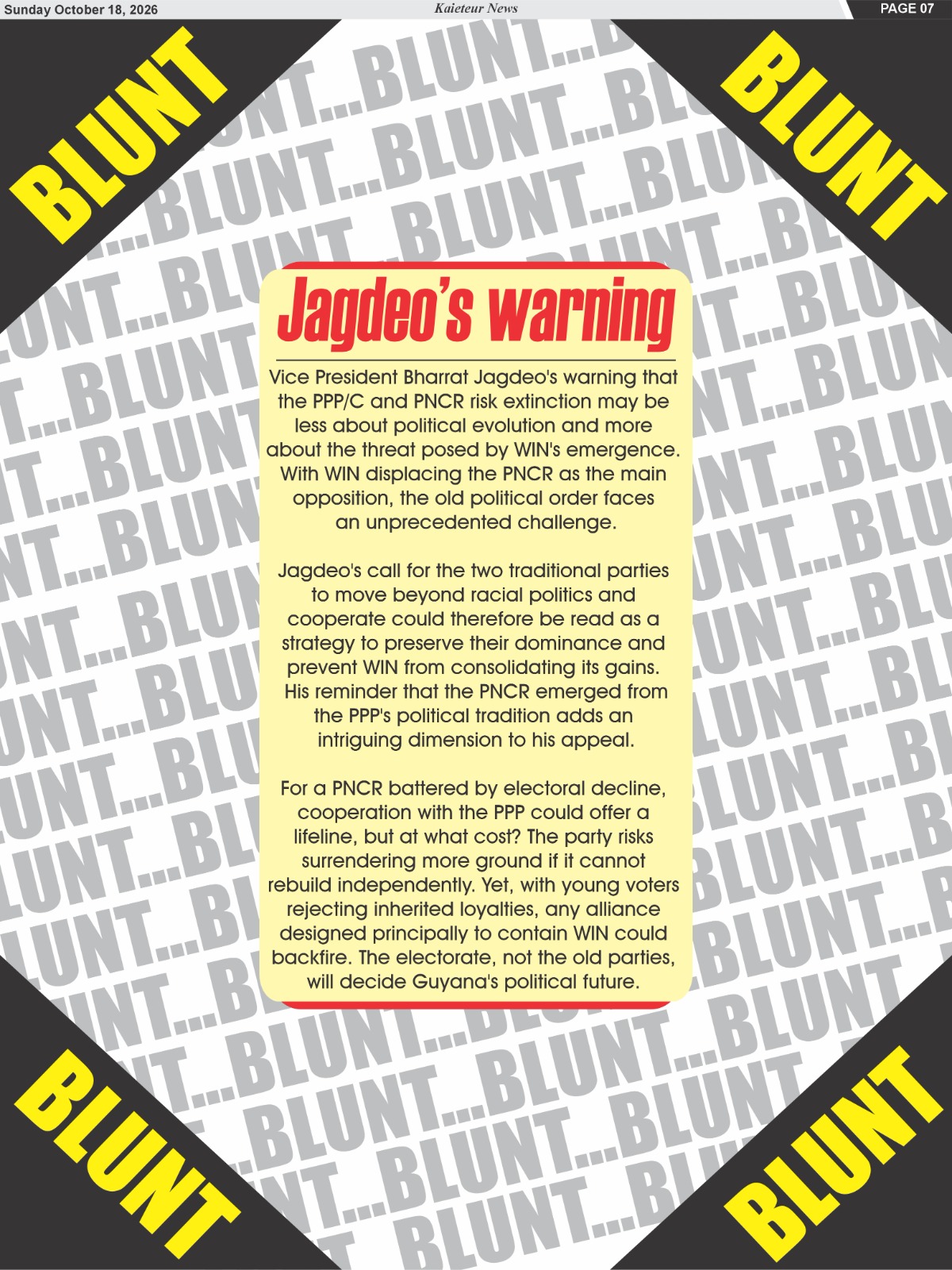
Blunt of the day
Sports

Features/Columnists

Sir. Ronald Sanders

The GHK Lall Column

Weekend Cartoon


