Latest update August 19th, 2026 10:39 AM



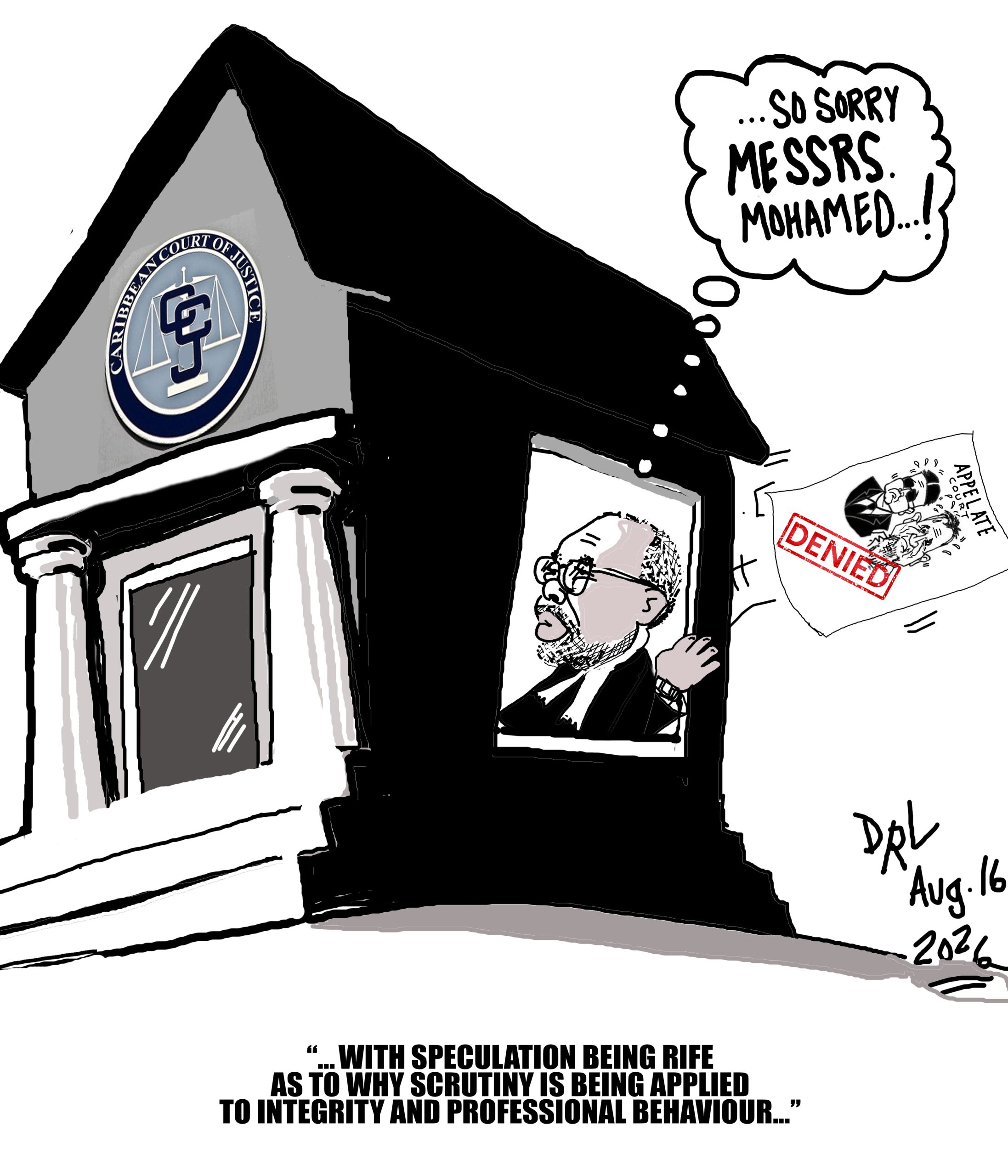
Mohameds call on CCJ President to recuse self from extradition case
(Kaieteur News) Attorneys representing Opposition Leader Azruddin Mohamed and his father Nazar Mohamed have called on the President of the Caribbean Court of Justice (CCJ), Justice Winston Anderson, to recuse himself from all proceedings concerning their clients, citing former internal judicial leaks and grave allegations of political maneuvering in Guyana.
In a 14-page letter dispatched to the CCJ Registrar in Port of Spain on 14th August, 2026, defense counsel: Roysdale Forde SC, Siand Dhurjon, and Damien DaSilva pressed for full disclosure of court records, asserting that their clients’ constitutional right to a fair hearing has been severely endangered.

CCJ President, Justice Winston Anderson
The legal team pointed to international reporting on leaked communications among sitting CCJ judges, highlighting remarks by Justice Jamadar, who spoke of a “toxic” work environment and an “attempt to influence the opinions of colleagues that differed from yours in an authoritative manner” during panel deliberations on the Mohameds’ appeal. The attorneys also referenced internal statements by Justice Eboe-Osuji, who alleged that Justice Anderson tried to “single-handedly override judicial independence” when attempting to announce a court decision contrary to the explicit wishes of a clear majority of the panel.
Compounding concerns over internal court dynamics are recent public claims by Leader of the People’s National Congress, Aubrey Norton. In an August 11 interview, Norton alleged that Justice Anderson personally telephoned him to broker agreement on filling Guyana’s top judicial vacancies, the positions of Chief Justice and Chancellor. Norton claimed Justice Anderson admitted he “was a part of the negotiations” surrounding former acting Chancellor Yonette Cummings-Edwards’ departure and boasted of being physically present “with the president.” Norton further stated that Justice Anderson pressed him to approve government-preferred candidates, allegedly pointing out that “Roxane George was an Afro Guyanese, so you got one” and framing the move as an opportunity for Norton to “put his name in the history books.”
The defense emphasised that under Article 127(1) of the Constitution of Guyana, judicial appointments are political decisions requiring agreement between the President and the Leader of the Opposition, leaving no lawful role for the CCJ President. The attorneys argued that such alleged interventions breach the separation of powers and create an indelible impression that the prestige of the CCJ Presidency was brought to bear in service of partisan objectives.

Opposition Leader Azruddin Mohamed and his father Nazar Mohamed
With extradition proceedings scheduled to recommence on 3rd September, 2026, for six consecutive hearing days, the legal team stressed that a proposed review by the Regional Judicial and Legal Services Commission offers no immediate relief. Consequently, the defense requested full disclosure within seven days of all internal deliberations, correspondence, and meeting records involving Justice Anderson and Guyanese political figures, while calling on Justice Anderson to state unequivocally whether Norton’s claims are admitted or denied and to take no further part in their clients’ case.
Anderson last week issued a lengthy public statement responding to a series of allegations made against him by fellow judges of the regional court, following reports first published in the Trinidad Express alleging internal turmoil, breaches of judicial protocol and claims that court panels were manipulated to secure particular outcomes in cases.
In the statement released on Friday, Justice Anderson said the reports had caused “concern, anxiety and profound sadness” both within the CCJ and across the region, and condemned what he described as the unauthorised leaking of confidential internal deliberations and correspondence. “Such disclosures and their publication are wholly unacceptable and strike at one of the fundamental principles upon which every independent judiciary depends,” he said, adding that the leaks have eroded “public trust and confidence in the third branch.”
At the heart of the controversy is a dispute over judicial attire. Justice Anderson confirmed that he removed a judicial colleague from the panel hearing a preliminary application in D’Almada v Trinidad and Tobago in July, after the judge insisted on wearing national dress rather than the court’s traditional robes or business attire during proceedings.
The CCJ President said when the founders of the CCJ established the Court, they determined that the longstanding Caribbean tradition of Judges wearing judicial robes during court proceedings would be maintained. He noted that as the Rules of Court did not contemplate hearings conducted “in chambers”, no express provision was made regarding attire in such proceedings. However, he said over time, it became the accepted practice, consistent with a number of Caribbean jurisdictions, including those sending their appeals to us, for Judges to wear bench jackets during interlocutory and chamber matters. “Then gradually it became accepted that CCJ judges would wear business suits/attire when not dressed in robes,” he said in the statement.
Share this:

Discover more from Kaieteur News
Subscribe to get the latest posts sent to your email.
Similar Articles
hits

Blunt of the day

Sports

Features/Columnists

Sir. Ronald Sanders

The GHK Lall Column

Weekend Cartoon