Latest update August 12th, 2026 10:20 AM



Latest News
- After 10 days of silence, Govt. confirms Guyana receiving 50% profit share
- Guyana must get more than 50% if country’s profits will be funding new oil projects – MP Andrews
- MV Barima tragedy… Internal records expose months of warnings, request for urgent repairs
- Colombia quake death toll tops 250 as rescuers race to find survivors
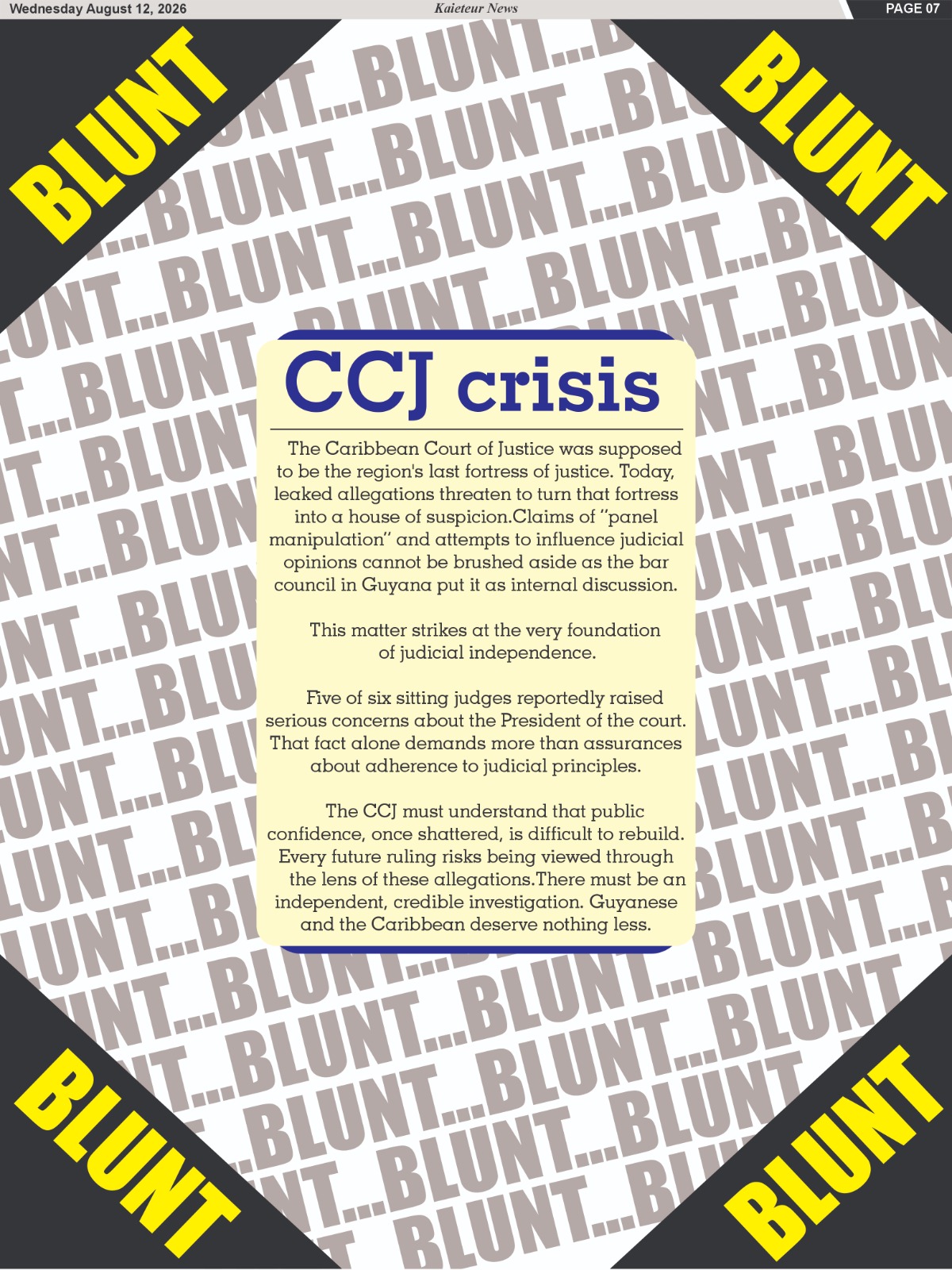
- Caribbean judiciaries rally behind CCJ as internal row erupts
“𝐅𝐫𝐨𝐦 𝐏𝐨𝐯𝐞𝐫𝐭𝐲 𝐭𝐨 𝐂𝐚𝐩𝐭𝐢𝐯𝐢𝐭𝐲, 𝐓𝐡𝐞 𝐍𝐞𝐰 𝐊𝐥𝐨𝐧𝐝𝐢𝐤𝐞 𝐟𝐨𝐫 𝐭𝐡𝐞 𝐃𝐞𝐬𝐩𝐞𝐫𝐚𝐭𝐞”
Dear Editor,
𝐓𝐡𝐞𝐲 𝐜𝐚𝐦𝐞 𝐜𝐡𝐚𝐬𝐢𝐧𝐠 𝐡𝐨𝐩𝐞 — 𝐧𝐨𝐭 𝐟𝐨𝐫𝐭𝐮𝐧𝐞, 𝐧𝐨𝐭 𝐨𝐢𝐥, 𝐛𝐮𝐭 𝐭𝐡𝐞 𝐩𝐫𝐨𝐦𝐢𝐬𝐞 𝐨𝐟 𝐬𝐮𝐫𝐯𝐢𝐯𝐚𝐥.
When you’ve spent your life fighting hunger and sanctions, a message that says, “We’ll buy your ticket, and you’ll pay for it by working” feels like a door opening to salvation.
Instead, for many Cubans, Venezuelan, and Haitian workers arriving in Guyana, that door closes into a cell.
One Cuban migrant told us, “They said it would take eight months to repay the passage. I thought, I can do that. But when I landed, they took my passport. No explanation. Just gone. They put us in a room with no privacy, no air, no light. And by morning, we were in a van heading to work — construction today, illegal mining tomorrow, then construction again. We worked like machines.”
“𝙏𝙝𝙚 𝙨𝙤-𝙘𝙖𝙡𝙡𝙚𝙙 𝙧𝙚𝙘𝙧𝙪𝙞𝙩𝙚𝙧𝙨 𝙥𝙧𝙤𝙢𝙞𝙨𝙚𝙙 𝙤𝙥𝙥𝙤𝙧𝙩𝙪𝙣𝙞𝙩𝙮. 𝙒𝙝𝙖𝙩 𝙩𝙝𝙚𝙮 𝙙𝙚𝙡𝙞𝙫𝙚𝙧𝙚𝙙 𝙬𝙖𝙨 𝙘𝙖𝙥𝙩𝙞𝙫𝙞𝙩𝙮.”
𝐓𝐡𝐞 𝐚𝐧𝐚𝐭𝐨𝐦𝐲 𝐨𝐟 𝐚 𝐝𝐞𝐜𝐞𝐩𝐭𝐢𝐨𝐧
Our investigative team traced the trail of these “opportunities” through social media — Facebook ads, Instagram reels, and encrypted WhatsApp groups promoting “Passage to Guyana: Work and Pay Later” schemes. The operators behind them frequently pose as travel facilitators or small business agents, but there is little evidence of legal registration or oversight.
Guyana’s labour laws contain no comprehensive framework for regulating foreign recruitment agencies. Once migrant workers arrive, they often enter a zone of legal limbo — neither documented employees nor formal residents. That legal vacuum gives cover to an emerging economy of “labour exploitation” operating under the sheen of development.
In interviews, multiple migrants described confiscation of identification documents, wage withholding, verbal abuse, and threats of abandonment in remote areas. One Venezuelan worker said, “They keep us quiet with fear. Who will we go to? The police? They are friends with the same people who brought us.”
The Cuban man who shared his story recalls when the illusion finally broke. “After eight months, I said, ‘I already paid.’ They laughed. They said I still owed for food, for transport, for everything. That’s when I knew — there was never an end.”
He spent a year and a half in what he calls “hell.” Two young women who traveled with him disappeared shortly after arrival. “We rode together in the van. After that day, gone. I don’t even want to think what happened to them.”
𝐌𝐨𝐝𝐞𝐫𝐧 𝐬𝐥𝐚𝐯𝐞𝐫𝐲 𝐛𝐞𝐡𝐢𝐧𝐝 𝐭𝐡𝐞 𝐨𝐢𝐥 𝐛𝐨𝐨𝐦
Guyana’s economic transformation has created an insatiable demand for labour — in construction, mining, services, and agriculture. But while the state celebrates booming GDP, it has yet to implement a parallel plan for protecting those it draws from beyond its borders.
The irony is painful: a country once known for exporting its people now thrives on exploiting imported desperation. In the race to modernize, some have turned poverty into a resource — harvesting it from across the Caribbean and Latin America.
There is historical symmetry here. During the 19th-century gold rush in the Yukon, men rushed to the Klondike chasing riches — few found gold, but many left empty, broken, or buried. Today’s migrant workers chase a similar illusion: that Guyana’s oil-age promise will trickle down to them. But the only ones guaranteed profit are the brokers who sell them that dream.
𝐓𝐡𝐞 𝐪𝐮𝐢𝐞𝐭 𝐜𝐨𝐦𝐩𝐥𝐢𝐜𝐢𝐭𝐲
When asked about these abuses, officials shrug and point to jurisdictional ambiguity. “We need more data,” one senior agency source said. “We can’t regulate what we can’t track.” But such deflections only reinforce the complicity: a silence that legitimizes exploitation because it serves a convenient shortage of labour.
Private businesses that benefit from these schemes operate without meaningful oversight. Reports reach the authorities about “foreign construction teams” living in inhumane conditions, but investigations rarely follow. The cases fall between ministries — Labour calls it “immigration’s problem,” Immigration calls it “private enterprise.”
And so, the racket thrives, protected by institutional paralysis.
There is, of course, a geopolitical dimension. Many Cuban migrants are politically stranded — unable to regularise elsewhere because of travel restrictions and sanctions. Some arrive through third countries like Suriname or Trinidad, smuggled across porous borders. For them, Guyana’s open frontier offers a semblance of safety — until that safety becomes servitude.
𝐀 𝐩𝐨𝐥𝐢𝐜𝐲 𝐯𝐚𝐜𝐮𝐮𝐦 𝐝𝐫𝐞𝐬𝐬𝐞𝐝 𝐚𝐬 𝐝𝐞𝐯𝐞𝐥𝐨𝐩𝐦𝐞𝐧𝐭
Guyana’s government has often said it welcomes “regional integration and cooperation,” but genuine integration requires regulation. Without a migrant worker policy that codifies rights, sets working-hour limits, guarantees wage enforcement, and criminalises debt bondage, the country risks institutionalising modern slavery under the banner of development.
Civil society and trade unions have repeatedly called for labour inspections and migrant registries. But in the haze of oil wealth and political self-congratulation, migrant workers remain invisible. The public seldom sees them. They live on the margins, housed in makeshift compounds, transported in silence, and dismissed when they collapse.
And yet, without them, many construction projects stall. Roads, bridges, and private housing complexes depend on their sweat. Migrant labour has become the ghost fuel of Guyana’s “new economy.”
Undoing this will require more than rhetoric. It demands enforcement mechanisms — cross-border cooperation, embassy oversight, and real-time reporting structures that allow migrants to file complaints safely. It requires that passports never become bargaining chips and that the phrase “work for passage” be recognised for what it is: coercion.
𝐓𝐡𝐞 𝐡𝐮𝐦𝐚𝐧 𝐜𝐨𝐬𝐭 𝐛𝐞𝐧𝐞𝐚𝐭𝐡 𝐭𝐡𝐞 𝐡𝐞𝐚𝐝𝐥𝐢𝐧𝐞
When the Cuban worker finally escaped — slipping through the border into Brazil and surrendering himself to the Federal Police — he said a weight lifted. “After one and a half years, I felt freedom again,” he told us. “And I promised myself that if I ever saw another ad saying ‘work now, pay later,’ I’d tell everyone to run.”
Guyana’s rise must not be built on the backs of people running from hell. If we are to call ourselves an oil nation of promise, we must also be a nation of conscience.
The government must act — not out of charity, but justice. Transparency in recruitment. Legal documentation for foreign labourers. Sanctions for traffickers and businesses that exploit. Public awareness campaigns that warn potential migrants of the schemes thriving in our midst.
These individuals did not come to steal jobs; they came to save themselves. Instead, many end up building the dreams of others while losing their own.
Beyond GDP: a test of morality
As Guyana stands at the threshold of transformation, we must decide what kind of nation we wish to be. One that counts success in barrels and contracts, or one that measures it in dignity and human worth?
Economic growth without ethical governance is just another gold rush — glittering, intoxicating, and ultimately cruel.
“𝙄𝙛 𝙬𝙚 𝙧𝙚𝙢𝙖𝙞𝙣 𝙨𝙞𝙡𝙚𝙣𝙩, 𝙬𝙚 𝙗𝙚𝙘𝙤𝙢𝙚 𝙥𝙖𝙧𝙩𝙣𝙚𝙧𝙨 𝙞𝙣 𝙩𝙝𝙚 𝙩𝙧𝙖𝙙𝙚 . 𝙄𝙛 𝙬𝙚 𝙖𝙘𝙩, 𝙬𝙚 𝙨𝙚𝙩 𝙖 𝙣𝙚𝙬 𝙨𝙩𝙖𝙣𝙙𝙖𝙧𝙙 𝙛𝙤𝙧 𝙟𝙪𝙨𝙩𝙞𝙘𝙚 𝙞𝙣 𝙩𝙝𝙚 𝙧𝙚𝙜𝙞𝙤𝙣.”
The Cuban worker’s warning echoes across borders: “Not all that glitters is gold. Some of it is a trap to steal your life.”
Guyana must ensure that the promise of development does not become someone else’s prison.
Sincerely
Hemdutt Kumar
Share this:

Discover more from Kaieteur News
Subscribe to get the latest posts sent to your email.
Similar Articles

Blunt of the day
Sports

Features/Columnists

Sir. Ronald Sanders

The GHK Lall Column

Weekend Cartoon