Latest update October 4th, 2026 10:35 AM


Latest News
- Controversial U.S. company in running for Amaila hydro project
- 40 citizens, 4 organisations appeal EPA’s no-EIA decision on Kurupung uranium project
- Israeli air attack on Gaza City apartment kills at least five
- CANU finds uncustomed alcohol at Windsor Estates property
- Govt. still reviewing Exxon’s 8th Stabroek project
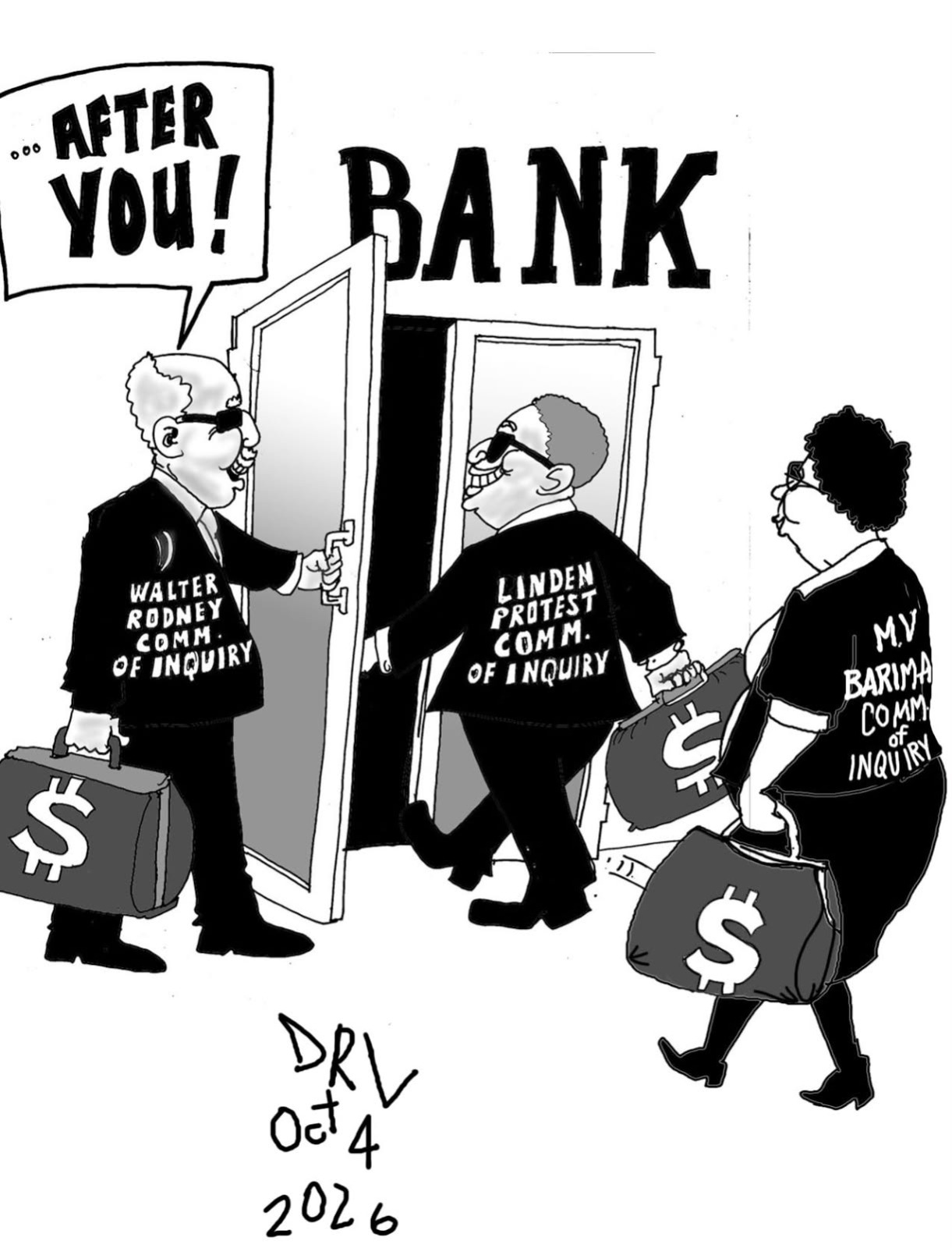
Where are the coroners?
(Kaieteur News) – The law in Guyana governing the holding of a Coroner’s Inquest is both clear in its intent and, at the same time, revealing in its limitations. Rooted in the Coroners Act, Cap. 4:03, the legal framework establishes the circumstances under which deaths must be investigated and the mechanisms through which such investigations are to be carried out.
At its core, the law requires that where a death is sudden, violent, unnatural, or of unknown cause, it must be reported to the appropriate authorities. Upon such a report, a coroner is obligated to inquire into the circumstances of the death. This inquiry may take the form of an inquest—a formal judicial examination aimed at determining the identity of the deceased, and how, when, and where the person came to their death.
Importantly, the law does not mandate that every unnatural death automatically results in an inquest. Rather, it places a duty on the coroner to investigate and to determine whether the holding of a formal inquest is necessary. This distinction is significant. It reflects an intention to allow some degree of discretion, enabling the coroner to decide whether the available evidence justifies a full public inquiry or whether the matter can be resolved through other investigative means.
Under the existing legal framework, the coroner plays a pivotal role. The office is not merely administrative; it is quasi-judicial, carrying with it the responsibility to ensure that suspicious or unexplained deaths are subjected to proper scrutiny. Inquests, when held, serve an essential public function: they promote transparency, provide answers to grieving families, and may uncover facts relevant to criminal proceedings.
However, while the structure of the law has remained largely intact, a significant development occurred with legislative changes introduced under the APNU+AFC administration. On January 14, 2016, the National Assembly passed the Coroners (Amendment) Bill 2015 following what was widely described as a heated and protracted debate between the Government and the Opposition.
The amendments did not fundamentally alter the substantive law governing inquests. Instead, they addressed an important structural issue: the definition and scope of who may act as a coroner. Under the amended provisions, the magistrate of the magisterial district in which an unnatural death occurs is designated as the coroner. Where that magistrate cannot conveniently or speedily be found, or is unable to act, the law provides that the nearest Justice of the Peace who is able to do so shall assume the role. A coroner, in this context, is defined as a public official who investigates, by way of inquest, any death not due to natural causes.
Crucially, the amendment also widened the meaning of “coroner.” According to the explanatory memorandum, it empowered the Judicial Service Commission (JSC) to appoint “fit and proper persons” to serve as coroners across the country. This was a forward-looking reform, intended to expand the pool of individuals capable of performing this critical function, and to ease the burden on magistrates who already face heavy caseloads. Yet, despite this legislative advancement, there has been little evidence that the intended expansion has been meaningfully implemented. There are no widely known or publicly identified appointments of such specially designated coroners under the authority of the Judicial Service Commission. In effect, the system continues to rely almost exclusively on magistrates and, in limited circumstances, Justices of the Peace. This gap between legislative intent and practical implementation is increasingly difficult to justify. Guyana has, in recent years, experienced a troubling rise in reports of unnatural deaths—ranging from violent crimes to accidents and other unexplained fatalities. Each of these cases represents not only a potential legal matter but also a human tragedy, often leaving families without answers and without closure.
The consequence is a growing backlog of cases that either await inquest or are never fully ventilated through the formal process envisioned by the law. Magistrates, already burdened with their regular judicial duties, cannot reasonably be expected to absorb this additional workload without consequence.
It is precisely this situation that the 2015 amendment sought to address. By allowing for the appointment of additional, qualified individuals as coroners, the law created a mechanism through which the system could be strengthened and made more responsive. However, a mechanism unused is a problem unsolved. The Judicial Service Commission should move with dispatch to identify and appoint suitably qualified persons to serve as coroners. These individuals must possess the requisite legal knowledge, independence, and integrity to discharge the responsibilities of the office effectively.
Such appointments would not only reduce the existing backlog of inquests but also enhance public confidence in the administration of justice. More timely inquests would mean quicker answers, greater transparency, and a stronger foundation for any subsequent criminal proceedings. The law, as it stands, provides the tools. What is required now is the will to use them. In the face of rising unnatural deaths, the failure to fully operationalize the office of the coroner is no longer a matter of administrative oversight—it is a matter that goes to the heart of justice itself.
(The views expressed in this article are those of the author and do not necessarily reflect the opinions of this newspaper.)
Share this:

Discover more from Kaieteur News
Subscribe to get the latest posts sent to your email.
Similar Articles
Website Hits

Blunt of the day
Sports
Features/Columnists

Sir. Ronald Sanders

The GHK Lall Column

Weekend Cartoon