Latest update September 29th, 2026 6:48 PM


Latest News
- Breaking News: Unrest at Vigilance after police arrest Mark Cromwell’s wife and brother in connection with missing Surinamese men
- Court rules Ramson breached Access to Information law
- Two Brazilians killed; others injured in smash-up on Linden–Mabura Highway
- Fire breaks out at Sophia Children’s Home
- Antigua rejects open-ended U.S. deportee deal
Full 50% profit share
(Kaieteur News) – The more revenues Guyana collects for its oil, the more the mystery deepens about when it will begin to receive its full 50% profit share. Why the uncertainty, what is going on with Guyana’s full profit share? Why did Alistair Routledge, President of ExxonMobil Guyana hedge when asked that question? What did he hide within his answer, about when Guyana will receive its half share of profits?
Since the War against Iran started, oil prices have almost doubled to around US$100 a barrel. More revenues mean there is a bigger pool for 75% cost recovery deductions from off the top. The seven already approved oil projects should be repaid by yearend, once oil prices stay around US$100 a barrel, and production remains at approximately 900,000 barrels daily. But there were three considerations that factored heavily in Routledge’s answer to the question about when Guyana starts receiving its 50% profit share. He fudged his answer: “What exactly that percentage is depends on oil price, depends on volume, depends on how much money is being spent in the months or two months leading in to any given month.” Those are important, but so also the 25% costs that are carried forward, the lack of ringfencing, and new oil projects presented by ExxonMobil that could add US$25-30B in new costs to Guyana’s cost bank.
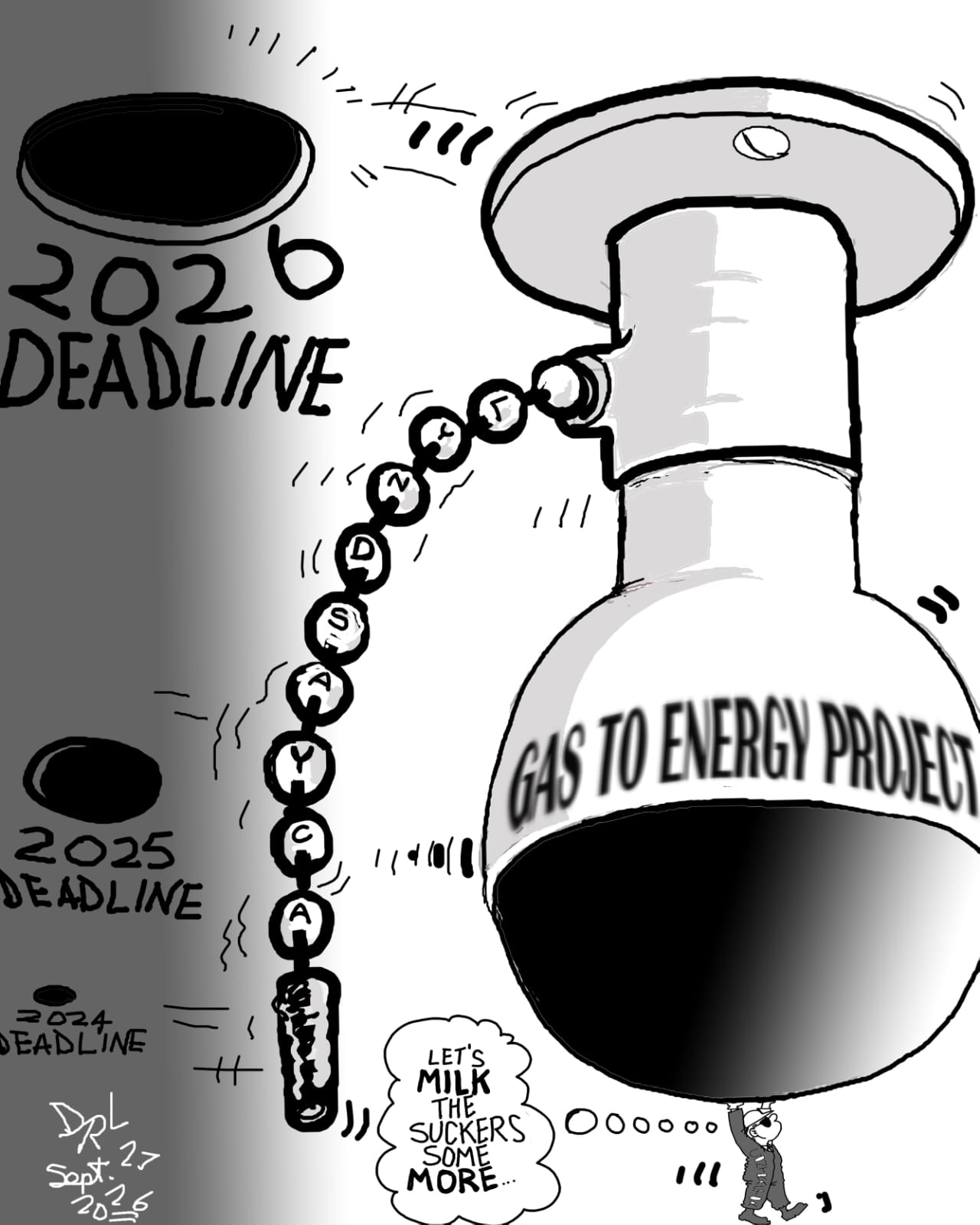
Instead of Guyana being nicely positioned to begin collecting its full 50% profit share, as stated in the 2016 Production Sharing Agreement, those three factors contribute powerfully in delaying this country’s receiving that 50% profit share. Instead of the cost bank being depleted to zero, those three factors (carryforwards, no ringfencing, and new projects) insert residual costs and add new costs into the cost bank. Under this scheme, the cost bank is a perpetual, never-ending game that traps Guyana. It is in ExxonMobil’s interests to keep the cost bank running forever. More billion-dollar bills entered on Guyana’s side of the ledger, and the full 50% profit share is a mirage.
Now ExxonMobil pushes ahead with two new oil projects number eight and nine, Longtail and Haimara, in the Stabroek Block. From past standards, the Guyana Government would approve these two new oil projects, following some farcical review. Longtail and Haimara represent new costs added to the supposedly rapidly dwindling Guyana cost bank.
What citizens are absorbing, in their capacity as eyewitnesses, is this game that inserts fresh billions into Guyana’s cost bank, through these ongoing projects. No sooner that costs attached to existing projects are poised to approach zero, than new ones enter into the scheme. Guyanese can be confident that when Longtail and Haimara reach near their total cost removal state, that there will be more to follow after them. ExxonMobil has this vision, its cost squeeze on this country, down to a science. All the company has to have is a government willing to perpetuate its exploitative 75% cost recovery bonanza, which is what it has in the PPPC Government. Willing, prostrate, and colluding governments have been high points of the ExxonMobil Guyana experience. With carryforwards and no ringfencing, projects keep rolling off Guyana’s oil partner’s assembly line. They continue to be approved routinely, and the cost billions go on increasing. It shouldn’t surprise that there is this dodging about when Guyana will get the contracted for 50% profit share, a real half share.
Routledge gave a little opening, in his nuanced conditioning of Guyanese about what they should expect. We do not disagree about the roles of oil price and volume (daily production), but we point to that part Routledge slipped in: “depends on how much money is being spent in the months…leading to any given month.” It is also about what he didn’t say, what suits ExxonMobil’s program. We say this: the oil game played by a master operator such as ExxonMobil is a slick one. Depending on how much is involved in the 25% costs the company brings forward, and ExxonMobil spends on new projects, Guyana’s 50% profit share is elusive. Frankly, full 50% profits for Guyana may always be out of reach, something dreamed of, but which never happens. It was why Routledge hedged his answer, said nothing about the three factors identified.
Share this:

Discover more from Kaieteur News
Subscribe to get the latest posts sent to your email.
Similar Articles
Website Hits

Blunt of the day

Sports

Features/Columnists

Sir. Ronald Sanders

The GHK Lall Column

Weekend Cartoon