Latest update January 9th, 2026 12:30 AM

Jan 09, 2026 Features / Columnists, Peeping Tom
(Kaieteur News) – A source with a long memory and a short fuse, a man who had witnessed the grand ideological parades of the past from a safe and skeptical distance, recently passed me a note over a worn table in a quiet Georgetown rum shop.
“They used to have a plan,” he murmured, the scent of aged Demerara rum and damp concrete mingling with his words. “Forget whether it was a good one or a bad one. It was a plan. Burnham gave every year a title. A mission. The Year of Production, 1974. The Year of Agriculture, 1975. The Year of Education, 1976. It was theatrical, it was oppressive, it was often a farce—but by God, it was a declaration of intent.”
He went on, “Now we have a different kind of farce. We have the Year of the Scattergun, every year. Our Budget keeps getting larger and larger each outdoing the other. Money falls from the sky like showers in May-June. But the same old problems remain”
He leaned in, his voice dropping to the conspiratorial register. He said, “Before this next avalanche of budget billions buries us in fresh concrete and bitumen, dedicate 2026 to something simple: The Year of Fixing the Obvious. Start with the roads. Everyone complains. No one connects the dots. The dots are all red, and they’re hanging over every congested junction.”
He was right. The evidence is not classified; it’s in plain sight, requiring no clandestine meetings with disgruntled engineers, only a functioning set of eyes and the patience to sit in traffic on the East Coast Public Road. The government’s approach to development is a kind of grandiose civil engineering Stalinism—monolithic, top-down, and bizarrely in love with traffic lights.
When the East Coast was widened, the planners, in their infinite wisdom, studded it with signalized junctions. The consideration of roundabouts—a traffic solution so elegantly simple it is ubiquitous in the very former colonial power whose infrastructure model we ostensibly inherited—was apparently deemed too radical, too fluid, too uncontrollable.
Now, my source conceded, it’s likely too late to rip out most of those lights and install roundabouts. The traffic lights have been set, both physically and bureaucratically. But the intelligence failure is ongoing. “It’s a sensor issue,” he said, tapping the table. “Not just the electronic ones, but the sensory organs in the heads of the traffic department.” At countless junctions, late at night or in off-peak hours, lines of vehicles sit idling, belching exhaust, waiting for a pre-programmed bulb to change color while the crossing road lies empty, a ghost avenue. The installation of induction loop sensors or cameras to create an adaptive, responsive light system is not aerospace technology. It is Traffic Management 101. Its absence is a quiet scandal, a daily tax on time, fuel, and sanity paid by every commuter.
But the real gold, according to my source, lies in the “natural” roundabouts Georgetown has already built and then blindly ignored. He laid out a map, not from the Ministry of Public Works, but from sheer observational logic. “Look at the Square of the Revolution,” he said, circling the Cuffy Monument with a calloused finger. “You have Vlissengen, Homestretch, Croal, South Road—a spiderweb of congestion. The lights are a permanent apology for bad design. The monument is a perfect central island. The people are already creating their own anarchic bypasses behind the pavilion. Meanwhile they are still fighting the the geometry. They are policing a solution that is begging to be implemented.”
He moved his finger north. “The Cenotaph. Another natural circulatory system, waiting for paint and signage. The road encircling St. George’s Cathedral. Same story. These aren’t proposals; they are recognitions of reality. All that’s needed is for the authorities to see what already exists and lane it.”
Then he brought up the old train line between Main and Vlissengen that has been developed ostensibly as a recreational area. “A recreational area?” He snorted. “It’s a parking lot for the GRA and other agencies and businesses. It is a monument to missed opportunity. That strip is a ready-made traffic lane. Use it to convert Lamaha Street into a proper four-lane corridor, using the trench as a median. But to do that, you’d have to tell a government agency—the GRA—to move its inspection unit. And that,” he said, finishing his rum, “requires a political will that is currently being expended on ribbon-cuttings for four-lane highways that will instantly become two-lane roads.”
And here we arrived at the pattern of self-sabotage. Billions are spent widening roads to four lanes. Almost immediately, the kerbside lanes on Sheriff Street; at Grove on the East bank of Demerara; and on the East Coast train line, are surrendered to parked cars, turning the gleaming four-lane roads back into the choked, cluttered corridors they were meant to replace. It is a breathtakingly wasteful cycle. The state builds a road, then allows citizens and businesses to un-build it, lane by lane, through sheer administrative indifference.
“So, name the year,” my source said, rising to leave. “The Year of Fixing the Obvious. Before you pour another billion into a new project, fix the billion-dollar projects you just finished. Install the sensors. Paint the roundabouts that are already there. Enforce the no-parking laws. Have the courage to tell the GRA to pack up and move. Stop approving businesses on main public roads.” He then slipped out into the Georgetown dusk, leaving behind the empty glass and the map of a city whose solutions are staring it in the face, waiting only for someone in charge to see them.
(The views expressed in this article are those of the author and do not necessarily reflect the opinions of this newspaper.)
Subscribe to get the latest posts sent to your email.
Your children are starving, and you giving away their food to an already fat pussycat.
Jan 09, 2026
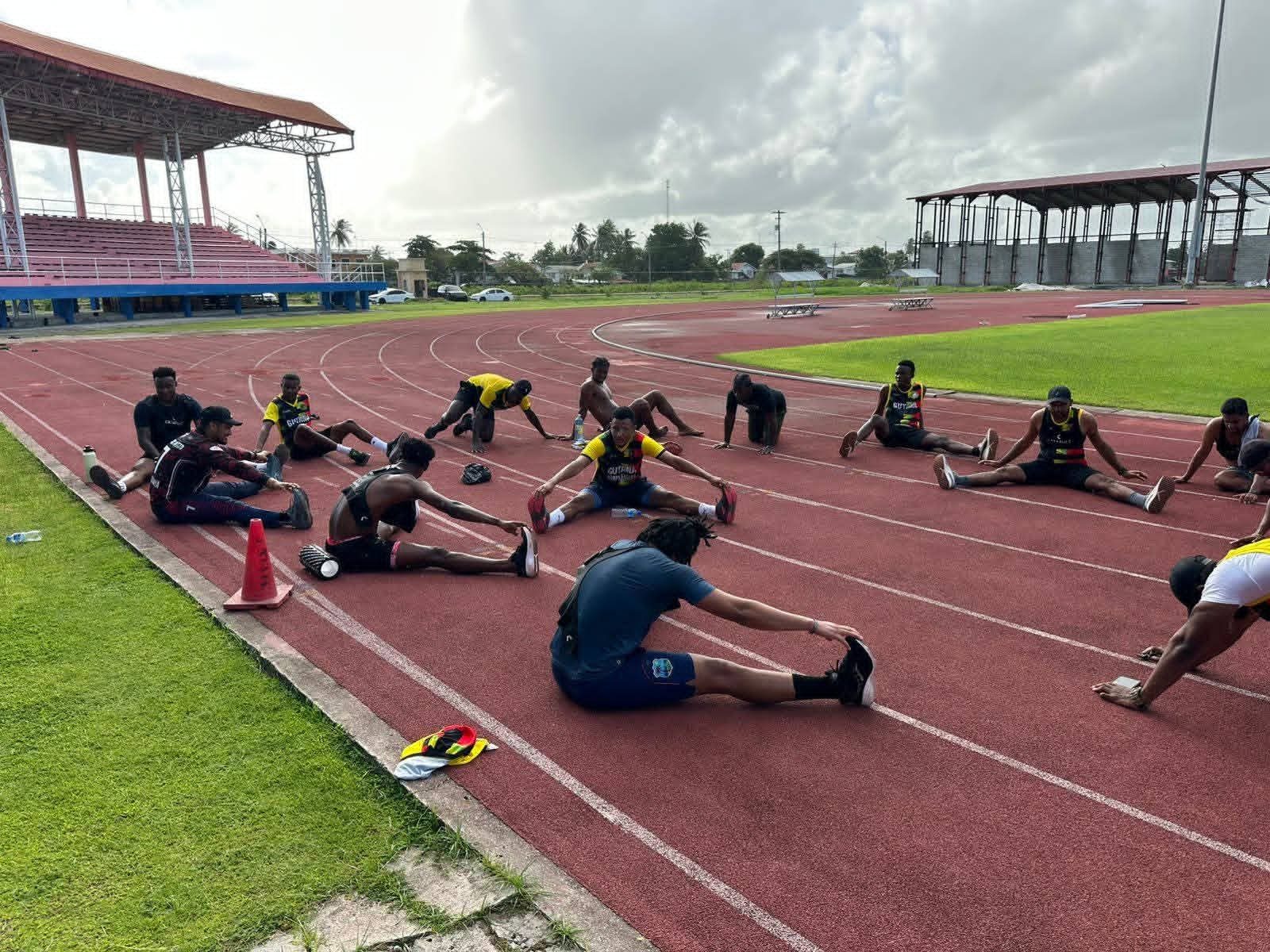
Kaieteur Sports – The Guyana Harpy Eagles conducted their first training session yesterday at the National Track & Field Facility, Leonora, with preparations for this 2026/27 season already...Jan 09, 2026
(Kaieteur News) – A source with a long memory and a short fuse, a man who had witnessed the grand ideological parades of the past from a safe and skeptical distance, recently passed me a note over a worn table in a quiet Georgetown rum shop. “They used to have a plan,” he murmured, the scent...Jan 04, 2026
By Sir Ronald Sanders (Kaieteur News) – As 2025 draws to a close, the Caribbean Community stands at a moment that calls for less rhetoric and more realism. CARICOM is experiencing a period in which external pressure is intensifying, new norms are hardening among powerful states, and the need for...Jan 09, 2026
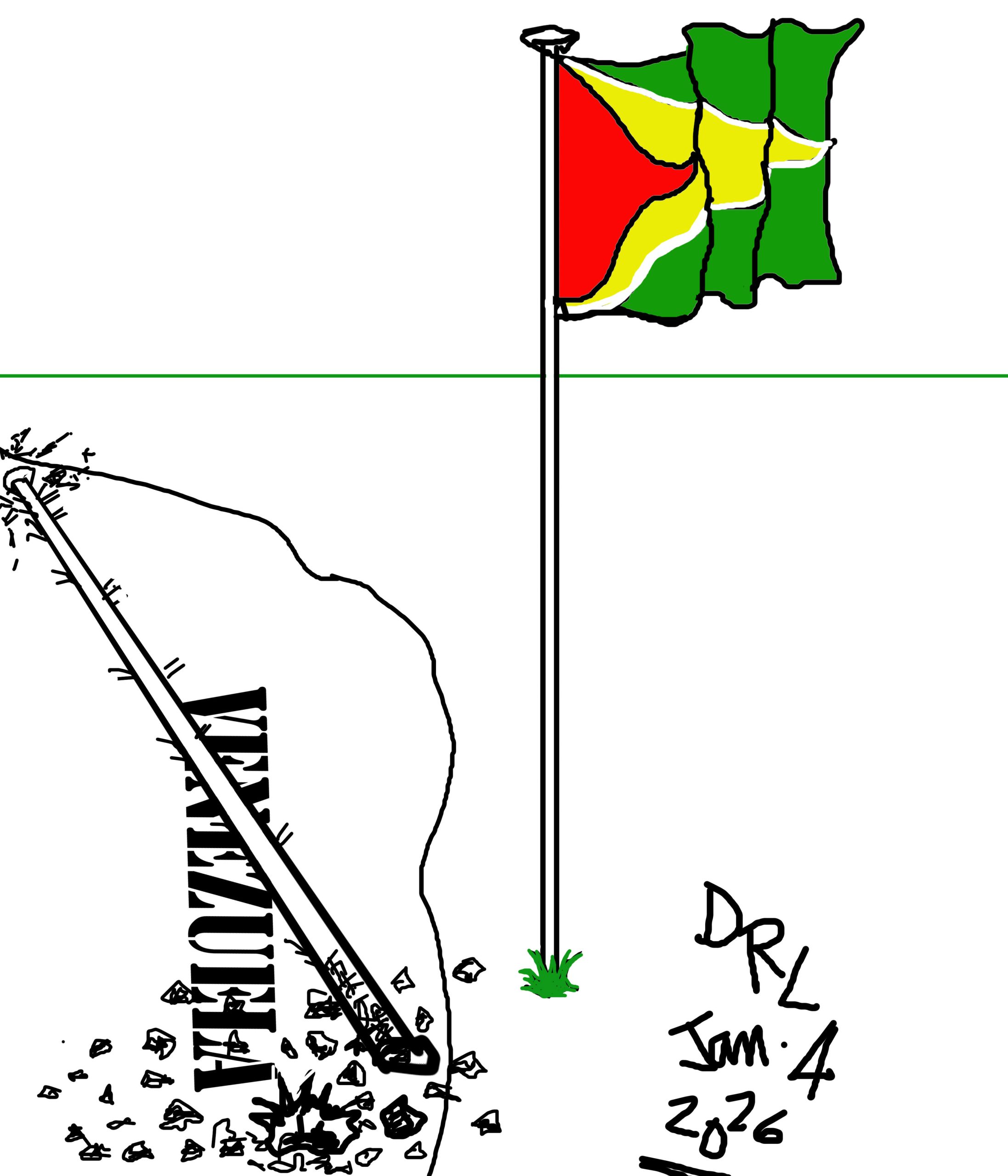
Hard Truths by GHK Lall (Kaieteur News) – It could be that I’m losing it. The more I read about US visions for Venezuela, the more bizarre matters become. It can’t be me losing it, but somebody uptown in icy DC. Consider the free-floating picture that is US-Venezuela, and the head...Freedom of speech is our core value at Kaieteur News. If the letter/e-mail you sent was not published, and you believe that its contents were not libellous, let us know, please contact us by phone or email.
Feel free to send us your comments and/or criticisms.
Contact: 624-6456; 225-8452; 225-8458; 225-8463; 225-8465; 225-8473 or 225-8491.
Or by Email: glennlall2000@gmail.com / kaieteurnews@yahoo.com