Latest update August 23rd, 2026 10:28 AM



Latest News
- ExxonMobil walks away with almost three times Guyana’s debt without being audited
- Risk-free Stabroek Block operations not enough for Pres. Ali to renegotiate lopsided deal
- Despite visual impairment, Corentyne teen shines with 7 Grade Ones at CSEC
- Canawaima breaks down days after safety clearance
- Police probe gunfire near Office of the President
The Old and the New
Kaieteur News – Guyana is changing. Everyone says so. You see the roads, the high-rises, the bright paint of new businesses, and you cannot deny it. A certain kind of development is taking place.
But when you pause, you must ask: development for whom? And for how long will there be a Guyana that belongs to its people, and not only to those who already possess?
It has always been believed that Guyana was a large place, a vast emptiness in which each man might have his share. But this was belief, nothing more. In reality, it is the old story: a small group, clever with friendship and with the use of names, takes more and more. What was once wide and abundant begins to shrink into private holdings. And you see again what history has always taught: that a country is not shared, but consumed.
This consuming has its peculiarity. In a normal capitalist society, one expects that competition decides who survives. In Guyana, it is not competition. It is connection. A man is rich not because he has outworked another, but because he has shaken the right hands, whispered to the right ears. He is close to power. That is enough.
It is striking, too, that many of these new rich are not of the ruling party. They are not men formed in the party’s struggles. They are outsiders who have learned that influence lies not in party loyalty but in proximity to those who govern. By this method, they have inserted themselves into the centre. From there, wealth has flowed.
Guyana has always had its oligarchs. Under the long PNC rule, even with the language of socialism, there was a handful of families who controlled trade, property, and the very possibility of commerce. They flourished when the country sank. And they flourish still.
But today they are no longer alone. A new class has risen—more aggressive, less burdened by history, less polite about where their fortunes come from. They are not content to exist beside the old oligarchs. They mean to replace them. The old oligarchy now discovers what the poor had always known: that power, once turned against you, has no memory of your usefulness.
History, again, provides its lesson. These groups, whether old or new, do not only amass. They consolidate. Wealth becomes class. Class demands influence. And soon policy bends. Then, without noticing, one finds not the rule of people, nor of parties, but of class.
The political parties cannot escape. To contest elections is to need money, and the money is here, within Guyana, in the hands of the few. The diaspora may give, but it is never enough. And when money is taken, obligations are created. After the election, there is always a knock at the door.
The PPP itself has lived through this cycle. After 1992, the old oligarchs found their way back. They used emissaries, men inside the party who could be relied on. Influence seeped in, unhurried but sure. A new weakness was found, cultivated, expanded. What began as a few hands shaking became a network of power. By the time anyone noticed, it was already a structure.
Now another set of men, the new oligarchs, carry the confidence that comes not only from wealth but from the certainty that government cannot ignore them. They have secured their place. The older order, watching, discovers that their long dominance is fragile. The new men are pressing, and may yet press them out.
So, there are two oligarchies in Guyana. One belongs to the past, grown fat on accommodation with every ruling party. The other belongs to the present, born not of loyalty to any party, but of loyalty to connections within the government itself. It is a simple thing, this shift, but it is decisive.
In time, people will say this was the moment the country passed from one hand to another, from the old to the new.
(The views expressed in this article are those of the author and do not necessarily reflect the opinions of this newspaper.)
Share this:

Discover more from Kaieteur News
Subscribe to get the latest posts sent to your email.
Similar Articles
hits

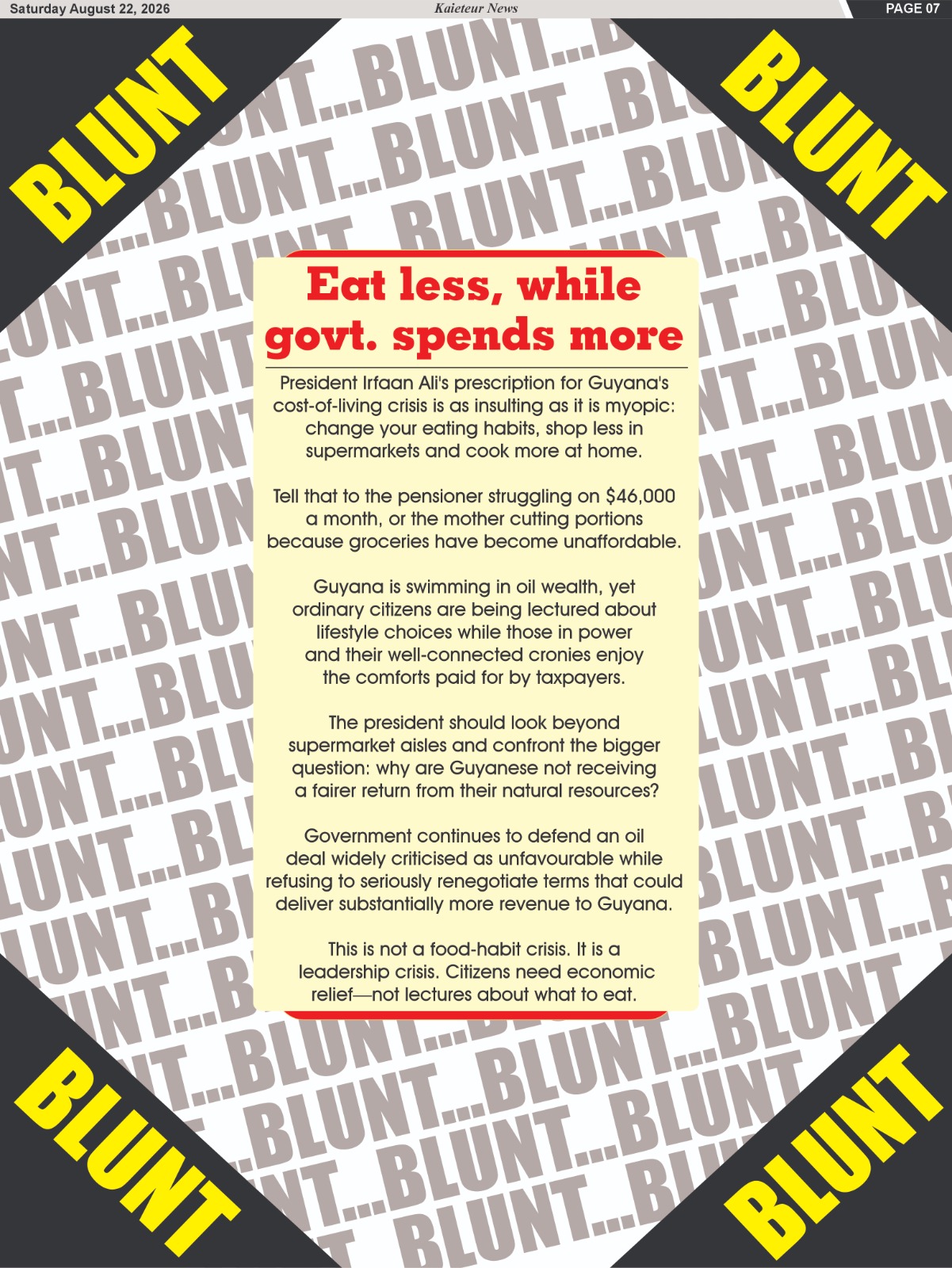
Blunt of the day
Sports
Features/Columnists

Sir. Ronald Sanders

The GHK Lall Column

Weekend Cartoon


