Latest update August 12th, 2026 10:20 AM



Latest News
- After 10 days of silence, Govt. confirms Guyana receiving 50% profit share
- Guyana must get more than 50% if country’s profits will be funding new oil projects – MP Andrews
- MV Barima tragedy… Internal records expose months of warnings, request for urgent repairs
- Colombia quake death toll tops 250 as rescuers race to find survivors
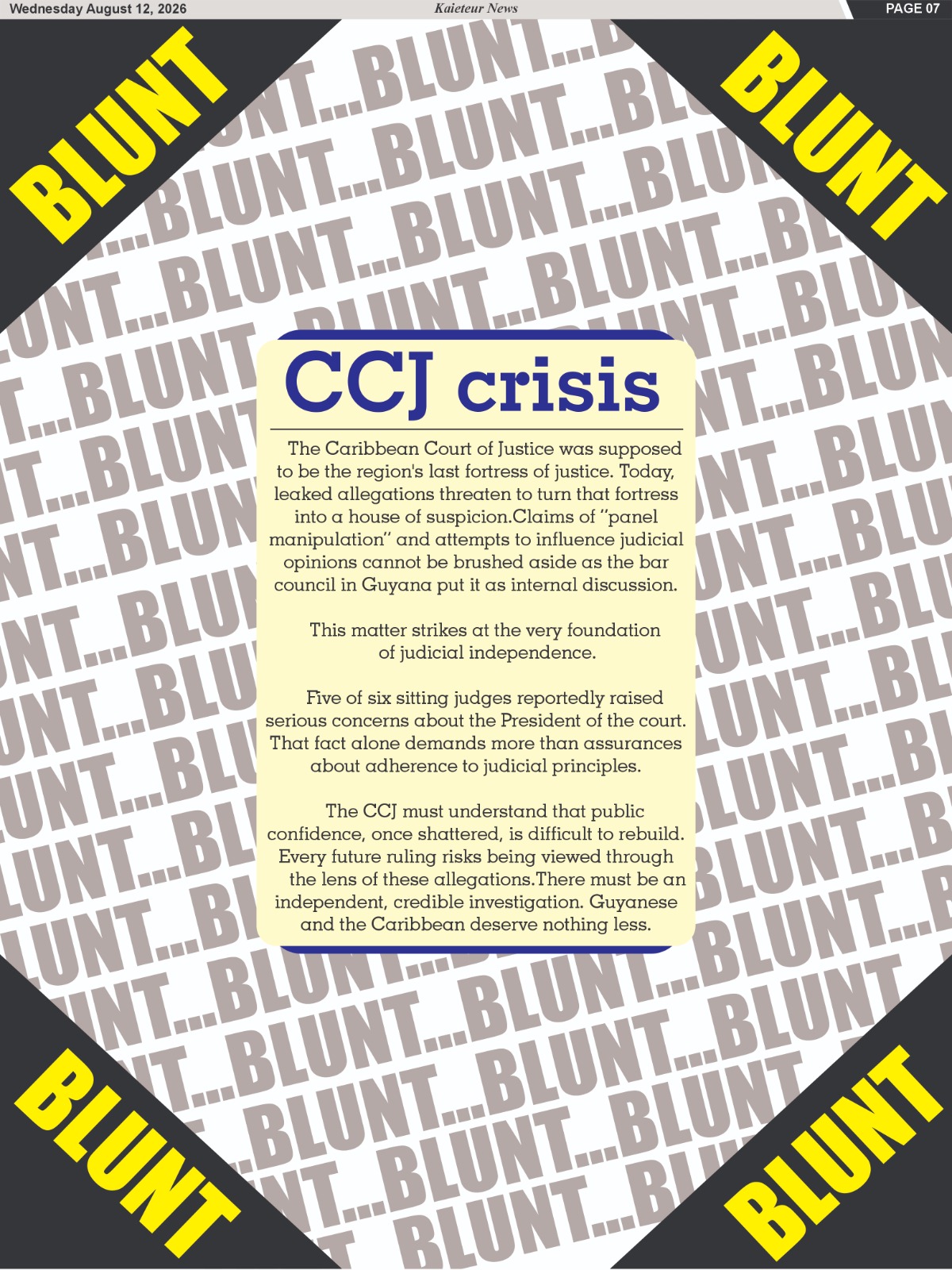
- Caribbean judiciaries rally behind CCJ as internal row erupts
An economic case for PPP/C and Guyanese Young People
Dear Editor,
Kaieteur News – Economists closely analyse the demographic and policy factors that shape a country’s growth trajectory. In Guyana, young people represent a pivotal demographic. According to the CIA World Factbook, approximately 21.23% of our population is aged 15–24, which translates to about 159,281 young people in 2020. Projecting that share onto the anticipated 2025 population of approximately 835,986 yields 177,000 young peoples. This cohort not only constitutes a significant voting bloc but also serves as the driver of tomorrow’s workforce, innovation, and tax base. More importantly, they represent Guyana’s economic and political future, and harnessing their potential will largely determine our economic growth.
From a macroeconomic perspective, political representation is crucial because it influences policy priorities. The People’s Progressive Party/Civic (PPP/C) has taken a decisive step by including 27 candidates under the age of 25 on its 2025 electoral list. These young candidates come from various disciplines, including science, health, agriculture, and media. By granting young people a seat at the legislative table, the party and government ensure that fiscal and development policies reflect the aspirations of the generation that will bear their costs and benefits.
In contrast, other parties have not been as explicit in their young people engagement. The Partnership for National Unity (APNU) claims that about 60% of its slate is under 40. Yet, they have not disclosed how many candidates fall within the critical under-25 age bracket. Although individual young candidates, such as 27-year-old Eden Corbin, are highlighted, there is no clear strategy for integrating young people perspectives into budgetary decisions.
The Alliance for Change (AFC) promises that half of its cabinet will be women and half will be young people, but it fails to provide specific numbers for actual young people candidates. Likewise, the We Invest in Nationhood (WIN) party has not disclosed how many young people are on its slate, which is a common trend for WIN, as it often lacks details on its party platforms. For economists, these omissions indicate a weaker commitment to incorporating young people expertise into policymaking and a lack of strategic planning for Guyana’s economic future.
When comparing the parties’ manifestos from an economic perspective, the PPP/C stands out for investing in human capital and economic diversification. The PPP/C manifesto emphasizes building human capital and supporting innovation. For instance, in education and scholarships, they will continue the GOAL scholarship program, which has already benefited nearly 30,000 citizens, and provide free tuition at the University of Guyana to foster a more skilled workforce. Moreover, in terms of digital infrastructure and innovation, the PPP/C plans to introduce a national e-ID system, an AI government assistant (named “AskGov”), as well as technology parks and innovation hubs. These initiatives create a foundation for a knowledge-based economy, diversifying beyond traditional extractive industries.
The PPP/C has also stated its commitment to involving young people in decision-making and supporting young people-led enterprises. In housing and asset formation, the party plans to offer cement and steel vouchers, low-interest home loans, and proposed investment vehicles for young people to facilitate asset accumulation and improve long-term economic stability. These policies align with economic evidence indicating that countries investing in education, technology, and asset formation achieve higher and more inclusive growth, particularly for younger generations.
In contrast, while the APNU presents ambitious promises, its proposals lack fiscal clarity. The APNU Young people Empowerment Scheme includes a national young people leadership program, young people training centers, a young people investment fund, and cash stipends of G$50,000 per month for tertiary students. While these ideas aim to uplift young people, they also entail significant budgetary implications. Without explicit revenue measures or detailed costings, there are concerns about the sustainability and inflationary pressures of such programs. The APNU’s term in government from 2015 to 2020 saw rising deficits and economic contraction, and replicating this approach could jeopardize macroeconomic stability.
On the other hand, the AFC’s Education Policy 2.0 proposes establishing skills institutes, smart classrooms, and doubling teachers’ salaries. However, these initiatives mirror existing PPP/C programs and fall short of presenting a comprehensive economic agenda for young people. There is little focus on job creation, entrepreneurship, or housing, which are key drivers of economic mobility.
Meanwhile, the WIN manifesto focuses on increasing public assistance, pensions, and salaries while lowering taxes and VAT. Critics argue that the manifesto merely replicates other parties’ policies and lacks novel ideas, with no targeted young people programs. Doubling and tripling benefits without detailing financing risks, large fiscal deficits, and failing to invest in the labor force that will ultimately fund these promises.
When analyzing the manifestos of the parties, young people are better positioned under the PPP/C’s policies. They have not only proposed detailed economic and social policies targeting the younger generation but also granted them a seat at the table for planning and development in Guyana. The PPP/C’s electoral list underscores this commitment. President Irfaan Ali’s commitment to the young people of Guyana is evident in his assertion: “Young people are the architects of tomorrow. We must provide them with the tools, support, and platforms to be effective leaders and change-makers.”
In economic terms, Guyana is at a crossroads. One path involves investing in human capital, digital transformation, and financial inclusion, promoting sustainable growth with widespread participation. The other path offers generous transfers without a clear funding strategy and places minimal emphasis on young people empowerment. I am convinced that the PPP/C’s program presents the most viable way forward for both Guyana’s young people and the country’s future.
Respectfully,
Dr. Tilokie Arnold Depoo,
Economist
Share this:

Discover more from Kaieteur News
Subscribe to get the latest posts sent to your email.
Similar Articles

Blunt of the day
Sports

Features/Columnists

Sir. Ronald Sanders

The GHK Lall Column

Weekend Cartoon