Latest update September 24th, 2026 10:31 AM


Guyana hit by a 15% tariff
Kaieteur News – Guyana’s latest episode of diplomatic bungling marries farce with tragedy. The government of Guyana, having supposedly negotiated on behalf of its people with the economic leviathan of the Western Hemisphere, the powerful United States of America, has emerged from secretive talks not with the triumphant fanfare of reduced tariffs, but with the dull thud of a 15% tariff slapped on its exports to the United States.
This, we are told, is cause for celebration.
The Guyana Manufacturing and Services Association (GMSA), apparently privy to some esoteric knowledge denied the rest of us, issued a statement of warm congratulations—an applause more befitting the end of a civil war than the imposition of a barrier to trade. The Private Sector Commission (PSC), never one to miss a chance to echo a chorus line it assumes the government wants to hear, followed suit in the manner of a loyal house cat purring under the hand that feeds it. No surprise there. Guyana’s private sector has long learned that its survival depends not on independence of thought, but on the skillful nodding of its head.
But what are we celebrating? A tariff reduction, yes, from a hypothetical 38% to a very real 15%. The 38% was a phantom menace to begin with. It was one of Donald Trump’s trademark bluffs, a poker game played with the threat of economic retribution. And like all his deals, it follows the predictable rhythm of intimidation followed by concession. He threatens high, settles low and then declares victory.
The baseline tariffs for trade surplus countries are now 15%. For trade deficit countries, 10%. The key distinction is not the numbers but the story: Guyana now pays more than most of the Caribbean, and for that we’re expected to say thank you?
The matter might have been less galling had the government explained what had been done in our name. But transparency, like fiscal prudence and clean procurement, has never been the strong suit of the current administration. Throughout the process, the Guyanese people were informed that negotiations were ongoing, that discussions were taking place “at various levels.” What levels? Between whom? Over what conditions?
The answers never came, and the silence was not accidental. It was a calculated strategy of obfuscation. To involve the public, to seek the expertise of seasoned negotiators—including those who once served in the Caribbean’s Regional Negotiating Machinery—might have risked competence, and competence is often a threat to power.
Consider the facts. Guyana enjoys a significant trade surplus with the United States—but only because ExxonMobil, an American company operating in Guyana’s offshore waters, ships out its share of crude oil. That oil attracts zero tariff. It generates no direct earnings for the state beyond the notoriously generous production-sharing agreement signed under mysterious and ignoble circumstances. If oil exports were subtracted from the ledger, the United States would be left with a trade surplus over Guyana. In other words, the entire justification for imposing the higher 15% tariff collapses under minimal scrutiny. Did our negotiators raise this point? Was this arithmetic even part of the discussions?
We may never know. The details of the negotiation have been filed away under the general heading of “government business,” which in Guyana usually means “none of yours.” There are no public minutes, no briefings in Parliament, no published assessments of the economic impact of the tariffs on domestic manufacturers. And in the place of disclosure, we are offered press releases dripping in platitudes from the GMSA and the PSC. These representative organizations that should be watchdogs have become, instead, cheerleaders.
One begins to suspect that the GMSA and PSC were not only not consulted but are desperate to pretend they were. Their statements read less like endorsements than rehearsed lines. In truth, their role is not to challenge but to echo, not to agitate for better outcomes but to shield the government from criticism by pretending that all is well in the house of commerce.
But all is not well. A 15% tariff on Guyana’s exports makes our goods less competitive. It limits access. It undercuts manufacturing and weakens one of the few sectors in the economy that is not wholly dependent on extractive foreign investment. And all of this comes at a time when Guyana should be leveraging its newfound oil wealth to build economic sovereignty instead of begging for breathing space while Exxon ships out barrels and ships in tax holidays.
That our business associations do not rage against this outcome, but instead applaud it, is perhaps the saddest epilogue of all. Rather than demand to know who led the negotiations (and whether the “Balded Wonder” of local legend was involved), rather than call for transparency and independent review, they have chosen to play the part of chorus. They sing praises while the trade gates close.
In the end, what we are witnessing is not just the failure of a negotiation but the ritual of acquiescence—the performance of gratitude in the face of loss, the veneration of secrecy as statecraft, and the chronic naivety of Guyana’s private sector institutions.
(The views expressed in this article are those of the author and do not necessarily reflect the opinions of this newspaper.)
Share this:

Discover more from Kaieteur News
Subscribe to get the latest posts sent to your email.
Similar Articles
One thought on “Guyana hit by a 15% tariff”
Website Hits

Blunt of the day
Sports

Features/Columnists

Sir. Ronald Sanders

The GHK Lall Column

Weekend Cartoon
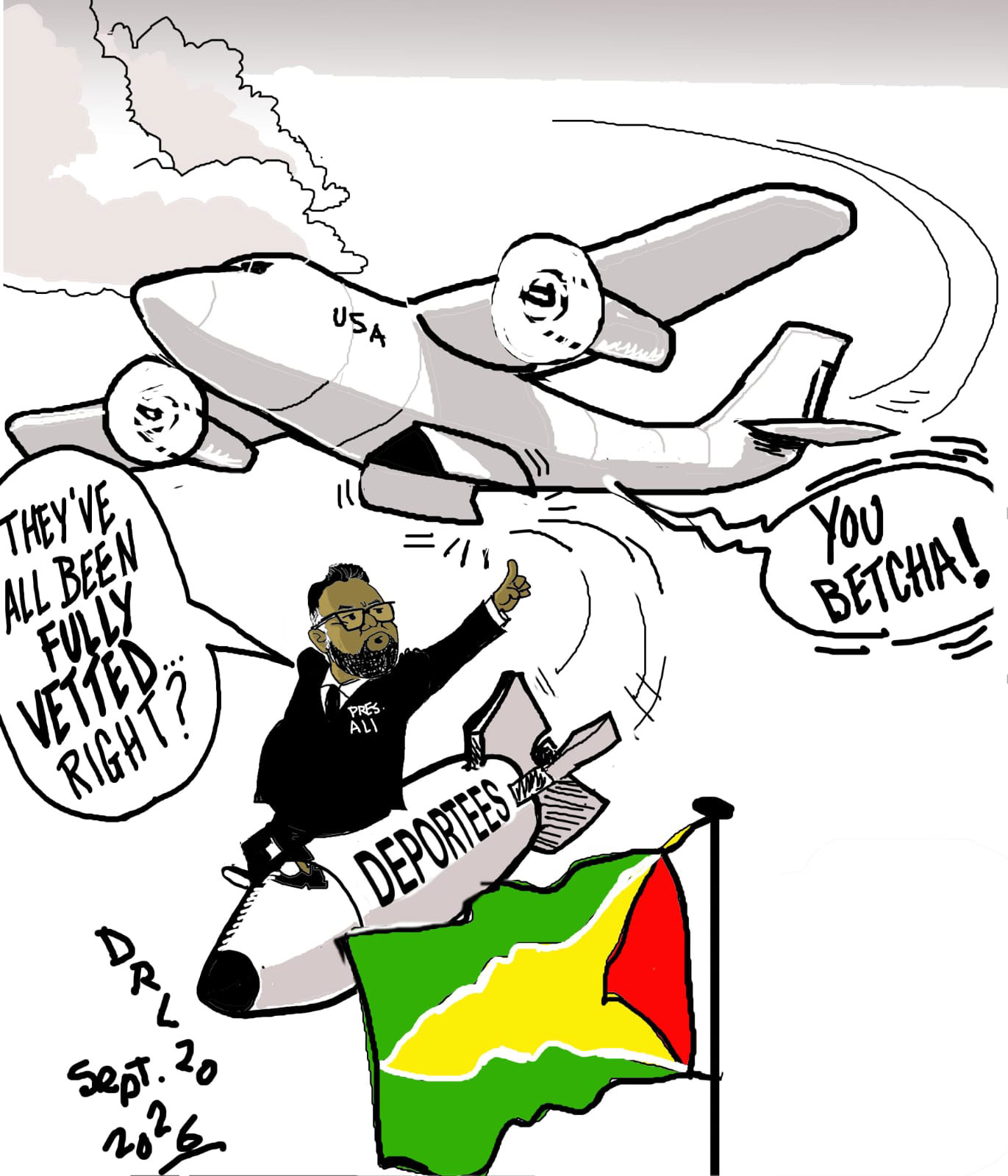


Guyana faces a 15% US tariff, impacting exports and potentially hindering economic growth.