Latest update October 2nd, 2026 7:00 AM


Latest News
- ‘Demon’ denies role in Surinamese men’s disappearance
- PPP activist slaps Rubis pump attendant to ground after she refuses to load gas bottles
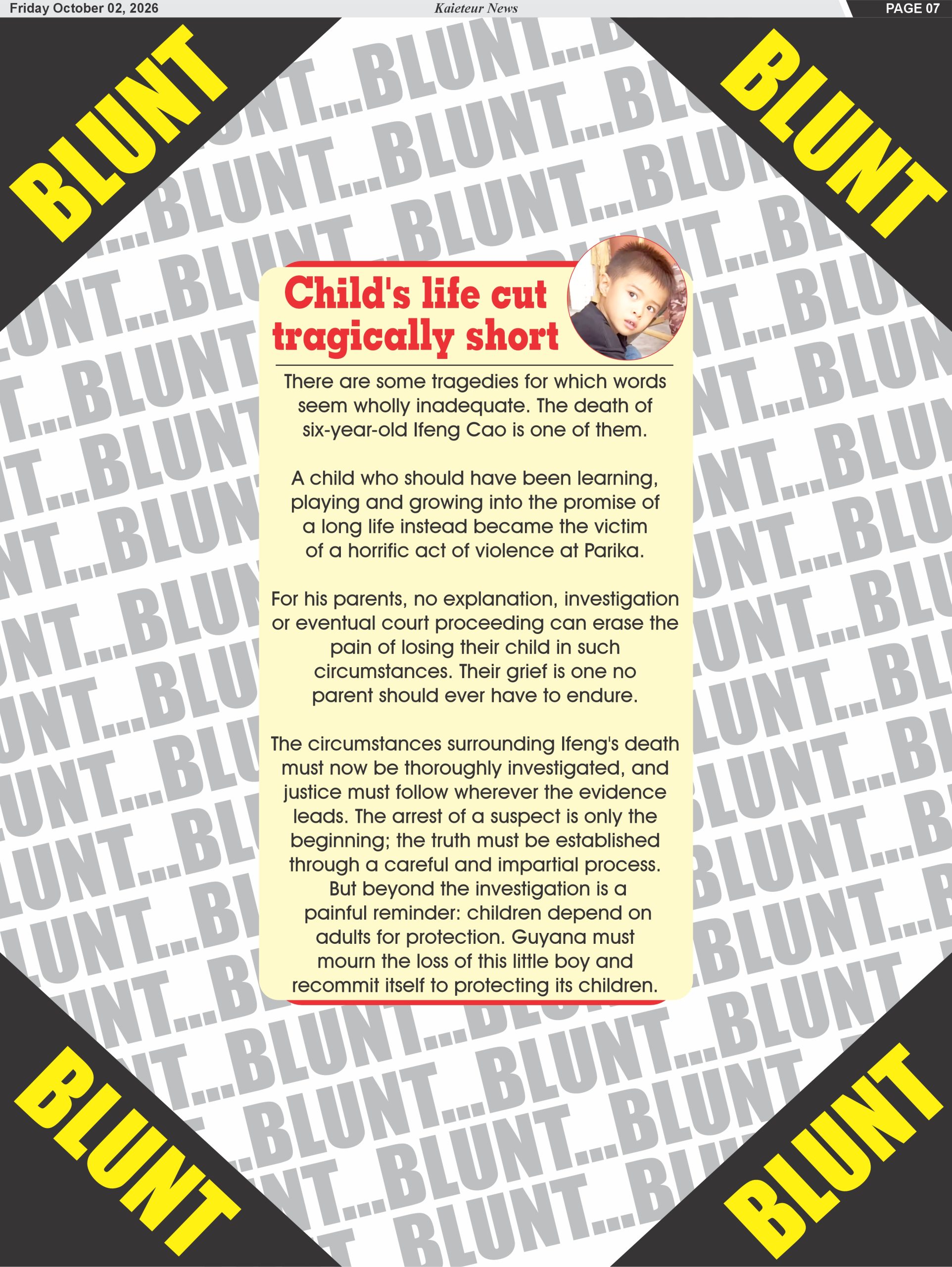
- 76-year-old Chinese businessman admits killing boy, 6, amid US$3M dispute with parents
- Demon’s brother charged with abduction of Surinamese men
- Guyana and France renew air services agreement
Favouritism and mental illness

Dr. Telford Layne Jr.
By Dr. Telford Layne Jr. PsyD, MSc. Postgrad, BSc.
Clinical and Developmental Psychologist – Psychoanalyst
Unwrapping Gift – Clinic
Kaieteur News – One of the primary inhumane treatments that a parent, grandparent, relative, or boss can be meted out by a parent, grandparent, or boss is favouring one child over another. One of my casual thoughts is that the unfavoured child is affected. Little do you know both are and in some cases, the favoured child had the biggest challenges in life compared to the unfavoured child.
Favouritism, both in childhood and in other contexts, can have significant negative impacts on mental health and is long-lasting, even extending into adulthood and potentially leading to depression, anxiety, and low self-esteem. Especially parental favouritism, the significance of its impact on mental health, is a disaster for both favoured and unfavoured children. It can also result in strained relationships, trust issues, and a tendency towards performance anxiety or imposter syndrome later in life. What is more telling is that favouritism becomes a generational trauma. For instance, a preferred child’s spouse and children will also be preferred, whereas the un-favored child’s spouse and kids will continue to hold the legacy of ignorance.
So, what makes favouritism so dangerous is the unfair support shown to one person or group, especially by someone in authority and with reasonability. The unfair support is interrupted, and rightfully so, it feels seen as being betrayed and rejected. It is saying to the unfavoured child that you are not deserving, special, or unique to be accepted and treated fairly. You are not welcome. Unappreciated. Your existence offends.
To the favoured child, being preferred means and can be interpreted as being better than the rest. Their status as humanism is higher for acceptance that you are judged by a different standard and seen differently than others. You are beyond normal to your environment and the people you are with. That you are cared for and protected
Impact on Favored Child:
Pressure and Anxiety:
Favoured children may experience intense pressure to maintain their “perfect” status, leading to performance anxiety and fear of failure. The platform they are put on makes it difficult for them to accept criticism and the challenges of life. They are unable to regulate their emotion and sustain character development.
Distorted Self-Perception:
They might develop a sense of entitlement or struggle with forming healthy relationships due to over-reliance on validation and difficulty with boundaries. Most favourite children develop personality disorders such as antisocial personality disorder and narcissism. Becoming narcissists. Entitled, lacking empathy, and craving the need for administration. Obsession with power, Grandiose. When this is not given, they are made to earn it. Anger management is needed, among other psychological interventions. Paranoid and Obsessive-Compulsive Disorder. Conduct Disorder
Difficulty with Intimacy and relationship:
They may find it challenging to form genuine connections, potentially leading to issues with trust and abandonment. Unable to deal with relationship failures and tend to be transactional in relations. Later in life, even their boyfriends/girlfriends or spouses find them “clingy” and “needy”, eventually separating them. Moreover, the unfavoured child never develops a healthy bond with the “favoured” part even though it is nobody’s fault, nor do they seem to settle in terms of individual relationships, whether romantic or not.
Impact on Non-Favored Child:
Low Self-Esteem and Depression:
Non-favored children may experience feelings of inadequacy, self-doubt, and depression due to perceived lack of parental – affection, acceptance, approval, affirmation, attention and support. I have several clients aged 29 to 47 years old, and they are still fighting to get validation from their parents. To be seen, heard, recognized, and shown that you belong.
Resentment and trust Issus:
They may harbour resentment towards their siblings: bitterness, jealousy, discontent, heartache and even death. Not being the favoured child stings very intently. Poor conflict resolution is a reality of this family environment; the lack of cooperation, unity and support for lacking is very high. Toxicity and mode regulation are problematic in this environment, with the unflavored child being hypervigilant and hyper-sensitive. Favouritism can create deep-seated trust issues, making it difficult for them to form healthy relationships and trust others in the future. The unfavourite child becomes emotionally unavailable and can use silent treatment to punish.
Anxiety: They experience anxiety related to their perceived shortcomings or unfair treatment. Overthinking always creates a worst-case scenario. Restlessness, inability to focus or concentrate. Suicidal ideations.
A home with a favourite child is a toxic and unhealthy environment. Favouritism was introduced into this family by a parent or caregiver struggling with their mental health created by the impact of childhood or adult trauma. Maybe they were once a favourite or unfavorite child. As parents, they cannot regulate their emotions and provide positive parenting. Maybe they are using favouritism to punish a child or a child’s parent. Either way, this adult parent is psychologically struggling while abusing and destroying the lives of family members. Parents who exhibit favouritism may also experience distress, guilt, or difficulty maintaining healthy relationships with all their children.
How to heal:
For the favoured child, psychotherapy is the first step to address possible personality disorders and distortion of self and behaviour towards others. I will cover other aspects of favoured children in the following article.
For the unfavored child or person, psychotherapy is needed. Also, you can use some firsthand approaches and methods to commence your recovery and healing.
Nurture your inner child: – You may want to start with the basics. Start by identifying the child within who feels uncared for. Identify how you can care for and nourish that child now. Say the statements to yourself that you most need to hear from your parents, and you learn to provide yourself with the love, validation, and support that you always needed. Nurturing your inner child also involves remembering you were not at fault — not then, not now.
Understand your parents: – It is not about accepting or justifying hurtful behaviours, but rather the reasons behind those. Think about what your parent(s) must have experienced for them to become an unloving parent. Recognizing that they may have gone through trauma themselves may help you realize that the way they treated you was not personal. Instead, it was a symptom of what they experienced themselves and had nothing to do with you.
Validate your pain: – What you feel is natural, valid, and not uncommon.
“Remind yourself that it is OK to feel exactly how you do. Sometimes, our feelings were not acknowledged or validated in meaningful ways when we were kids, and doing so for ourselves as adults is empowering.
Identify expectations: –
It is a good idea to explore if you are still expecting something from your parents that they cannot provide. Most healing moments for adults who were unloved or unfavourited as a child is when they realize how they were treated reflects the adults who mistreated them, not the children they were. Realizing that there is nothing you can be or does, that may lead your parents to show you love can be a liberating feeling. Being an unloved child is not something you cause or deserve.
Practice self-compassion: – It is not easy to go from self-criticism to self-love, but all self-compassion needs to look like it’s trying not to put ourselves down.
Share this:

Discover more from Kaieteur News
Subscribe to get the latest posts sent to your email.
Similar Articles
Website Hits

Blunt of the day
Sports

Features/Columnists

Sir. Ronald Sanders

The GHK Lall Column

Weekend Cartoon