Latest update October 2nd, 2026 10:27 AM


Latest News
- Chinese businessman confesses to killing boy, 6, over US$3M dispute with parents
- Guyana’s oil reserves drop below 11B barrels – Exxon says
- Mazaruni prison officers rescue miner after boat mishap
- NIS pensioners allegedly owed arrears since 2021
- ‘Calls grow for Karimbaksh to go’ – Opposition parties, several groups urge independent probe into rape allegations
This Day in History -October 16
Compiled by Zena Henry
The Great Hurricane of 1780 struck the Caribbean, killing thousands
Kaieteur News – The Great Hurricane of 1780, also known as ‘Huracán San Calixto’, ‘the Great Hurricane of the Antilles’, the ‘Great Hurricane of the West Indies’, and the ‘1780 Disaster’, was the deadliest Atlantic hurricane on record.

Countries affected by the hurricane except Bermuda
An estimated 22,000 people died throughout the Lesser Antilles when the storm passed through the islands from October 10 to October 16. Specifics on the hurricane’s track and strength are unknown, as the official Atlantic hurricane database only goes back to 1851.
The hurricane struck Barbados likely as a Category 5 hurricane, with at least one estimate of wind speeds as high as 200 mph (320 km/h), (greater than any in recorded Atlantic basin history) before moving past Martinique, Saint Lucia, and Sint Eustatius, and causing thousands of deaths on those islands. Coming in the midst of the American Revolution, the storm caused heavy losses to the British fleet contesting for control of the area, largely weakening British control over the Atlantic. The hurricane later passed near Puerto Rico and over the eastern portion of Hispaniola, causing heavy damage near the coastlines. It ultimately turned to the northeast and was last observed on October 20 southeast of Atlantic Canada.
Cuban Missile Crisis begins as photos are taken of nuclear missiles in country
The ‘Cuban Missile Crisis’ was a 35-day (16 October – 20 November 1962) confrontation between the United States and the Soviet Union, which escalated into an international crisis when American deployments of missiles in Italy and Turkey were matched by Soviet deployments of similar ballistic missiles in Cuba. Despite the short timeframe, the ‘Cuban Missile Crisis’ remains a defining moment in US national security and nuclear war preparation. The confrontation is often considered the closest the Cold War came to escalating into a full-scale nuclear war.

U.S. Naval Squadron off the coast of Cuba in October of 1962. (GETTY IMAGES)
In response to the presence of American Jupiter ballistic missiles in Italy and Turkey, and the failed ‘Bay of Pigs’ Invasion of 1961, Soviet First Secretary Nikita Khrushchev agreed to Cuba’s request to place nuclear missiles on the island to deter a future invasion. An agreement was reached during a secret meeting between Khrushchev and Cuban Prime Minister Fidel Castro in July 1962, and construction of a number of missile launch facilities started later that summer.
Meanwhile, campaigning for the 1962 United States elections was underway, and the White House denied charges for months that it was ignoring dangerous Soviet missiles 90 miles (140 km) from Florida. The missile preparations were confirmed when a US Air Force U-2 spy plane produced clear photographic evidence of medium-range R-12 (NATO code name SS-4) and intermediate-range R-14 (NATO code name SS-5) ballistic missile facilities. When this was reported to President John F. Kennedy, he then convened a meeting of the nine members of the National Security Council and five other key advisors, in a group that became known as the Executive Committee of the National Security Council (EXCOMM). During this meeting, President Kennedy was originally advised to carry out an air strike on Cuban soil in order to compromise Soviet missile supplies, followed by an invasion of the Cuban mainland. After careful consideration, President Kennedy chose a less aggressive course of action, in order to avoid a declaration of war. After consultation with EXCOMM, Kennedy ordered a naval “quarantine” on October 22 to prevent further missiles from reaching Cuba. By using the term “quarantine”, rather than “blockade” (an act of war by legal definition), the United States was able to avoid the implications of a state of war. The US announced it would not permit offensive weapons to be delivered to Cuba and demanded that the weapons already in Cuba be dismantled and returned to the Soviet Union.
After several days of tense negotiations, an agreement was reached between Kennedy and Khrushchev- publicly, the Soviets would dismantle their offensive weapons in Cuba and return them to the Soviet Union, subject to United Nations verification, in exchange for a US public declaration and agreement to not invade Cuba again. Secretly, the United States agreed with the Soviets that it would dismantle all of the Jupiter MRBMs which had been deployed to Turkey against the Soviet Union. There has been debate on whether or not Italy was included in the agreement as well. While the Soviets dismantled their missiles, some Soviet bombers remained in Cuba, and the United States kept the naval quarantine in place until November 20, 1962.
China detonates its first nuclear weapon
Project 596, Chic-1 by the US intelligence agencies was the first nuclear weapons test conducted by the People’s Republic of China, detonated on 16 October, 1964, at the Lop Nur test site. It was a uranium-235 implosion fission device made from weapons-grade uranium (U-235) enriched in a gaseous diffusion plant in Lanzhou.

The mushroom cloud from the test
The atomic bomb was a part of China’s ‘Two Bombs, One Satellite’ programme. It had a yield of 22 kilotons, comparable to the Soviet Union’s first nuclear bomb RDS-1 in 1949 and the American ‘Fat Man’ bomb dropped on Nagasaki, Japan in 1945. With the test, China became the fifth nuclear power in the world and the first Asian nation to possess nuclear capability. This was the first of 45 successful nuclear tests China conducted between 1964 and 1996, all of which occurred at the Lop Nur test site.
Kingston, Jamaica is rocked by the Rodney riots after Walter Rodney is barred from the country
The Rodney riots were riots and civil disturbances in Kingston, Jamaica in October 1968. The riots were sparked by the Jamaican Government of Hugh Shearer banning Guyanese University Lecturer Dr. Walter Rodney from returning to his teaching position at the University of the West Indies.

University Students being pursued by the Jamaican Police
Rodney, a historian of Africa, had been active in the Black Power Movement, and had been sharply critical of the middle-class in many Caribbean countries. Rodney was an avowed Socialist who worked with the poor of Jamaica in an attempt to raise their political and cultural consciousness.
When Rodney attended a Black Writers’ Conference in Montreal, Quebec, Canada in October 1968 the Government took the opportunity to ban him from returning, citing, among other things, trips to Cuba and the USSR as justification.
On learning of the ban, students at UWI, Mona began a demonstration under the leadership of the Guild of Undergraduates, closing down the campus. They then proceeded to march first to the Prime Minister’s Residence, and then to the Parliament Building in Kingston. On the way many more demonstrators joined in, and eventually the disturbance became increasingly violent spreading across the city. Eventually, several people were killed and there were millions of dollars in property damages. The riots were part of an emerging Black Consciousness Movement in the Caribbean, and helped inspire the 1970 Black Power Revolution in Trinidad and Tobago.
The ‘Million Man March’ takes place in Washington, D.C.
The ‘Million Man March’ was a large gathering of African-American men in Washington, D.C., on October 16, 1995. Called by Louis Farrakhan, it was held on and around the National Mall.

1995 ‘Million Man March’ Washington DC
The National African American Leadership Summit, a leading group of civil rights activists and the Nation of Islam working with scores of civil rights organisations, including many local chapters of the National Association for the Advancement of Coloured People (but not the national NAACP) formed the ‘Million Man March’ Organising Committee. The Founder of the National African American Leadership Summit, Dr. Benjamin Chavis Jr. served as National Director of the ‘Million Man’ March.
The Committee invited many prominent speakers to address the audience, and African American men from across the United States converged in Washington to ‘convey to the world a vastly different picture of the Black male’ and to unite in self-help and self-defense against economic and social ills plaguing the African American community. The march took place in the context of a larger grassroots movement that set out to win Politicians’ attention for urban and minority issues through widespread voter registration campaigns.
Share this:

Discover more from Kaieteur News
Subscribe to get the latest posts sent to your email.
Similar Articles
Website Hits

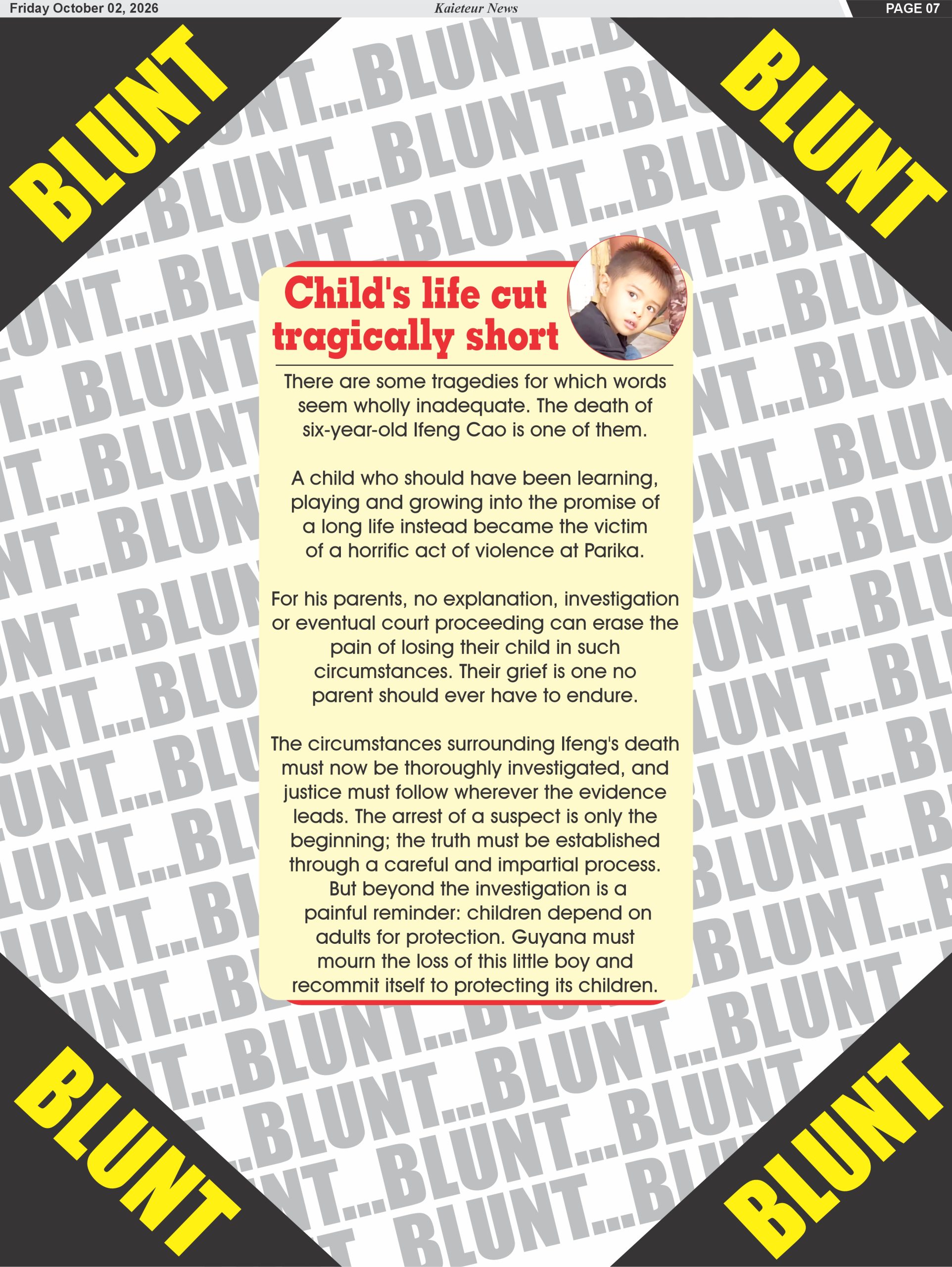
Blunt of the day
Sports
Features/Columnists

Sir. Ronald Sanders

The GHK Lall Column

Weekend Cartoon