Latest update September 5th, 2026 10:33 AM


Latest News
- Govt’s ‘mad man approach’ to borrowing must end – Norton
- British man accused of scamming Guyanese was jailed for fraud in the UK
- Over 90 contractors bid to rebuild Little Diamond-Herstelling NDC office
- WTC director Wesley Kirton rescued from Moblissa swamp
- U.S. pressure on Iran starting to tell, as sanctions and blockade bite
CARICOM DIVIDE MUST BE BRIDGED
By Sir Ronald Sanders
It’s no secret that the countries of the Caribbean Community and Common Market (CARICOM) are divided over the response to the situation in Venezuela.
Detractors of the CARICOM project and Caribbean integration have seized upon the obvious cleavage in the grouping to advance their view that not only is Caribbean integration not possible, it isn’t even desirable.
It might surprise these detractors to know that CARICOM is not the only group of nations in the Organization of American States (OAS) in which division over the response to the situation in Venezuela exists. There is similar division among the members of the Central American Integration System (SICA), comprising 8 countries of Central America and the Dominican Republic, as well as among the members of the Latin American Integration Association (ALADI), consisting of 11 independent countries in South America (except Guyana and Suriname) and Mexico.
For completeness, we should note that Belize is uniquely a full member of both the 14-nation CARICOM group and SICA.
The fact of a different national position on elements of the Venezuela situation is no indication that integration in CARICOM or any other group of countries is fragmenting, or on the verge of collapse.
Each of these groups are made-up of sovereign states. They have the right to act as their governments at the time deem to be in their national interest. While it is wholly desirable – and to their benefit – for all countries in these groups to seek the greatest coherence and unity of action in conducting their external affairs, nothing legally binds them to do so.
In CARICOM’s case, the Revised Treaty of Chaguaramas (CARICOM Treaty) states among its objectives: “enhanced co-ordination of Member States’ foreign and [foreign] economic policies”. The obligation is not for harmonization; it is for “enhanced coordination” which does place an obligation on governments to organize different elements of activity so as to enable them to work together effectively. But, in the end, it does not require them to act in exactly the same way.
The Treaty also provides for the actions of the Council for Foreign and Community Relations (COFCOR). The relevant clauses of the Treaty require Foreign Ministers to: “seek to ensure, as far as practicable, the adoption of Community positions on major hemispheric and international issues; and to co-ordinate the positions of the Member States in inter-governmental organisations in whose activities such States participate”.
In the final analysis, each CARICOM government of the day – like every other government in multilateral and international organisations – acts in accordance with what it considers the national interest as it sees it. The factors that influence what action a government takes in inter-governmental organisations are many. Among them would be: standing up for principle; adhering to international law and norms; respecting the rules and procedures of organisations; and responding to pressure or forms of encouragement from other countries that are capable of punishing or rewarding them.
Those are the facts of life. Undoubtedly, each, or all, of these factors were evaluated by individual CARICOM governments when they adopted positions in the OAS in the debates and votes related to Venezuela. For some governments, being punished or rewarded by powerful countries may have weighed more heavily than other considerations.
In the event, in each of the ballots that have taken place over the last three years in the OAS at the levels of the General Assembly, the Meetings of Consultation of Foreign Ministers and the Permanent Council, CARICOM countries voted differently.
The differences continue now. However, what is at stake in the current OAS situation is no longer Venezuela by or of itself. The issue now directly relates to a movement away from consensus, which has traditionally guided decision-making, to one of imposition of the will of a simple majority. In this circumstance, any 18 of the 34 countries in the OAS can discard rules, procedures, norms and even international law, to achieve their own objectives, and that, regrettably, is what has been happening.
The most blatant manifestation of this troubling development is that the Permanent Council of the OAS, which has no such authority under the Charter of the Organisation or by its own rules, was made by a group of 18 countries to unseat the representative of a government, still in effective control of a country, and to seat the representative of another group proclaimed to be the legitimate government.
It takes two-thirds of the OAS member states to adopt the Organisation’s budget. But a simple majority imposed a decision on what faction in Venezuela is the legitimate government and who the representative to the OAS should be. That, of itself, is alarming.
This development was sharply criticised by 15 member states on procedural and jurisdictional grounds. Among the objections to the vote were that: the Permanent Council acted beyond its authority; the decision should have been handled by either an existing Meeting of Foreign Ministers or the General Assembly; and it violates the OAS Charter and its instruments.
México, and 9 CARICOM countries have formally written to the President of the Permanent Council, pointing out glaring inconsistences in the appointment of Mr. Juan Guaido’s agent as Venezuela’s Permanent Representative and to non-conformity with international law and the normative framework of the OAS. In the case of the 9 CARICOM countries, they have requested that the existing Meeting of OAS Foreign Ministers review this development.
In taking the action, the nine CARICOM countries are standing-up for adherence to international law and norms, and for the Charter and rules of the OAS, for, without them, the rule of the jungle prevails. And that affects every CARICOM country, because they are each too powerless to defend their rights on their own.
That is why, whatever factors determine the position of CARICOM governments, they should all be very cognizant that, in international politics, today’s allies could be tomorrow’s adversaries, but standing-up for principles and the law are permanent and constant values. Those are the shields and swords of small states; they are the factors over which they should cohere in their own interest.
(The writer is Ambassador of Antigua and Barbuda to the United States and the Organisation of American States. He is also a Senior Fellow at the Institute of Commonwealth Studies at the University of London and at Massey College in the University of Toronto. The views expressed are entirely his own)
Responses and previous commentaries: www.sirronaldsanders.com
Share this:

Discover more from Kaieteur News
Subscribe to get the latest posts sent to your email.
Similar Articles
Website Hits

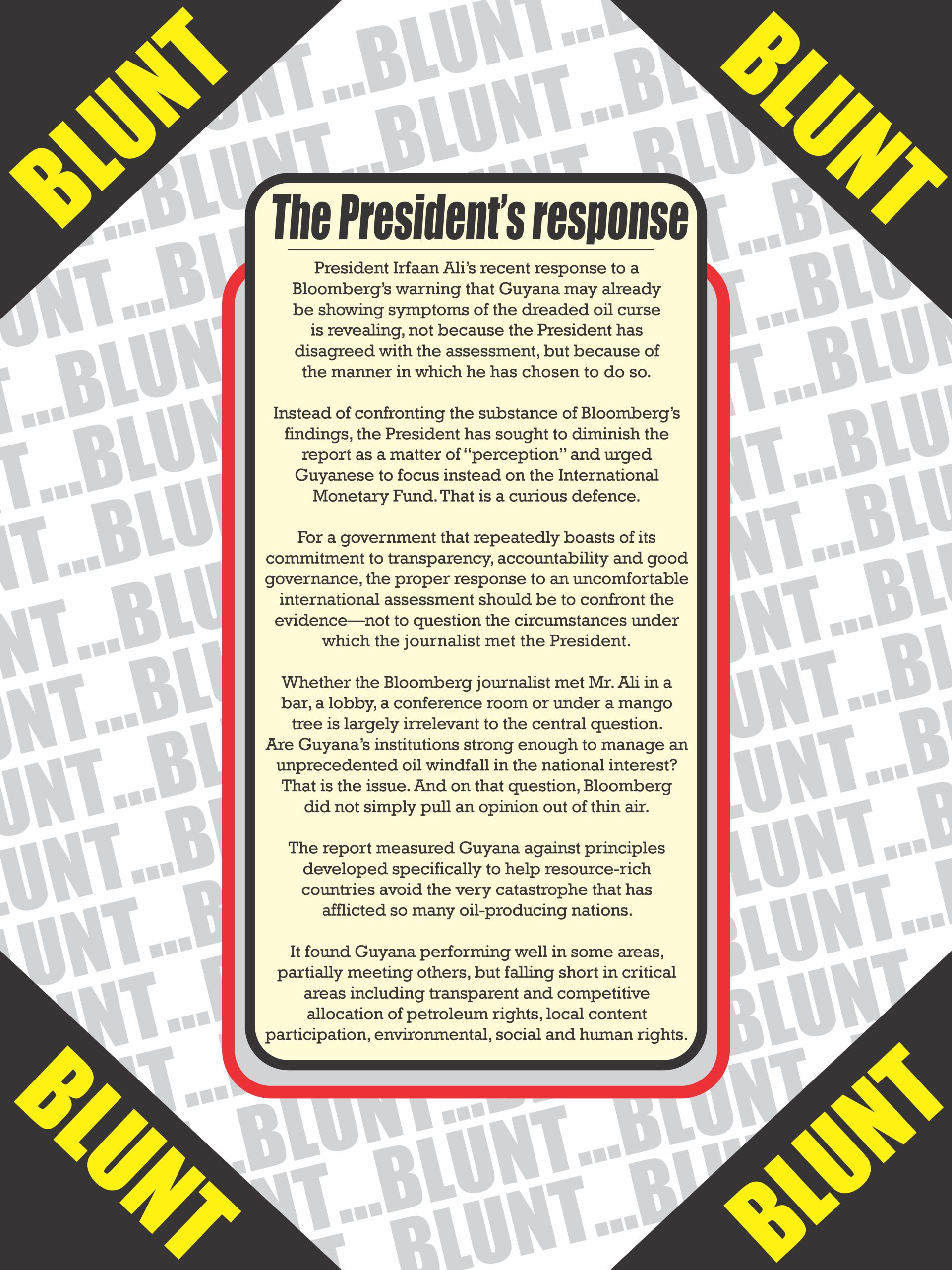
Blunt of the day
Sports

Features/Columnists

Sir. Ronald Sanders

The GHK Lall Column

Weekend Cartoon


