Latest update August 14th, 2026 10:25 AM



Latest News
- ExxonMobil produced one billion barrels of oil in less than 7 years – Routledge
- Canadian firm announces plan to advance, integrate 3.2M ounce gold project with 4.64M Oko West project
- 15-year-old arrested after Corriverton fisherman dies following altercation
- Huge oil spill off the coast of Oman now covers hundreds of square miles
- US$3.6B spent in local companies since 2019 – Exxon
Politics cannot salvage a sunken ship
(Kaieteur News) – There comes a point when politics must give way to practical reality. The fate of the sunken M.V. Barima has now reached that point.
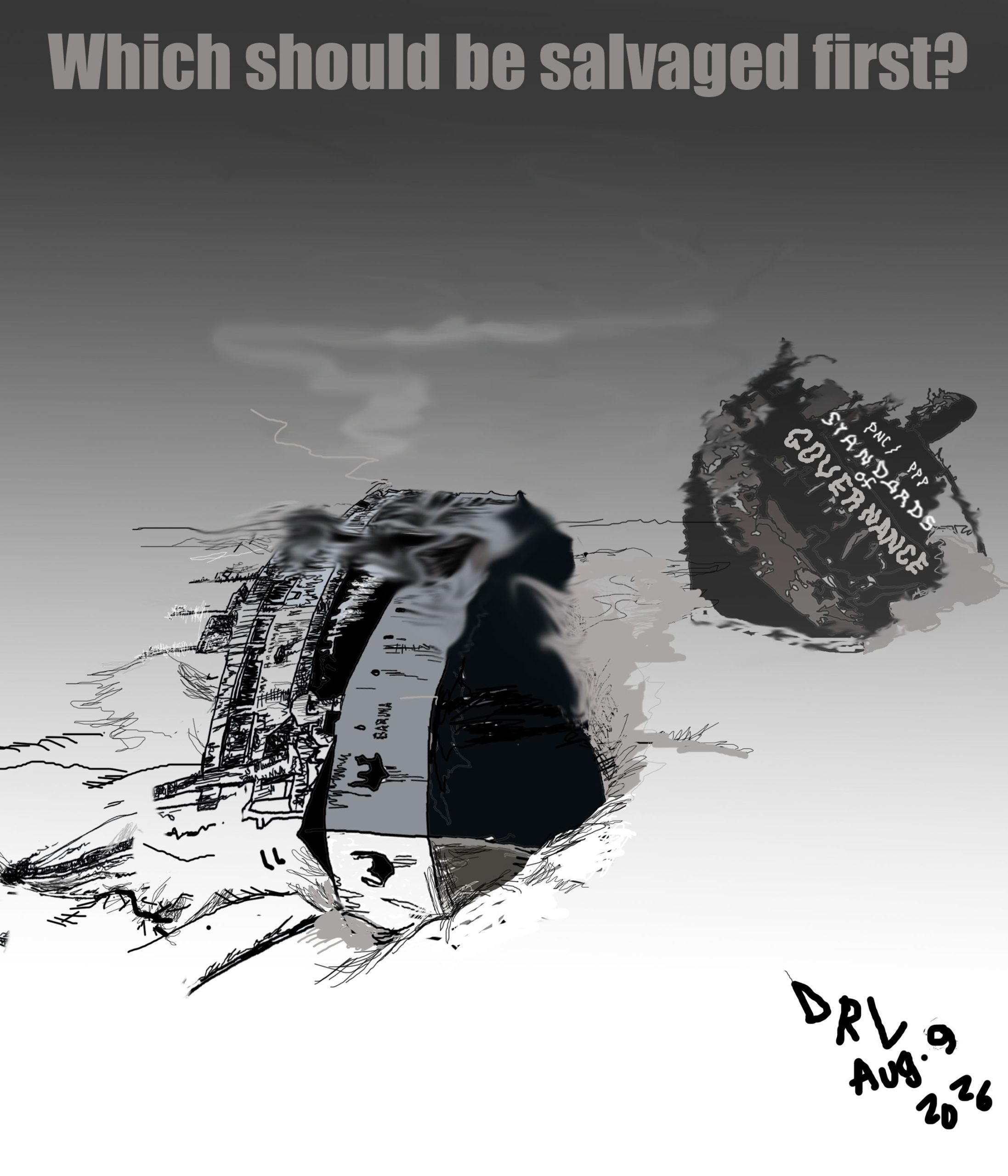
The Leader of the Opposition has publicly offered to salvage, at his expense, the vessel. On its face, that may sound generous, but no serious government would be expected to accept such an offer under the present circumstances.
The reason has little to do with personalities and everything to do with prudence. Governments must protect not only the public purse but also the integrity and reputation of their decisions.
The Leader of the Opposition is subject to sanctions imposed by the United States Office of Foreign Assets Control (OFAC). He is also facing criminal indictments in the United States relating to financial matters.
Whether he is ultimately vindicated or convicted is a matter for the legal process. But while those matters remain unresolved, no responsible government would knowingly accept financial assistance connected to such an individual.
That is not a political judgment; it is the kind of risk assessment that governments around the world routinely make. No administration worth its salt would voluntarily invite those complications into a matter that is already under intense national and international scrutiny.
So let us dispense with this issue of the Opposition Leader’s offer. The real question is not who is offering to undertake or pay for a salvage operation but whether such an operation can even be carried out successfully.
That is a technical question requiring technical answers. It is one for marine engineers, naval architects, salvage specialists and accident investigators.
Everything publicly known about the conditions at the wreck site suggests an extraordinarily difficult operation. The vessel reportedly lies on its side in muddy conditions, with strong tides, heavy siltation and little or no underwater visibility.
Each of those factors presents major challenges by itself. Together they create one of the most difficult environments imaginable for marine salvage.
Time has also become an enemy. The longer a vessel remains submerged, the more deeply it can settle into soft riverbed mud and become partially buried by silt.
Cargo inside the vessel further complicates matters. As weight shifts during any lifting attempt, stresses are placed on sections of the hull that were never designed to bear such loads.
This raises an obvious concern. Could the vessel break apart while being raised?
Marine salvage experts know that this is a real possibility with severely damaged or heavily submerged vessels. When lifting forces are concentrated on sections of a hull, enormous structural stresses can develop.
Lifting may cause the vessel to crack or split. The risk becomes even greater when the vessel is lying on its side and partially embedded in mud.
The suction created by deep mud can itself be formidable. Salvage crews often have to overcome not only the vessel’s weight but also the powerful grip of the riverbed before the wreck can even begin to move.
Even if lifting begins successfully, the cargo inside may shift unpredictably. Such movement can suddenly alter the vessel’s centre of gravity and place additional strain on an already fragile structure.
Engineers therefore proceed with extreme caution in such circumstances. Every cable, lifting point and buoyancy calculation must be carefully designed to avoid catastrophic failure.
There is another dilemma that deserves equal attention. Investigators must preserve evidence while salvors seek to recover the wreck.
The condition of the hull could provide important clues about the vessel’s seaworthiness before it sank. Damage patterns may also assist investigators in determining whether structural failure occurred before or after the sinking.
A difficult salvage operation could unintentionally destroy that evidence. If the vessel fractures during recovery or has to be cut into sections before removal, important forensic information may be permanently lost.
Sometimes there is no perfect solution; recovering the vessel may preserve some evidence while destroying other evidence in the process. That is precisely why decisions of this nature require careful balancing of engineering realities, investigative needs and public safety.
It is remotely possible that salvage specialists may ultimately conclude that recovery is feasible. It is more likely that they may determine that recovery would require dismantling the wreck piece by piece because raising it intact presents unacceptable technical risks.
Either conclusion should be based on science rather than politics. Public confidence depends upon decisions being guided by professional expertise rather than public pressure.
The nation deserves answers about what happened to the M.V. Barima. Those answers will come from careful investigation, not from political gestures.
The government does not require financial assistance to make the necessary decisions. Least of all does it need funding from a political leader whose has his own lega problems inside and outside of the country.
This tragedy calls for expertise and sober judgment. In the end, engineers, not politicians, will determine whether the M.V. Barima can be safely recovered without sacrificing the very evidence needed to establish the truth about what really caused the vessel to capsize and sink.
(The views expressed in this article are those of the author and do not necessarily reflect the opinions of this newspaper.)
Share this:

Discover more from Kaieteur News
Subscribe to get the latest posts sent to your email.
Similar Articles
One thought on “Politics cannot salvage a sunken ship”
Leave a Reply

Blunt of the day
Sports

Features/Columnists

Sir. Ronald Sanders

The GHK Lall Column

Weekend Cartoon


It was great of you to dismiss AZMo’s insensible & desperate offer which is not feasible , practical or legally right due to his “extradition’ court issue in regard to his financial crimes in Guyana & the US!!! He is a wanted man in the US for these serious financial & other crimes!!! Stupidly he felt he could evade the “extradition court case” in Guyana in light of the CCJ’s ruling to proceed with the case, by engaging the government with the assistance to salvage the M V Barima wreckage at the bottom of the Ocean!!! This is a case of desperation!!!
A bull sensing he is going to slaughter house”!!!
An incisive article examining all the ramifications before a sensible decision is made!!!