Latest update August 12th, 2026 10:20 AM



Latest News
- After 10 days of silence, Govt. confirms Guyana receiving 50% profit share
- Guyana must get more than 50% if country’s profits will be funding new oil projects – MP Andrews
- MV Barima tragedy… Internal records expose months of warnings, request for urgent repairs
- Colombia quake death toll tops 250 as rescuers race to find survivors
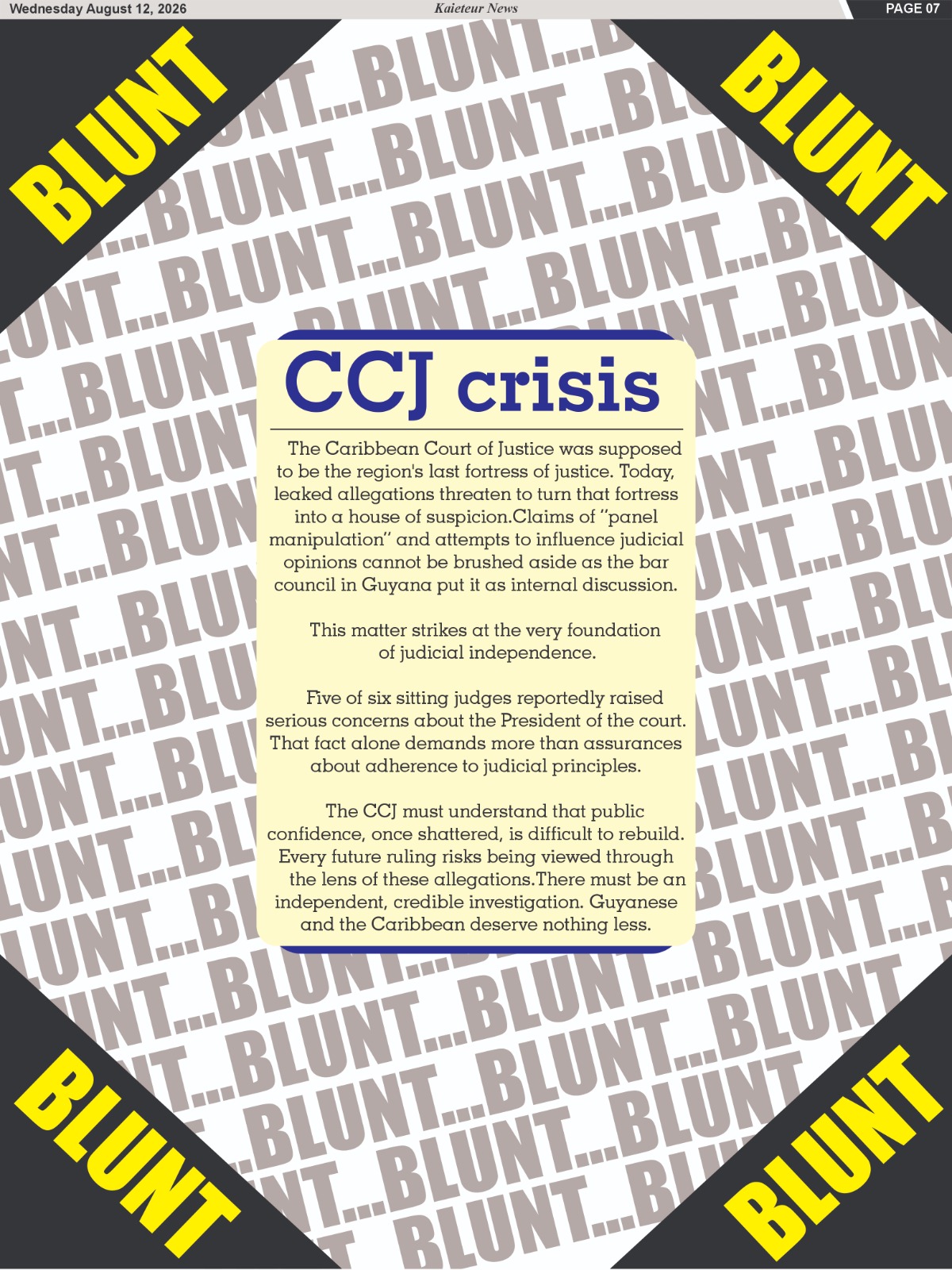
- Caribbean judiciaries rally behind CCJ as internal row erupts
Mistaking the symptom for the cause
(Kaieteur News) – The anti-government critics argue that over the past five years of strong economic growth, income gains have not been evenly shared. That claim sounds straightforward, but it risks oversimplifying how modern economies, especially developing ones, actually function.
It is also important to recognise that growth rarely translates into identical outcomes for all citizens, and measuring fairness only through income distribution ignores broader development realities such as access to services and opportunities created during expansion. Even in the most socialist systems, income distribution is never perfectly equal because differences in skills, geography, access to education and political structures always create variations.
Instead, those governments attempt to balance this reality by providing extensive subsidized or free social services such as health, education, housing, electricity, water food and transportation that raise the living standards of lower-income groups. In practice these services often matter more than direct income equality when assessing how fair a society really is.
A household with lower cash income may still enjoy decent living conditions if healthcare education and transport are affordable or free at the point of use. For a country in the early stages of developing a petro-economy, income distribution is almost always skewed toward certain sectors and skill groups.
This is because oil-driven growth creates rapid demand for specialised labour imported services and capital-intensive industries that do not immediately benefit all citizens equally. Oil wealth tends to circulate first through multinational firms and high-skilled employment before it reaches the broader population.
This pattern is not unique to any one administration but reflects the structure of commodity-based growth where revenue flows through concentrated channels. But the critics ignore this in favour or arguing that it is biased and discriminatory government that is responsible for unequal income distribution.
They mistake the symptom for the cause. What sustains unequal income distribution over time is not simply the ruling party but the prevailing neoliberal economic philosophy.
This philosophy emphasises market efficiency, liberalisation, fiscal restraint and foreign investment even when these choices can widen income gaps. Neoliberal economics prioritizes private sector led growth, deregulation and incentives for investors as the main drivers of development.
In such a system, governments often reduce direct intervention in pricing, wages and production which can increase inequality across different groups. Because capital and investment are rewarded more quickly than labor income, wealth accumulates faster at the top of the distribution.
Over time this leads to structural gaps where certain sectors and individuals consistently outpace others regardless of overall growth performance. In Guyana this philosophy is not confined to one political party but is shared across the political spectrum. So, merely changing parties will not solve the problem. All of Guyana’s parliamentary parties are part of the neo-liberal flock.
As a result, policy debates often differ in tone but not in their underlying commitment to market driven development strategies. The real challenge is therefore not to deny inequality but to understand its sources and manage it through better policy choices.
Only by recognising both structural constraints and policy options can a society pursue growth that is both strong and broadly shared. Another issue with the argument about five years of high growth paired with inequality is that it treats growth as a simple statistic rather than a complex process that unfolds unevenly across time and sectors.
Different industries expand at different speeds and wages respond with a delay so short-term distributional snapshots can give a misleading picture of long-term structural change. It is also important to separate perception from policy outcomes because inequality in income does not automatically mean absence of redistribution efforts.
Many governments actively redistribute through taxes reforms, subsidies, and cash grants, even if gross income differences remain visible in official statistics. In more ideological terms some critics overlook that equality can be achieved in different dimensions and not only through cash income.
Access to quality public goods such as education and healthcare can equalize life chances even when earnings differ significantly. In petro economies government revenue often expands rapidly but institutional capacity to distribute benefits evenly tends to lag behind. This lag creates visible concentration of wealth in urban areas and in sectors directly connected to oil production and services.
Different metrics can therefore lead to different conclusions about inequality outcomes. And instead of merely being critical, critics should say what needs to be done and from this we will know what side of the ideological divide they sit.
(The views expressed in this article are those of the author and do not necessarily reflect the opinions of this newspaper.)
Share this:

Discover more from Kaieteur News
Subscribe to get the latest posts sent to your email.
Similar Articles

Blunt of the day
Sports

Features/Columnists

Sir. Ronald Sanders

The GHK Lall Column

Weekend Cartoon