Latest update September 21st, 2026 2:51 PM


Latest News
- Three killed in Baramita clash
- Defense accuses Police of misrepresenting court testimony, Magistrate says court unfazed by media
- Mohamed alleges political hand behind review of Justice Persaud’s U.S. visa
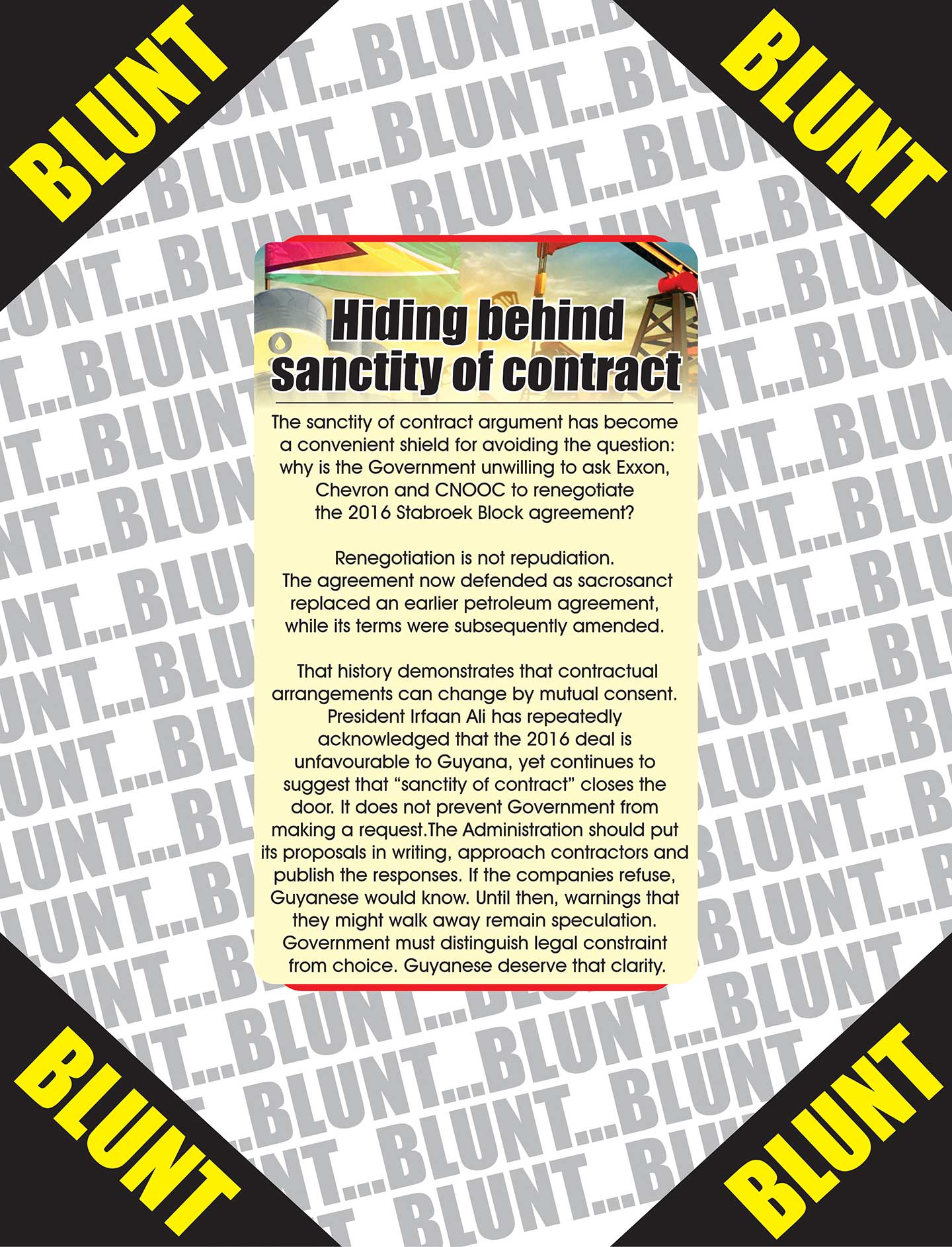
- ‘Stop blaming ‘sanctity of contract’ for keeping 2016 oil deal – Chris Ram tells Pres. Ali
- Iran and U.S. trade threats after Houthi attacks escalate regional conflict
The Vice President must smell the air
(Kaieteur News) – For many of us, the cinematic portrayal of elderly care provides an image of dignified spaces where private rooms open onto lush gardens, and communal areas–such as dining and recreational rooms – hum with quiet activity. These images, common in films from the developed world, are not mere fiction. They reflect a standard of care and a philosophy of aging that prioritizes some amount of privacy, respect, and quality of care.
In Guyana, however, the reality for too many of our elders is a stark and heartbreaking contrast. Elderly homes are often a world of either open wards with no privacy or crowded rooms, inadequate facilities, and an overwhelming institutional smell that signals a loss of personhood.
The recent announcement by the Vice President that the government will support daycare and elderly care facilities is therefore a welcome recognition of a deep and growing need. But support must be strategic and visionary.
The immediate, intuitive response—to divert public funds to bolster existing charitable homes—is a well-intentioned but fundamentally flawed approach. It risks perpetuating a cycle of mediocrity, using taxpayer dollars to subsidize substandard conditions. And worse, it stultifies the very concept of corporate, personal and community social responsibility.
When the government steps in as the primary financier of private charitable facilities, many of which already raise significant donations, it sends a dangerous message. It tells corporations and philanthropic citizens that their responsibility ends at a donation drive, absolving them of the need to invest in substantive, infrastructural improvements. It tells facility managers that the goal is mere sustenance, not transformation.
Charity becomes not a springboard for excellence, but a crutch for the status quo. We cannot donate our way to dignity. Dignity must be architected, legislated, and built.
Instead, the government’s role should be that of a standard-setter and a pioneer. The State must build what it wants to see. It should construct, perhaps on the very grounds of the Palms or on new land, a first-world model elderly care home. This would not be another monolithic institution, but a humane community that embodies best practices.
Many years ago, I saw a clip of a private company bring in small containerized homes which they planned to sell to miners in the interior. The cost was reasonable, then about $1.4 M. Today the cost would be a cheaper.
These units could be turned into elevated, containerized individual apartments. They offer a practical, scalable, and dignified solution. They offer a private space for a bed, small sitting area, a kitchenette, and bathroom. With many small units like these, arranged in community clusters with shared dining, medical, and recreational pavilions, we can lift the standard of local elderly care. This model directly attacks the core indignities of lack of privacy, the institutional smell and the crowded clutter of residents’ room.
Such a facility would serve a dual purpose. First, it would provide an immediate, transformative home for a segment of our population, particularly the most vulnerable who currently endure the open wards of the Palms, the Amerindian Hostel, or the Night Shelter—places where some are in need of hospice care and find only custodial holding.
Second, and just as critically, it would establish an irrefutable benchmark. It would show Guyanese citizens, private investors, and charitable boards what is possible. It would make the cinematic standard a Guyanese reality. This model home would become a demonstration project that raises the aspirations of elderly care.
The government can no longer justify open wards by pleading limited resources. When a State model demonstrates an affordable, dignified alternative, this will also help lift private elderly care standards. Corporate social responsibility would be redefined: it would no longer suffice to write a cheque to a substandard home; true responsibility would involve funding the replication of the model’s private units, its therapeutic gardens, or its trained staff.
In this way, the paradigm shifts. The government’s role shifts from subsidizing failure to catalyzing excellence.
The Vice President’s announcement is the starting pistol. The next step must be a visit, not just a photo opportunity, to State-run and private elderly homes. The Vice President must smell the air and witness the erosion of privacy. From that sobering experience must spring a resolve not to patch and prop, but to revolutionize.
As the government channels resources into new sectors and infrastructure, it must ask itself what development truly means. The government itself concedes that development must be measured by how we treat our most vulnerable at the twilight of their lives.
The solutions are evident like container homes for the elderly that provide greater privacy and their own washroom and private areas. We have the need, painfully evident.
Now we need the political will to build a new standard—not in a movie, but on Guyanese soil—to prove that a society’s greatness is reflected in the dignity it grants its elders. Let us build that model, and let the private elderly homes follow suit.
(The views expressed in this article are those of the author and do not necessarily reflect the opinions of this newspaper.)
Share this:

Discover more from Kaieteur News
Subscribe to get the latest posts sent to your email.
Similar Articles
Website Hits

Blunt of the day
Sports
Features/Columnists

Sir. Ronald Sanders

The GHK Lall Column
Weekend Cartoon