Latest update September 3rd, 2026 10:25 AM


Billion-dollar exploration bill
(Kaieteur News) – Guyana is a ‘world-class’ find for ExxonMobil, and it comes with all of the bona fides of a once-in-a-lifetime occurrence. Grab onto it when it falls into the hands, and never let go. Wring it for all that it’s worth, squeeze every ounce of richness out of it.
ExxonMobil has a history of knowing exactly what to do when such circumstances are theirs, and the controlling hand belongs to the descendants of the old Standard Oil Trust. The founders and early pioneers weren’t called “robber barons” on an impulse, and they deserved that derogatory identifying mark in its every letter. Over a hundred years later, ExxonMobil is operating with the freest of free hands in suddenly oil-rich Guyana, and with that comes a big bill, one of many with that size, an exploration total for a gigantic US$2.266B.
The world of oil exploration and its related charges are a mystery to the Guyana Government, with very few Guyanese having any understanding beyond the superficial relative to what that covers, how that works, how the costs are arrived at. There was one Guyanese, Dr. Vincent Adams, the then Executive Director of the Environmental Protection Agency, who knew enough, perhaps too much from ExxonMobil’s point of view, and that was the end of his tenure. It has been the kind of partnership that prospers between the Guyana Government and the US multinational corporation early on.
Meanwhile, the oil exploration bills have grown to an enormous US$2.66B, what can’t be questioned, what can’t be touched, because Guyanese are in the dark, don’t have a clue of how much of those bills are genuine and how much represents possible padding on a massive scale.
The comparison was made between the total royalties Guyana has collected so far for its oil, and it is less than a US$1B six years after oil production began offshore. When looked at with a sharply critical eye, there is little strength in denying that ExxonMobil may have found and perfected an additional cost recovery regime. In other words, it could be that the 2% royalties and questionable half and half profit sharing split paid by ExxonMobil to Guyana are partially recovered under the camouflage of exploration costs.
When so much of Guyana’s oil business, the inherited patrimony of Guyanese, has been hidden from citizens, and is a mystery to them, then what better opportunity can there be than to work and rework US billions in exploration costs to the advantage of those doing the billing?
When members of an audit team are blocked from areas on an offshore oil platform under the full control of ExxonMobil, then it is a strange and sinister kind of partnership that is in operation. Why was such blockage, such concealment, necessary, what was there to hide, when it is one’s own partners who are on the premises? When there’s ongoing disagreement about tax receipts, and the maze that is erected to hide from Guyanese, the owners of the nation’s oil wealth, what has happened, then all manner of skepticisms arises about that US$2.66B exploration bill for the six years since oil went into production in Guyana’s waters. It is a black hole of uncertainty for Guyanese, but a probably rich motherlode for ExxonMobil.
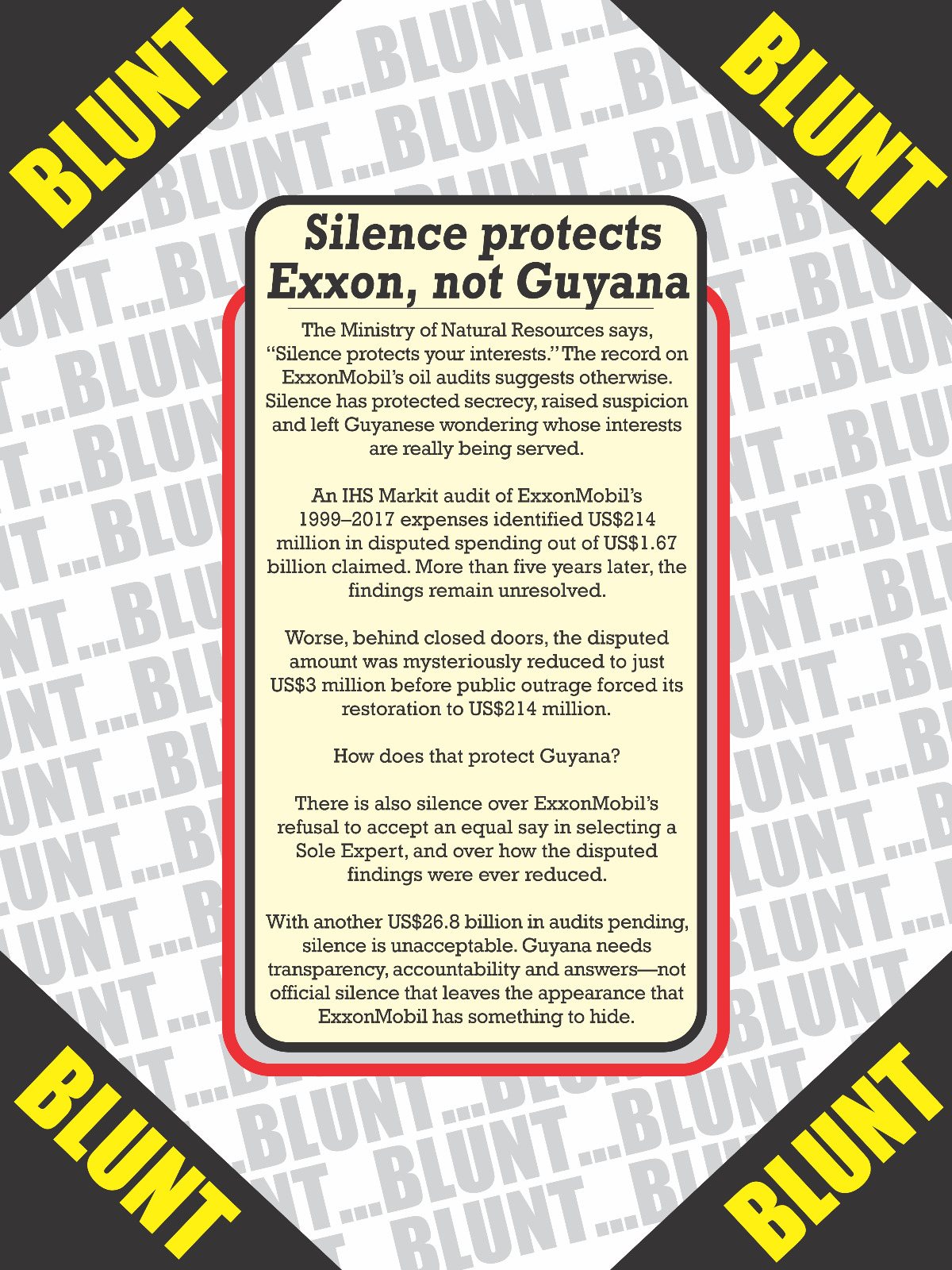
Who is interested in knowing, checking, probing for the substance that prop up those exploration bills? There have been three audits of ExxonMobil expenses, and the results of them are all suspended higher than the new Demerara River Bridge. The quality of audits has been questioned, with the requisite skills of the auditors put under the spotlight. The seriousness of the PPPC Government has been called into question, with a finger pointed at its willingness to be more for ExxonMobil’s interests, than what benefits Guyanese.
The standing practice of the government has been ‘don’t do anything to rock ExxonMobil’s boat’. The deep local impression is that whatever the price that Guyanese have to pay to keep the US oil behemoth happy, then it will be paid. Total exploration costs are now bigger than some past national budgets, and it’s business as usual in Guyana.
ExxonMobil controls a world-class oil treasure in Guyana. Exploration costs are one of the bigger gems.
Share this:

Discover more from Kaieteur News
Subscribe to get the latest posts sent to your email.
Similar Articles
Website Hits

Blunt of the day
Sports

Features/Columnists

Sir. Ronald Sanders

The GHK Lall Column

Weekend Cartoon


