Latest update August 16th, 2026 10:20 AM



Latest News
- Four more oil discoveries in Guyana likely to go “above and beyond what we thought were opportunities” – Exxon CEO
- Disgraceful for VP Jagdeo, Min. Bharrat to allow citizens to rely on Exxon for updates on recovery of all investments – Christopher Ram
- Linden chef killed in Soesdyke-Linden accident
- Rapid expansion in Guyana could add 307MW daily by 2030 – GPL
- Powerful magnitude 7.7 earthquake kills at least 47 in Indonesia
Sovereignty, Protection, and the Extradition Debate: A Test of Guyana’s Legal and Moral Architecture
Dear Editor,
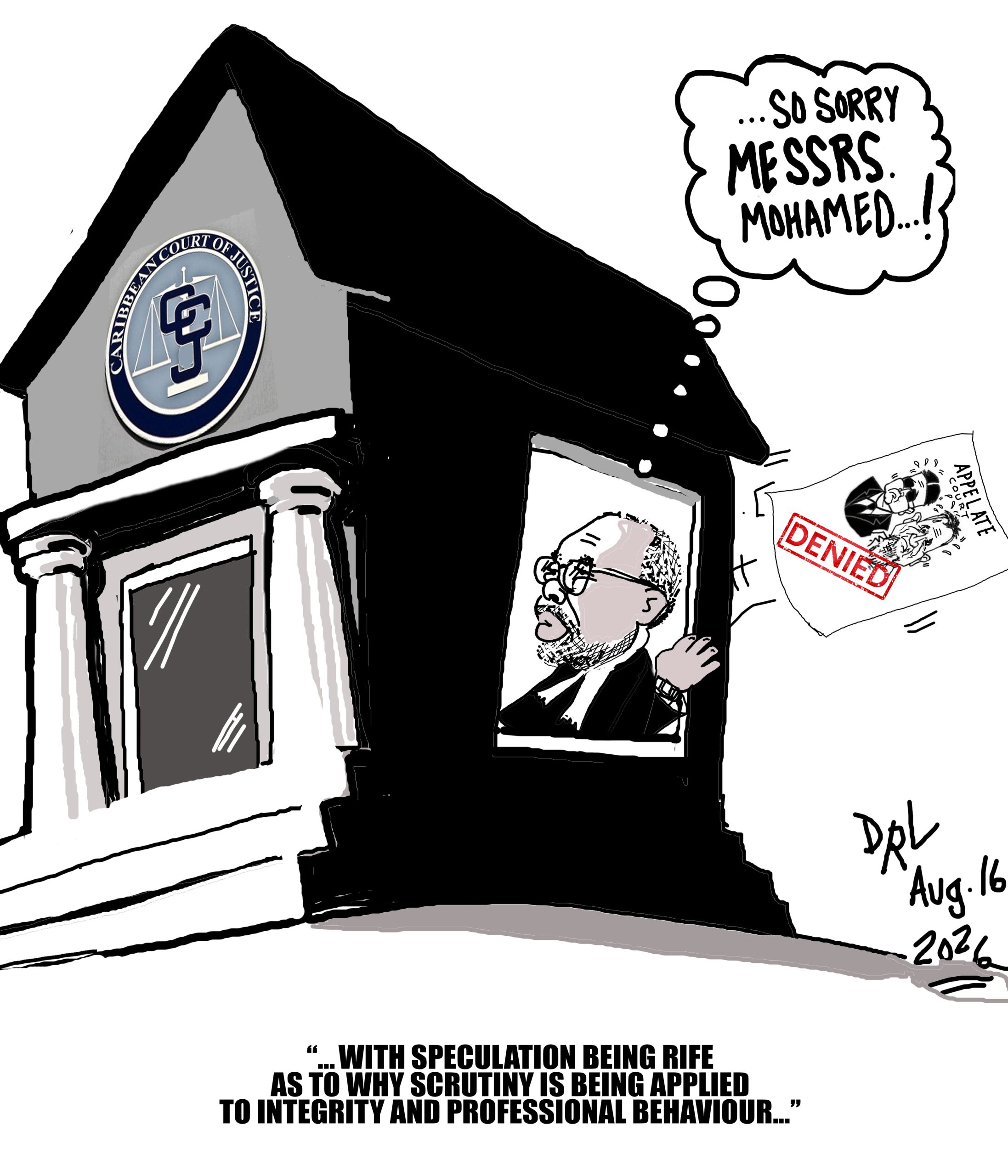
In the wake of the U.S. indictment and possible extradition proceedings involving Mr. Nazar and Mr. Azruddin Mohamed, I wish to contribute a perspective rooted in both constitutional principle and international legal practice.
This letter does not seek to defend or condemn any individual. Its purpose is educational: to situate the matter within the broader framework of what every State owes its citizens, and what the international system expects of sovereign nations.
The State’s Core Duty of Protection
The first and most sacred duty of any State is protection: the safeguarding of life, liberty, and property for each citizen under its jurisdiction. This duty is codified not only in moral terms but also within constitutional and international instruments. When a State fails in this protective function, whether by omission, collusion, or external submission, it compromises its own legitimacy and weakens its sovereignty. The Guyana Constitution reinforces this protective principle in several ways.
Article 138 guarantees protection of the right to life.
Article 139 ensures personal liberty except by due process of law.
Article 149D and related clauses guarantee equality before the law and freedom from discrimination. Article 154A, introduced in the 2003 reforms, directly incorporates international human rights instruments into domestic law, including the International Covenant on Civil and Political Rights (ICCPR), which Guyana ratified in 1977. These provisions establish that every citizen enjoys protection not only from private harm but from any action of the State that jeopardizes liberty without fair process.
Domestic Law and Extradition
Guyana’s extradition regime operates under the Fugitive Offenders Act (1988, amended 2024) and through bilateral treaties, including the U.S.–U.K. Extradition Treaty (1931), which continues to apply to Guyana as a successor state. That treaty and domestic statute provide for extradition only when the alleged offences are criminal in both jurisdictions and where judicial oversight is guaranteed.
However, under Section 13 of the Act, extradition shall be refused if it appears that the request is “politically motivated” or if the person is “sought for the purpose of prosecuting or punishing him on account of his race, religion, nationality, or political opinions.” This clause directly echoes Article 3 of the European Convention on Extradition (1957) and similar provisions globally, reflecting an international consensus that extradition must not be used as a tool of political persecution.
Thus, while the Executive may receive and process an extradition request, the final determination belongs to the judiciary. The High Court and Court of Appeal remain the constitutional buffers against arbitrary surrender of citizens to foreign jurisdictions.
Any deviation from that process would amount to a constitutional breach.
Guyana’s International Obligations
Although Guyana has not acceded to the 1951 Convention Relating to the Status of Refugees nor its 1967 Protocol, it is bound by the ICCPR and the Convention Against Torture (CAT)—both of which impose duties to prevent the transfer of any person to a country where they may face persecution, torture, or denial of due process.
This duty, known as non-refoulement, has achieved the status of customary international law, binding even on non-signatory states.
The UN Human Rights Committee, in its 2020 and 2023 observations on Guyana, noted with concern the absence of national asylum procedures and warned that deportations or extraditions undertaken without safeguards could violate Articles 6 and 7 of the ICCPR (the rights to life and to freedom from torture or cruel, inhuman, or degrading treatment).
Thus, Guyana’s international reputation depends not merely on cooperation with powerful states, but on upholding these universal norms. Diplomats and international observers judge sovereign maturity not by compliance alone, but by balance: fidelity to law and protection of citizens’ rights.
The Political and Diplomatic Context
International law recognizes that extradition can be politicized. States have at times softly facilitated the exit of individuals deemed inconvenient, often to avoid domestic controversy while signaling cooperation abroad.
Latin American history provides numerous examples—from Peruvian politician Víctor Raúl Haya de la Torre’s asylum in the Colombian embassy in 1949 to modern instances where dissidents were permitted to “leave quietly” under diplomatic arrangements.
Such actions, however, come at a reputational cost: they suggest that the State prefers expedient diplomacy to principled governance. In Guyana’s case, this perception would be particularly damaging, as our legal institutions are still consolidating post-colonial independence and regional credibility.
The Way Forward
Given these domestic and international parameters, I respectfully submit that the government’s handling of the Mohamed case must adhere to the following principles:
- Judicial Independence: No extradition should proceed without exhaustive judicial review. Political expedience must yield to constitutional duty.
- Transparency: The public deserves to understand the process and reasoning behind any extradition decision, as secrecy breeds suspicion.
- Reciprocity and Fair Trial Guarantees: Guyana must demand explicit written assurances from the requesting state concerning humane treatment, access to counsel, and fair trial.
- Protection from Political Retaliation: Where the accused’s political or business connections create potential conflict of interest, an independent oversight mechanism should be established.
- Legislative Reform: The absence of asylum and refugee laws is a glaring gap. Parliament should enact comprehensive legislation incorporating non-refoulement and political asylum safeguards, thereby strengthening both sovereignty and reputation.
Conclusion
The extradition of any citizen is not a simple administrative act; it is a test of the Republic’s legal and moral architecture. Guyana must show that it can cooperate internationally without compromising the protective core of citizenship.
If the State abandons that duty, citizens may seek protection elsewhere.
But if the State upholds both justice and sovereignty, it earns the respect of its people and the world alike.
Respectfully
Dr. Walter H Persaud
Share this:

Discover more from Kaieteur News
Subscribe to get the latest posts sent to your email.
Similar Articles

Blunt of the day

Sports

Features/Columnists

Sir. Ronald Sanders

The GHK Lall Column

Weekend Cartoon