Latest update July 26th, 2026 2:05 AM



Latest News
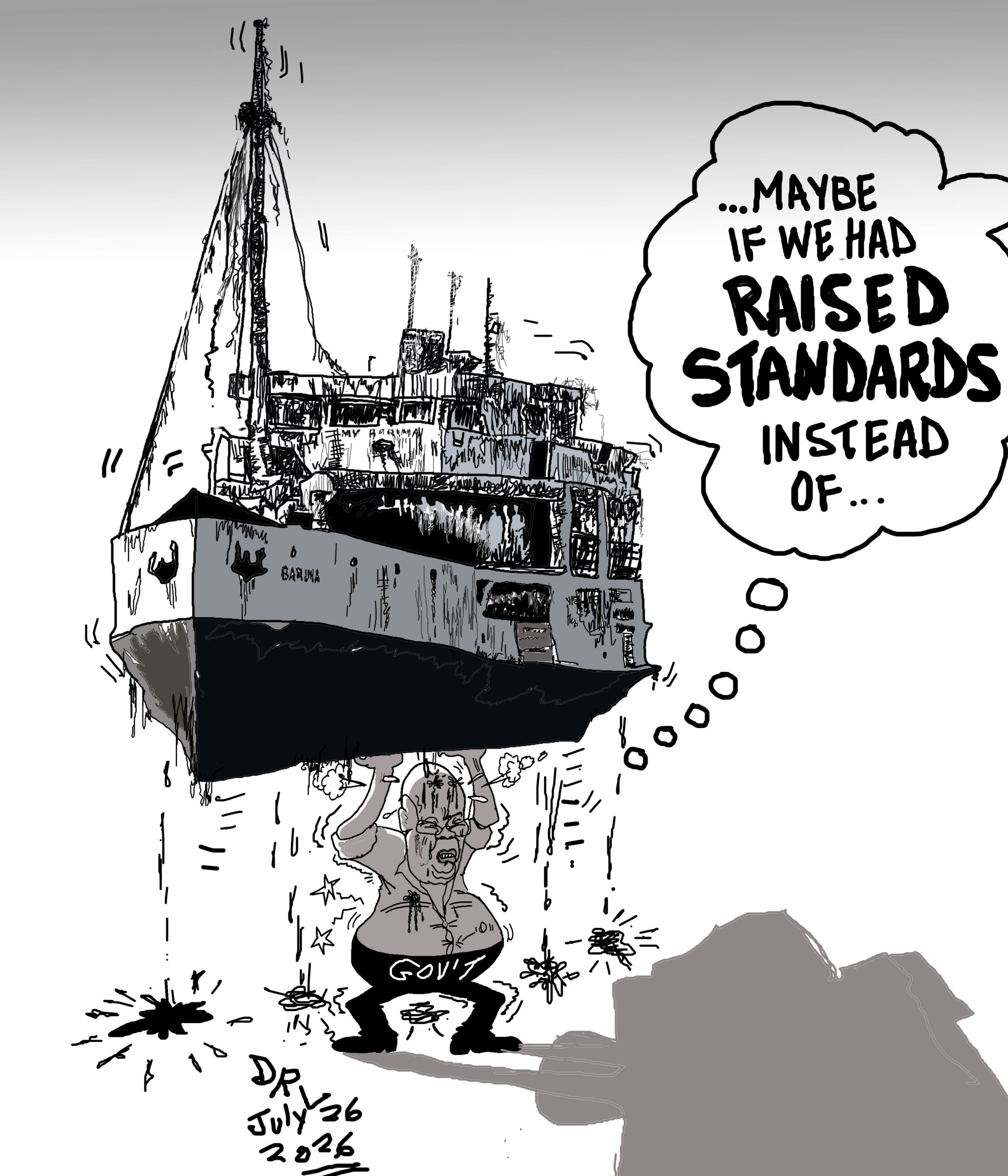
- Pres. Ali to unveil 5-member Int’l COI today to probe MV Barima disaster
- After six years of pumping oil, Guyana’s debt increased sixfold
- Other nations’ ministers stepped down following deadly ferry disasters
- Grieving mother calls on Govt. to subsidise airfares after ferry tragedy claims son
- GHRA demands Parliament-led COI into MV Barima sinking
In the age of Artificial Intelligence (AI), data is the new oil; is Guyana on the verge of giving it away?
Karen Abrams, MBA, AA, Doctoral Candidate
Kaieteur News- If we allow foreign companies to build, train, and control the AI systems that will run our farms, schools, hospitals, and government, we are effectively handing them the keys to our future. Once our national data crosses our borders, we may never regain control of it. That said, foreign partnerships can still be valuable, but only when they are governed by strong rules that protect our sovereignty and ensure the benefits flow to our people. In this column, I will make a distinction between ‘small AI’, relatively inexpensive, locally trained AI models that can run on low-cost devices and ‘big AI’, multi-billion dollar systems controlled by massive foreign corporations.

Karen Abrams, MBA, AA, Doctoral Candidate
Artificial intelligence is not a distant future, it is here, shaping economies, rewriting business models, and influencing public life. In the developed world, AI is already a productivity engine, quietly transforming industries from finance to agriculture. But for developing nations like Guyana, the AI story will be written under very different conditions, and unless we act deliberately, we may find ourselves on the wrong side of a growing global divide.
The promise of AI is undeniable. Properly deployed, it can help address the very real, very human challenges that dominate life in developing countries; managing water scarcity, improving crop yields, predicting infrastructure failures before they become disasters. For example, with the Internet of Things (IoT), low-cost sensors can now track soil moisture, water flow, and electricity usage in real time, triggering automated decisions for farms that prevent waste and protect livelihoods. Combine that with ‘small AI’ models, and a farmer in the Rupununi could diagnose a crop disease with a single photo and receive instant, localized treatment advice. This is the power of merging IoT’s constant vigilance with AI’s analytical speed, turning raw data into money-saving action. These technologies are now survival tools, not just toys for wealthy nations. Countries that ignore them will pay the price in lower yields, higher costs, and squandered water and fertilizer resources.
One hard truth that we cannot ignore is that today, Guyana lacks the AI talent, STEM pipeline, and data infrastructure to fully develop and control these tools ourselves. This gap is not simply about funding; it is about human capital. Very few of our citizens are trained in coding, advanced Math, data science, or AI model development. Political divisiveness and inconsistent national development priorities further weaken our ability to sustain long-term innovation as the playing field is not level for innovators who can contribute significantly to the technological growth of Guyana. These obstacles will directly determine whether AI in Guyana is built by us, for us, or built elsewhere and rented back to us.
And here lies one of the greatest risks. In the absence of strong local capacity, the default path will be to allow foreign companies to manage our AI infrastructure. That means our national data; our citizens’ health records, financial transactions, educational performance, and agricultural patterns, will be stored, processed, and monetized abroad or outside of our control or even understanding, if we are not careful. The national security implications are enormous. Once our data leaves our jurisdiction, we surrender control over how it is used, who profits from it, and whether it can be turned against us. This is a complex and urgent issue, and one that deserves a full examination, which I will address in a subsequent column.
And yet despite these risks, some argue that “big AI” will leapfrog our nation’s development into modernity, much like mobile phones did. But this is not the same, AI is not a plug-and-play device, it is a ‘living’ system that learns from data. If the learning happens outside Guyana, the intelligence, the jobs, and the value creation will remain outside Guyana. In the early years, ‘big AI’ will likely widen the gap between developed and developing countries, but only locally built, locally trained models can ensure that our AI solutions reflect our culture, our needs, and our priorities and engage our brightest young minds with well paid jobs in what; in the global north, is a rapidly growing and critical industry.
The path forward demands urgent investment in three areas. First, we must build a strong AI talent pipeline of AI innovators, beginning in our schools, expanding through vocational training, and advancing into university-level research. Second, we need to strengthen national data governance to protect privacy, require local storage and processing, and ensure models are developed with local expertise. We must also enable secure data sharing to drive innovation in key development sectors and third, we must forge political consensus to treat AI as a long-term national priority, shielded from election cycles, partisan disputes, and shifting political winds.
Guyana’s oil economy gives us a once-in-a-lifetime opportunity to fund this transformation. But money alone will not solve the problem. Without skilled people to design, deploy, and govern AI systems, we will remain dependent on foreign expertise and foreign infrastructure. In a world where intelligence is the new currency, that is a recipe for permanent dependency. The choice before us is clear, become creators of AI that serves Guyana, or consumers of AI that serve others. The technology is ready. The question is, are we?
Share this:

Discover more from Kaieteur News
Subscribe to get the latest posts sent to your email.
Similar Articles

Blunt of the day

Sports

Features/Columnists

Sir. Ronald Sanders

The GHK Lall Column

Weekend Cartoon