Latest update August 10th, 2026 12:59 AM



Latest News
- CCJ under pressure as judges’ leaked emails raise questions over independence
- Guyana must now receive its 50% profit in Exxon deal
- Israel rejects Trump’s 15-point plan for Gaza, stoking tensions with U.S.
- ‘Hands off the Kurupung’ – Region 7 Vice-Chair warns EPA against approving uranium drilling
- Canje businessman killed after struck by car driven by Dr. Ramayya
Jagdeo doesn’t want Guyanese vote to change Exxon deal
…dismisses citizens’ demand for renegotiation; parties call for referendum on contract

Vice President, Bharrat Jagdeo
Kaieteur News – Despite some 94% of Guyanese surveyed last year demanding a change to the lopsided ExxonMobil contract, Vice President Bharrat Jagdeo has dismissed the issue and said that calls for the matter to be put to a vote is a moot one.
Back in October last year, a survey conducted by Ram and McRae found an overwhelming number of Guyanese are in support of a renegotiated oil contract between the Government of Guyana (GoG) and American oil supermajor, ExxonMobil. Since the terms of the 2016 deal were made public, citizens have been calling on the government to engage the contractor for a renegotiation. These calls have, however, been shut down by politicians, with some even describing citizens as “low lives” for demanding more out of their resources.
Moot issue
At one of his most recent media briefings, Jagdeo was asked: With elections coming up on September 1, will voters be given a chance to have their say if they would like a renegotiation of the contract or not, or will that be some time off?
He responded, saying that he had seen the AFC campaigning on the issues.
“I saw them campaigning on that now, and it’s a question of believability too. So, it’s not just about what you say. It is a question of believability.”
In dismissing the question of a referendum on the contract, Jagdeo said the call is coming from a party whose leader is on Exxon’s payroll. “So, I’m not wasting time, I think, those are moot issues.”
Chartered Accountant, Christopher Ram, had said that the survey provides compelling evidence that the Government’s “sanctity of contract” position is at odds with public sentiment. The survey, conducted by Ram and McRae, using the Google Forms platform, attracted 135 responses from a diverse group of respondents, including professionals, academics, students and citizens. In revealing statistics associated with the survey, Ram explained, “An overwhelming 94% of respondents believe the Government should seek to amend the current Petroleum Agreement, with only 6% either opposed or unsure.”
Ram, who is also a lawyer, reasoned that these stark statistics alone should give pause to those who continue to defend the status quo of the lopsided oil deal. “The survey revealed that only 3.8% of respondents were satisfied with the existing provisions of the Agreement. The remaining 96.2% identified multiple areas requiring modification,” he added.
A whopping 83.2% of participants said they want the royalty rate revised, while 79.4% called for changes to tax payment arrangements. Presently, Guyana receives 2% royalty from Exxon on all petroleum produced and sold, whereas Exxon and its contractors are not required to pay taxes. To this end, the survey found that 66.4% seek modifications to tax certificates; 66.4% want the revenue guarantee revised and another 61.8% support ring-fencing provisions. The GoG has not implemented a ring-fencing provision to prevent Exxon from using revenue from one field to develop another. In this way, Guyana’s share of profits is significantly reduced until all costs have been recovered by Exxon and its co-venturers.
Since the release of the findings of the survey, there have also been calls for a referendum on the current oil contract. Businessman and advocate for a better oil deal, Dr. Glenn Lall, said that the referendum must allow citizens to vote on the demand for a 25% royalty instead of the current 2%, which the previous coalition government had negotiated with ExxonMobil back in 2016. Last year, some citizens had also called for the matter to be put to a vote, but this was resisted by the government. A referendum is a general vote by the electorate on a single political question that has been referred to them for a direct decision. Jagdeo had said then that while there might well be issues regarding bringing ExxonMobil to the table even with a successful referendum, he would prefer to deal with the matter after the general and regional elections.
He had said then, too, that the Guyana Elections Commission (GECOM) should focus on preparing for the 2025 general elections, and that any discussions on a referendum could be postponed until after the elections. “We have time enough to deal with that after the elections. But right now, GECOM must focus on one question, which is holding elections within the constitutionally prescribed timeframe,” Jagdeo had said.
The Vice President had highlighted that Exxon has made its position clear that it will not be up for a renegotiation of the oil deal. That deal waives all taxes and caters for it to be paid by the government out of its share. Guyana receives a 2% royalty; it allows Exxon and its co-venturers to recover up to 75% of production costs before the remaining 25% is shared between Guyana and the Stabroek Block partners. After accounting for the 2% royalty, cost recovery, and profit sharing, Guyana’s total take from the oil produced is 14.5% of the total value of the oil. Jagdeo added that any Guyanese, including himself, would want more out of the deal. “Would I like to have 75% instead of 52% in the future when all the costs are taken into consideration? We would love that. But the government of 2016 signed an agreement that says the only way you could have this amicably solved is with the agreement of the two parties,” he said.
However, Lall, who was at the forefront of that call then, has brought the matter back into the spotlight, saying Guyanese have had enough of the promises by the political leaders. “The days of begging these three political parties for dignity, decency, and honesty have long gone…Today, I am calling on every single Guyanese to demand that this Exxon oil contract be placed on the ballot paper come September 1.” “Let your vote… let my vote… let every Guyanese vote for what we want from this wealth God has blessed us with. Let us choose,” he said. The businessman asked whether Guyanese want to continue to survive “on this miserable, shameful 2% royalty — the crumbs that the PPP, PNC, and AFC sold us for or do we demand a fair share — a minimum of 25% royalty — so that all of us, our children, our grandchildren, and generations to come can eat properly, live with dignity, and walk with pride?”
Noting that the choice is simple, Lall said a 25% royalty will bring real salaries that reflect an oil-producing nation. “25% will ensure quality education with qualified teachers. 25% can provide free modernised healthcare that will serve all our people. 25% will pave our roads, provide clean water, and create real jobs. 25% will pull Guyana out of darkness and into the light of prosperity,” the businessman said. He charged that if citizens sit down and accept the current 2%, then they must be prepared to live with “that same old salary, cash grants, and vouchers. And stop complaining — while billions of your wealth is being shipped out every single day.” He said the oil resources were meant to be Guyana’s, this oil was meant to be a blessing, but because of the “greedy, selfish, and heartless politicians, it has become a curse. A curse that has many of our brothers and sisters building cardboard shacks for shelter, while foreigners build castles overseas…”
The calls for renegotiation of the contract have been made by several people in and out of Guyana. Only recently, the Alliance For Change (AFC) said that if it were to accede to office at the upcoming general elections, it would renegotiate the controversial 2016 oil contract signed under the then APNU+AFC government.
This, it said, would be part of a broader effort to secure more favourable terms for Guyana in its expanding oil and gas sector. The party also said that the renegotiation of the 2016 Production Sharing Agreement (PSA) is part of the party’s 18-point plan heading into the 2025 general and regional elections. The Working People’s Alliance (WPA) is also on record saying that it supports the call for a referendum on the 2016 oil contract with ExxonMobil. “WPA notes recent calls for a referendum on the 2016 oil contract, while we do not oppose such move we strongly feel that such a referendum must also cover the distribution of the oil resources to the people and a form of governance to be adopted as we transition into a petro state,” Dr. David Hinds had said.
Meanwhile, even as Guyanese have been protesting for changes to the abrasive terms of the contract signed with Exxon and Co-venturers Hess and CNOOC; experts have said that even without bringing the oil companies back to the negotiating table, government can implement measures that allow greater governance of the sector, which is now the key driver of this country’s economy.
Five years after commencing production activities on the country’s first Floating Production Storage and Offloading (FPSO) vessel, Guyana has not implemented systems to verify the daily number of barrels being produced by ExxonMobil. The country has not only started up two more FPSOs without independent meters to verify production, but has also, to date, sanctioned a total of six projects. In the meantime, Guyana is dependent on the production statistics reported by the operator of the projects. In addition to the absence of a parent company guarantee in the event of an oil spill and the lack of ring-fencing on the projects, concerns have been raised about the transparency in the management of the sector and the spending of the oil funds.
The National Assembly, in December 2021, passed the Natural Resources Fund Act to govern the revenue earned from the petroleum industry. It earmarks specific guidelines for the use of the funds. However, there has been no indication from government as to a single project financed from this revenue stream to date. The first withdrawal from the account was made in May 2022. Parliamentary approval was granted for the sum of US$607.6 million to be transferred during the fiscal year 2022 and another US$1.002 billion in 2023. Section 16.2 of the NRF Act explains that “All withdrawals from the Fund shall be deposited into the Consolidated Fund and shall be used only to finance – (a) national development priorities including any initiative aimed at realizing an inclusive green economy; and (b) essential projects that are directly related to ameliorating the effect of a major natural disaster.”
Government has not identified what the “national development priorities” being funded by the oil revenue are. The country is therefore in the dark regarding the use of the funds. With little transparency regarding the use of Guyana’s oil wealth, International Financial Analysts worry that the revenue may not be used to develop the country and improve the lives of its poor citizens.
For instance, Director of Financial Analysis at the Institute for Energy Economics and Financial Analysis (IEEFA), Tom Sanzillo, had pointed out before that the government has not been prioritising saving the funds generated from the industry like Norway but has instead, has embarked on a massive infrastructural and energy development scheme which may very well benefit its partner, ExxonMobil, more than the citizens in the country.
He reasoned, “It may work to Exxon’s benefit to put in new roads, it may be Exxon’s benefit to build a new gas plant but they don’t need that kind of electricity system in Guyana and who knows if they actually need the roads that are being built because there is no public process so what you have is a plan and the plan is to use the money to keep the existing political structure in power and that’s what is going to be done.”
Director of Energy at Americas Market Intelligence, Arthur Deakin, had also shared the view that the government lacks a clear structure on how the resources from this sector will be used to transform the lives of Guyanese. He noted that Guyana’s oil sector has been moving at one of the fastest paces known in the industry; however, when it comes to translating that wealth to the population, this has been taking some time. In fact, the specialist pointed out that for the wealth to benefit the population, it would require structural planning by the administration. To this end, Deakin said, “The government lacks a clear vision, a clear plan on how it’s gonna spend the money it’s receiving from the oil revenue, so I think there is a lot of room for improvement.”
Share this:

Discover more from Kaieteur News
Subscribe to get the latest posts sent to your email.
Similar Articles

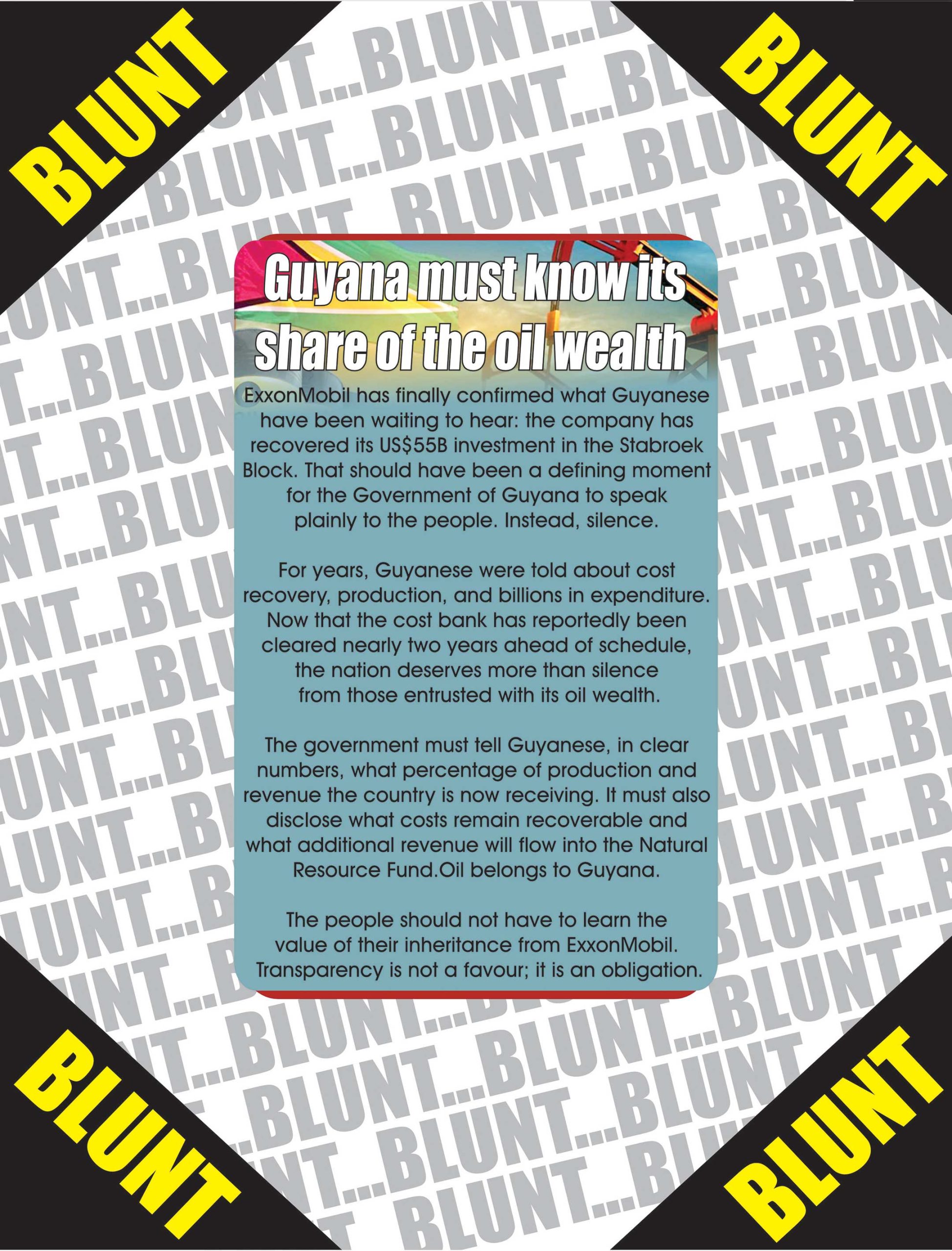
Blunt of the day
Sports

Features/Columnists

Sir. Ronald Sanders

The GHK Lall Column

Weekend Cartoon