Latest update September 20th, 2026 10:40 AM


Book Review…Stemming the tide of social discord
Book: Global Bioethics: The Collapse of Consensus
Editor: H. Tristram Engelhardt, Jr.
Reviewer: Dr Glenville Ashby
Bioethics is not always easily defined. For starters, we can explain this discipline as a study

The book cover of Global Bioethics
of moral principles relating to human behaviour. There has always been a strong link bioethics and end of life issues, for example, euthanasia and assisted suicide. Abortion, stem cell research, organ transplant, human rights, and even environmental concerns are also explored through bioethical lens.
Good and evil, goodness, morals, virtues have always been at the fore of human consciousness. Politicians, clerics, and philosophers have presented their own versions of good governance and righteousness. International law and public policy have advanced human rights and justice amid oppression and exploitation.
As we wrestle with presenting a normative standard for bioethical issues we are faced with the reality that for all our efforts, we fall short. Opinions and convictions differ. Lines are drawn, communications break down and we are left with a disturbing divergence.
Migration, cultural pluralism and globalization have posed major challenges to uniformity within bioethics. In fact, even the abhorrent act of murder can be contoured and redefined depending on situations. Bioethics becomes more blurred and ambivalent in matters of healthcare.
And the reemergence of Nietzschean philosophies has discounted God as the overriding adjudicator of morality. Which God? What scripture? By whose religious standards is Truth determined?
There is no single response in this illogical, discursive and circuitous discourse. What is certain is that truth, backed by religious dogma has led to the perpetration of the most heinous acts – violations of the very ethics and morals it set out promote. With swords and guns the western world has superimposed its brand of ethics on others whom were guided by their own moral compass.
Post-modernism challenges us to revisit the moral dogma of Kantian ‘categorical imperative.’ We must also question utilitarianism and its violation of individual rights. In an effort to reconstruct a bioethical framework that reflects the dynamism of today’s society, UNESCO, in 2003 considered it an opportune time to set universal standards in the field of bioethics with due regard for human dignity and human rights and freedoms, in the spirit of cultural pluralism inherent in bioethics.” (32 C/Res. 24)
But has it adequately respond to the myriad of needs of states, institutions, and individuals, especially in the area of health care?
Global Bioethics: The Collapse of Consensus, edited by Tristram Engelhardt seeks solutions to this unnerving disquiet. This profoundly scholastic work appeals to academicians and policy makers in this growing and highly contentious field. Philosophy, international law, culture and anthropology and contemporary sociology find their way into an array of complex arguments presented on the applicability of universal bioethics.
Many ethicists, including Engelhardt, have denounced the centralization and role of government in bioethics. They question the universal applicability of any piece of legislature that regulates open-ended concerns that bear historical, cultural, and metaphysical implications. Rather, they accept a market place of ideas that promote the common good while ensuring the protection of individual choices and rights.
Under the rubric of bioethical controversy, Engelhardt cites some examples related to health care. “Bioethics,” he says, “has failed to produce a generally accepted account of appropriate deportment…On the one hand abortionists and physicians assisting suicide are characterized as murderers or assistors in self-murder. On the other hand, such physicians are characterized as liberators from unjust, enforced pregnancy and terminal suffering.” He continues, “Those who impose all-encompassing, single payment, egalitarian health care systems such as exists in Canada are characterized as violators of basic human freedoms and market rights. On the other hand, those who support access to different levels of basic health care are characterized as violating basic rights to equality.”
According to Engelhardt, “as important as the disagreements, if not more important, is an understanding of the possible conditions for peaceable collaboration in the face of substantive moral disagreement.” He concludes, “Political space must be made not just for a diversity of communities within particular states, but for the emergence of worldwide networks of non-geographically based communities with their own particular understanding of moral probity, including bioethics, health care policy, and law”.
Given the pluralism of morals we begin to understand the enigmatic nature of bioethics and biolaw. Does God exist? Is homosexuality a sin? Is cloning a challenge to God’s sovereignty? Should states approve euthanasia? And what about abortion, is it murder? And on what grounds do you base your answer? The problem is, there is no single universally uniformed response. And reason, long used to justify decisions and beliefs is not a universal constant.
In fact, Stephen A. Erickson’s foreword well sums up the thematic thrust of this work. He writes: “Part of the problem we face going forward is surely bound up with the unraveling of the self sustaining integrity of reason itself.” He goes further: “We might say that reason has undergone its own self-deconstruction, thereby losing purchase on any claim it had to universality in any more than the most abstract and content –bereft sense.” He goes on to say that reason “draws from human desires and purposes in order to achieve operational content.”
Global Bioethics struggles with the competing interests of traditions and modernity; and between institutions and the rights of individuals.
Is there really a path to consensus? Engelhardt and company think not.
Feedback: glenvilleashby@gmail.com or follow him on Twitter@glenvilleashby
Global Bioethics: The Collapse of Consensus, edited by H. Tristram Engelhardt, Jr.
Publisher: M&M Scrivener Press
ISBN- 13: 978-0-9764041-3-2
Available at Amazon
Rating: Recommended
Share this:

Discover more from Kaieteur News
Subscribe to get the latest posts sent to your email.
Similar Articles
Website Hits

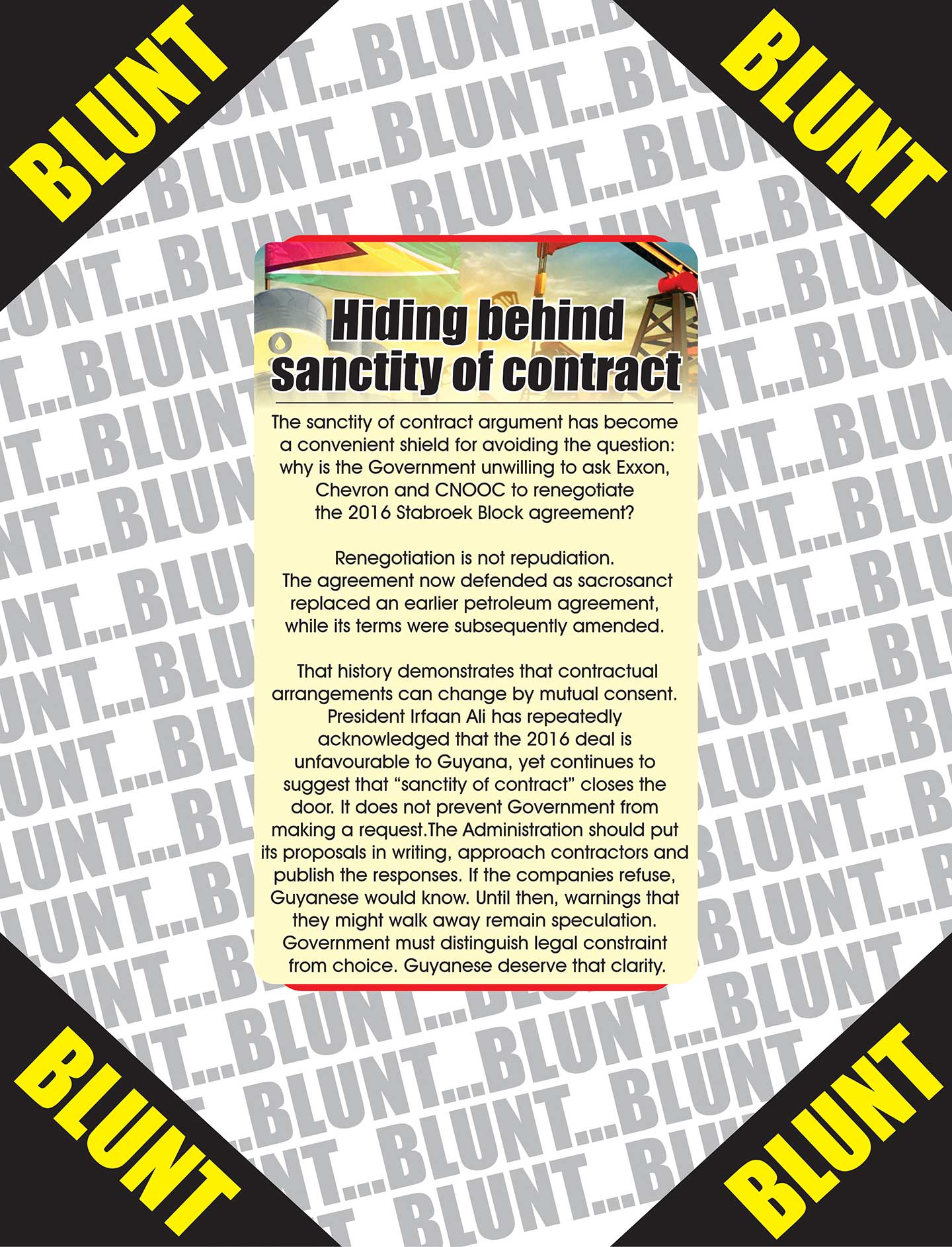
Blunt of the day
Sports

Features/Columnists

Sir. Ronald Sanders

The GHK Lall Column

Weekend Cartoon