Latest update September 19th, 2026 10:20 AM


Latest News
- Fear of return to home countries, diplomatic hurdles lead U.S. deportees to Guyana – sources
- Guyana’s 2026 oil earnings forecast jumps from US$2.8B to US$6.5B
- Sod turned for construction of new $1.3 billion New Amsterdam Market
- Iranians rally in biggest show of defiance against U.S. since war began
- APNU says 2020 election fraud trial exposing PPP/C’s own irregularities
Nagamootoo blasts Guyana’s ‘Missing in Action’ UN silence on Cuba
…describes country’s absence as ingratitude
(Kaieteur News) –Former Prime Minister Moses Nagamootoo has launched a blistering attack on the Irfaan Ali’s Government over Guyana’s failure to cast a vote at the United Nations on a motion seeking debate on the longstanding blockade against Cuba, describing the country’s absence as an embarrassing display of ingratitude.
In his latest My Turn column, Nagamootoo said he was stunned after learning that Guyana had failed to participate in the vote, reducing the country’s position to what he called “three words” – “It didn’t vote.”

Former Prime Minister, Moses Nagamootoo
According to Nagamootoo, the motion attracted overwhelming international backing, with 136 countries supporting debate on what many nations regard as an illegal and inhumane blockade that has contributed to severe shortages of food, fuel and medical supplies in Cuba.
The former prime minister argued that Guyana’s silence was particularly troubling given decades of Cuban assistance to this country. He pointed to Cuba’s role in strengthening Guyana’s healthcare system, training doctors, engineers and agronomists, and maintaining important trade ties through purchases of Guyanese rice and timber.
Painting a vivid picture of the humanitarian crisis, Nagamootoo referred to reports of surgeries allegedly being performed under torchlight because of electricity shortages, saying Guyana should have stood with a nation that has consistently supported it.
He directed much of his criticism at President Irfaan Ali, drawing attention to the coincidence between the president’s initials MIA and the military expression “Missing in Action.” Nagamootoo contended that Guyana’s absence from the vote reflected the president’s approval and represented a departure from the country’s long tradition of independent foreign policy under previous administrations.
Nagamootoo contrasted Guyana’s position with that of several Caribbean neighbours. Barbados, led by Prime Minister Mia Mottley, voted in favour of the motion, as did Jamaica, Suriname, Belize, Dominica, Haiti and several Eastern Caribbean states. Grenada, he noted, abstained, while Guyana failed to vote altogether.
He said there is a significant distinction between abstaining and not voting. An abstention, he said, reflects a deliberate decision to remain neutral while being present. Failing to vote, on the other hand, suggests absence or indifference.
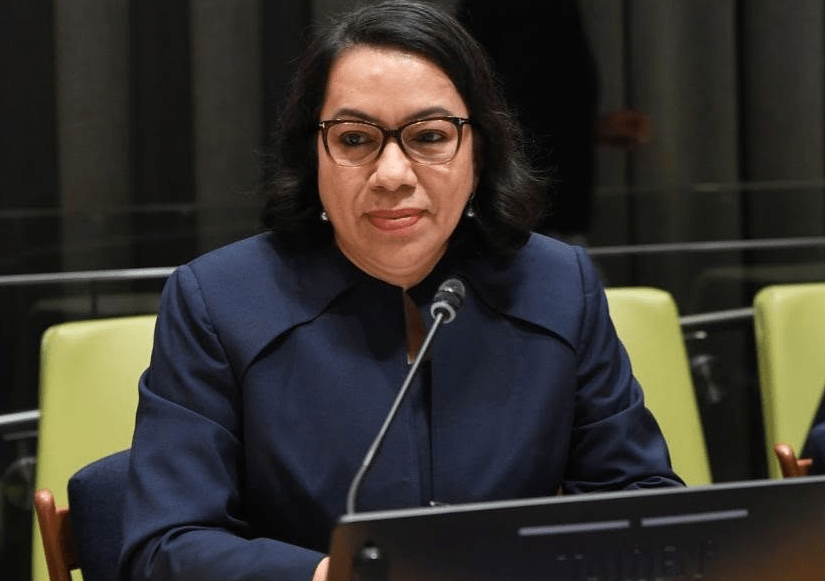
Guyana Permanent Representative to the UN, Carolyn Rodrigues
The column has reignited debate over Guyana’s foreign policy direction and whether its diplomatic posture is shifting amid changing geopolitical alliances. In a recent statement the Guyana Government called for a peaceful and democratic way forward as the economic and humanitarian situation in Cuba continues to worsen, stressing that any lasting solution must reflect the “will of the Cuban people.”
In the Ministry of Foreign Affairs statement, the government said Guyana stands in solidarity with ordinary Cubans facing ongoing shortages of food, fuel, medicine and electricity. It noted however, that the path out of the crisis must be people-driven and grounded in democratic principles.
“The Government of Guyana stands in solidarity with the Cuban people and welcomes a sustainable solution to the economic and humanitarian challenges in Cuba,” the ministry said.
It added that any resolution “must be based on the will of the Cuban people and founded on universal values, rule of law, humanitarian law, transparency and good governance.”
The ministry also urged all stakeholders to stick to dialogue, pointing out that diplomacy remains the most reliable route to stability and long-term recovery. “We encourage diplomatic dialogue that would promote stability and lead to the prosperity of the Cuban people,” the statement said.
Trinidad absent too
Meanwhile, in Trinidad and Tobago, the Kamla Persad Bissesar government has faced similar backlash for skipping the vote.
Opposition Senator and former foreign and Caricom affairs minister Dr. Amery Browne has called on the government to explain Trinidad and Tobago’s decision to abstain from a United Nations General Assembly (UNGA) vote calling for an end to the United States’ economic embargo on Cuba.
According to a Trinidad Guardian report, speaking at an opposition media briefing last week, Dr. Browne said the decision marks a significant departure from T&T’s long-standing foreign policy position, noting that successive administrations have supported UN resolutions against the embargo since 1992.
Dr. Browne questioned what mandate the government had to adopt this new position and whether citizens were consulted before the change.
“Why? On what basis have you changed the principled stance of Trinidad and Tobago in this manner? Trinidad and Tobago has always supported United Nations denouncements of the embargo. Why have we done so? Well, according to the United Nations, the embargo violates the United Nations Charter, which is an agreement which binds all member states of the UN. It also violates international law and significantly for us, these unilateral sanctions also affect the third country’s legitimate rights to engage in freedom of commerce.”
Dr. Browne rejected the argument that the embargo is solely a bilateral issue between the United States and Cuba, saying it has wider implications for countries that engage in international commerce.
“I saw the prime minister a couple months ago saying that the sanctions are exclusively a bilateral issue between the United States and Cuba. Rubbish. According to United Nations, and to anyone with an iota of sense, these sanctions also affect third countries, such as us, such as every other country in the world, besides the United States and Cuba, their freedom to legitimately engage in commerce. And that is why the United Nations General Assembly, that is why Caricom, that is why regional and international organisations across the spectrum have always had a stake and a voice and a role and a vote in this matter. We cannot exclude ourselves. We cannot be abstaining. We cannot be fleeing the room as has occurred recently. Trinidad and Tobago was looked upon as a leader.”
He further criticised the government’s decision as T&T prepares to assume a seat on the United Nations Security Council, arguing that the country should be demonstrating leadership and consistency in its foreign policy.
Share this:

Discover more from Kaieteur News
Subscribe to get the latest posts sent to your email.
Similar Articles
Website Hits

Blunt of the day
Sports

Features/Columnists

Sir. Ronald Sanders

The GHK Lall Column

Weekend Cartoon