Latest update May 26th, 2026 12:35 AM


Latest News
- Pres. Ali defends foreign firms ‘flipping’ mining claims despite Guyana getting nothing from deals
- ‘Normalise with Israel or deal with Iran dies’ – Trump threatens Arab world
- Family says teen acted in self-defense in Corentyne fatal stabbing
- U.S. military launches new strikes on Iran
- Woman on the run after miner killed at Bamboo Landing
Govt. to roll out AI-backed borders and virtual police stations
…Pres. Ali talks up high-tech security push
(Kaieteur News) – President Irfaan Ali on Friday unveiled the country’s future security blueprint emphasising that, “… The objective of our national security infrastructure of Guyana is to develop one of the most modern technologically integrated systems in the world.”
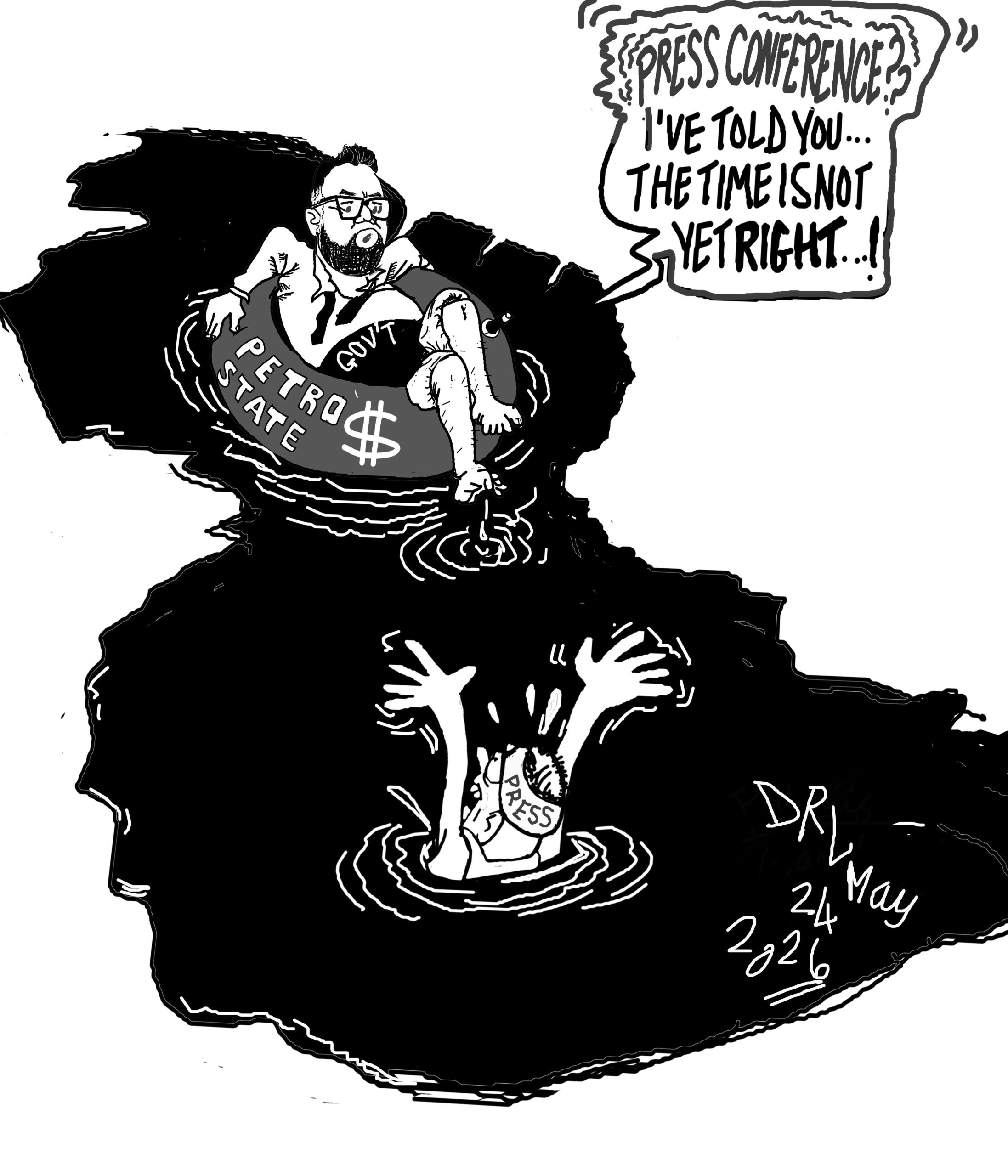
The president was at the time addressing reporters at his first press conference for the year. He explained that the government is seeking to create a common interface to enhance inter-operability and efficiency, built on partnerships with key allies and integrated into global systems.
“The advanced procedure information system in the coming years will be a critical tool for every single country,” Ali noted, adding that digitisation, digital passports, and digital ID cards are vital investments for shared international security responsibility.

President Irfaan Ali
The internal security architecture is built around seven core modern pillars: technology, intelligence, governance, resilience, community, civil society, and citizen services. Key components of this framework will include smart police stations, AI-powered policing, online crime reporting, integrated national databases, and real-time command and control centers that are regionally decentralised but centralised at a national level.
“The second and the objective of this is to ensure that we have a faster, citizen-friendly, data-driven policing architecture,” the President explained, pointing to newly placed security outposts within communities.
“The fact is that our communities are becoming deeper and more stratified, so the infrastructure and structure of our security architecture must reflect this changing dynamic,” the president said while highlighting artificial intelligence and predictive security as essential features to help in predictability, traceability, and crime-solving while removing human biases.
“That does not say that humans are not there. Humans are there in the backroom, but AI helps in doing analytics at a faster pace, scouring the dataset, scouring the footages, and coming up with scenarios, helping police and the system to respond more effectively and efficiently. So, AI is going to be an important part of our national security operations,” the president said.
President Ali listed predictive crime analytics, facial recognition, behavioural analytics, automated threat detection, smart surveillance, AI-supported traffic management, and drone integration as core capabilities.
“This will allow us, in real time, to predict patterns, networks,” he explained, giving the example of monitoring large crowds at a stadium with a single specialised vehicle. “Assessing threats, assessing behaviour, and giving advanced information to officers as to what and where these threats and behaviour can lead to security challenge. This is where the world is heading, and this is where we are heading.”
The third pillar focuses on national surveillance and safe country infrastructure, with an aim to have the entire country fully covered by CCTV by 2030. The network will integrate an intelligent traffic system using smart traffic cameras, which have already yielded massive reductions in speeding and accidents.
Ali revealed, “AI can now generate for us who are the repeat offenders in traffic offences, so you don’t need to go through days of documents. In milliseconds, we can generate a report about repeat offenders so that that can be integrated in the judicial system, and the judicial system can take the appropriate action based on the repeat offenders.”
He also detailed a successful pilot of a mobile traffic unit that flags outstanding offences automatically. “The test a few nights ago on the East Coast alone found 250 plus vehicles with outstanding tickets just driving through. And no human can interfere with the system, because the system would pick them up, document it on a screen, put it in a database, and then turn on even the traffic, the sirens, to stop the vehicle,” the president told reporters at the Office of the President.
This surveillance infrastructure will utilise sensor-enabled systems, including traffic lights that adjust their timing automatically based on real-time traffic flow. “The sensor-enabled infrastructure would also go a step further,” the President explained. “Our intention is that in critical areas, critical and sensitive areas, we will have sensor-enabled patterning. So we can launch the eyes in the sky with a vehicle that committed a crime. And the drones will go to the path that the vehicle is going and be able to identify that vehicle, trace that vehicle.”
He noted that this allows law enforcement to network all locations a vehicle visited 72 hours before to break into criminal networks, adding, “If you see the camera, the camera is seeing you. And if you are hiding from the camera, you are hiding something. So this infrastructure is going to be the backbone upon which we are building our country.” He cited the smart street monitoring pilot in the Stabroek area, where the crime rate plummeted from over 90 reports to less than six because everyone was integrated into the system.
To achieve full coverage, the government needs more than 25,000 static cameras across 6,700 sites, moving aggressively from the current closing figures of 1,300 sites and 6,000 cameras. This network will be supported by roving cameras, eyes in the sky, and private commercial or home security systems, which the state is encouraging via investment incentives. “And this will be interesting,” the President noted.
“So, the system is already delivering these results for us. The system allows for automated post audits.” He revealed that this audit capacity has enabled a deeper look into regulatory systems, stating that “today I can tell you, I know the Traffic Chief will have sent out 1,600 letters, just above 1,600 letters, on persons who they’re interested in to find out how they acquired their driver’s licence.”
To secure this process going forward, the state is migrating examinations away from human handling. “We are now moving the test, the driver’s licence test, to the Guyana Digital School platform, where the questions are automatically generated,” Ali announced. “Nobody would have any question paper two days before. If you go now to write it, 10 minutes after, the questions are completely different. It’s random sampling. The system throws up the questions and mark it immediately. So, you can know your results there,” he disclosed.
The data backbone will also anchor cybersecurity and digital resilience as core national pillars, particularly as the State prepares to fully implement the national payment system by the end of this year. “So you can go and just scan a QR code and pay for anything. You can do all your transactions on your phone,” Ali explained.
“You can pay anything globally, anywhere in the world, from your phone. So that tells you that major investment will be made in cybersecurity and digital resilience,” President Ali said. This includes a refined national strategy and a world-class, 24/7 Cyber Emergency Response Team to protect critical data and economic infrastructure, such as energy systems, oil and gas assets, fertiliser plants, and the Wales Development Zone.
“As we move towards owning more of our data and having data sovereignty, we have to ensure that the backbone is there to protect that data so that it’s not stolen,” the President emphasised, noting that domestic laws will be further amended to align with international standards.
For border security and immigration control, the State is actively deploying technology like automated e-gates and working on custom components to remove long immigration and customs forms in favour of self-declaration backed by stronger penalties. President Ali highlighted the rollout of the digital ID card, which will be distinct from the voting ID card, serving as the essential document for all banking and civic transactions. To support an aggressive rollout, the government is expanding registration from 10 regional sites to an additional 60 sites across the country. This will interface with a biometric immigration system, smart visas, and AI-supported traveler risk assessments.
“Once you express an interest to book a ticket, that is where the security system kicks in,” Ali explained. “And with AI, once you have this system, it gives you an alert that person X is a person of interest, and they’re trying to book your ticket… If the person then proceeds to pay for the ticket, it then gives you a high alert… So you can stop. Countries are even stopping now. That person, if it is someone in the black list, they are stopping that person from even booking the ticket. So you are preventing the threat even before the ticket is booked to come to your country. That is how advanced and integrated the global system is now. And that is where we are heading with this security infrastructure and architecture,” he told reporters.
This integration extends directly to port security, where advanced AI scanners will track shipping containers from origin to destination to ensure cargo profiles remain untampered with. To manage these interconnected feeds, the sixth pillar introduces an integrated intelligence and interagency coordination system. “It’s very important that all our systems are inter-operable. And they can talk to each other. And they’re not silos. This is important for efficiency and to ensure a whole-of-government security coordination,” the Head-of-State said while naming the Guyana Police Force, Guyana Defence Force, Customs Anti-narcotics Unit, the Special Organised Crime Unit and the Financial Intelligence Unit as core participants.
This platform will facilitate real-time information sharing, tiered command centre access based on clearance, and a unified crisis management system.
Share this:

Discover more from Kaieteur News
Subscribe to get the latest posts sent to your email.
Similar Articles

THE BLUNT OF THE DAY

Sports

Features/Columnists

Sir. Ronald Sanders

The GHK Lall Column

Weekend Cartoon