Latest update September 23rd, 2026 10:25 AM


Latest News
- Exxon boasts of US$55B Guyana payday
- GRA raked in $160.5B in taxes during first half of 2026 – Mid-Year Report
- Trump tells UN General Assembly he could ‘annihilate’ Iran but expects deal after midterms
- Narine admits failing to act on evidence of Mohamed’s alleged involvement in six execution-style killings
- Ram questions $89.9B housing spending
Oil shock from Iran war turns market upside down
…analysts predict possible big windfall for Guyana
(REUTERS) The global oil market has been thrown into turmoil by the escalating Iran war, wiping out expectations of a comfortable supply glut and instead pushing the world toward a significant oil shortage —a development that could deliver major gains for oil-producing nations like Guyana.
Analysts now warn that the conflict triggered by U.S. and Israeli strikes on Iran on February 28 has delivered a sharp and immediate blow to global oil supply, upending earlier forecasts and sending prices soaring. At the heart of the crisis is the Strait of Hormuz, a critical chokepoint through which roughly one-fifth of the world’s oil passes. Flows through the strait have been severely disrupted, effectively choking supply to global markets. In a dramatic reversal, a Reuters poll of eight analysts now projects that global oil demand will exceed supply by about 750,000 barrels per day this year.
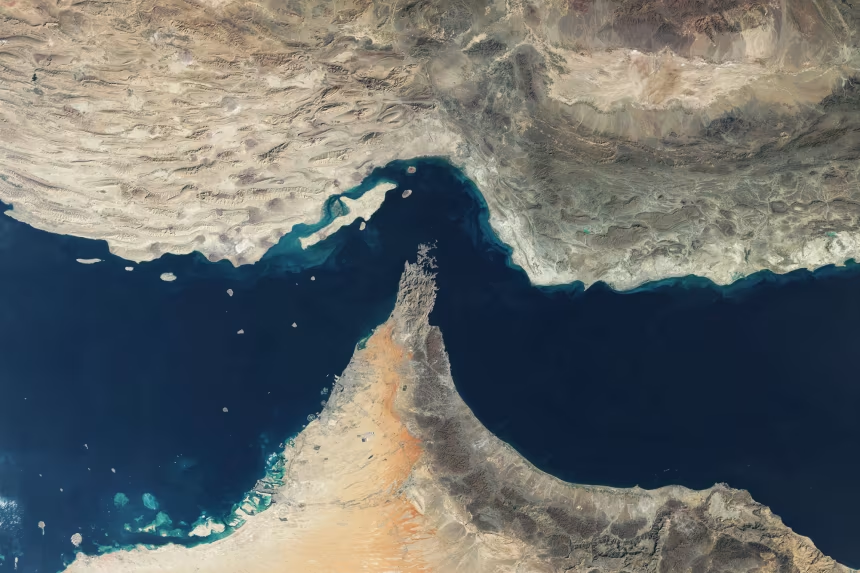
A satellite view of the Strait of Hormuz, a strategic waterway between Iran and Oman that links the Persian Gulf to the Arabian Sea.
Gallo Images/Orbital Horizon/Copernicus Sentinel Data 2025/Getty Images
Eight analysts polled by Reuters expect oil market demand will outpace supply by 750,000 barrels per day on average this year. A similar poll last September had predicted a 1.63 million bpd surplus for 2026, driven largely by OPEC+’s decisions to unwind some of its output cuts, and strong production from other producers like the U.S., Brazil and Guyana.
The International Energy Agency projected that the war had shrunk oil supply by around 11 million bpd as of the end of March, while ANZ bank estimated in an April 9 note that roughly 9 million bpd of crude supply had been effectively removed. Global oil supply was around 106.6 million bpd in January, according to the IEA.
These immediate shocks are expected to translate into an average production loss of 2.13 million bpd across the entire year, analysts said in the poll. They expect the market to see its steepest deficit in the second quarter – averaging around 3 million bpd – before tipping back into a surplus of 1.4 million bpd in the fourth quarter. Analysts warn, however, that projected deficits could steepen depending on how long disruptions through the Strait of Hormuz persist. Flows through the strait remain constrained, with traders reporting no clear signs yet of a sustained resumption in shipments since a ceasefire was announced Tuesday.
An estimated 136 million barrels of crude oil and products are stuck in the Gulf due to the conflict, said Vikas Dwivedi, global energy strategist at Macquarie Group. So, Andrew, NASA projects can take decades and run billions over budget. Clearing that backlog is likely to take time. Many shippers still face challenges in spite of the ceasefire, with reports of Iran planning to charge fees to ships transiting the Strait of Hormuz. “Issues include insurance and the risk of violating sanctions (by) transacting with Iran if tolls are paid,” Dwivedi said.
RESTORING PRODUCTION EXPECTED TO BE BUMPY
Supply disruptions due to the war prompted the largest annual price forecast increase in Reuters poll records last month, with analysts lifting their 2026 Brent forecasts by around 30% to $82.85 a barrel. The war has boosted oil prices by about 50%. Restoring oil production to pre-conflict levels will likely take months, depending on the extent of the damage sustained at oilfields during attacks and shutdowns, and on how freely shipping flows through Hormuz.
Even under a constructive security scenario, analysts at ANZ said output can only be partially recovered in the near term, with around 2 million to 3 million bpd potentially returning in the first month as export flows resume, and another 2 million to 3.5 million bpd potentially coming back into the market over the rest of the second quarter. “However, operational friction, damaged infrastructure and export bottlenecks mean recovery is unlikely to be smooth,” they said. There is also a chance that around 1 million to 2 million bpd of capacity may be permanently lost or limited even after the war, ANZ said, setting the stage for a tighter market and increased price volatility.
Share this:

Discover more from Kaieteur News
Subscribe to get the latest posts sent to your email.
Similar Articles
Website Hits

Blunt of the day

Sports

Features/Columnists

Sir. Ronald Sanders

The GHK Lall Column

Weekend Cartoon