Latest update July 1st, 2026 12:30 AM


Latest News
- Suriname pulls out of joint Corentyne bridge project
- ExxonMobil takes $82B from Guyana for production expense as citizens get $60B cash grant
- Rescuers in Venezuela pluck child alive from collapsed building six days after twin quakes
- Ogle Airport elects new board
- No severe COVID-19 cases recorded – Health Minister
The world needs a reset for peace, prosperity and respect for international law and sovereignty
Dear Editor,
It is well known that for more than six decades, the international system has witnessed the sustained application of economic sanctions as a central instrument of foreign policy, most notably in the cases of Cuba and Iran. While such measures are often justified as tools for promoting political reform or ensuring international security, their long-term humanitarian, legal, and geopolitical consequences demand critical reassessment.
Increasingly, global discourse is shifting toward a central question: do these policies advance human dignity and stability, or do they instead entrench hardship, exacerbate conflict, and undermine the very principles they claim to uphold?
The case of Cuba remains one of the most enduring examples of economic isolation in modern and contemporary history. The United States embargo comprehensive in scope and extraterritorial in application has significantly constrained Cuba’s access to global markets, finance, and essential goods. International observers, including United Nations experts, have warned that recent measures, such as fuel restrictions, may violate international law and the principles of sovereignty and non-intervention. The cumulative economic cost of the embargo has reached into the trillions of dollars, affecting three generations of Cuba’s population and nearly every sector of Cuban society. Further, its humanitarian impact is equally profound, contributing to shortages in food, medicine, fertilisers and critical infrastructure, placing disproportionate strain on vulnerable populations particularly children, women, the differently able and the elderly.
A comparable, yet distinct, experience is evident in Iran. Decades of sanctions, compounded by recent geopolitical escalation, have severely constrained the country’s economic capacity. Inflation, poverty, and food insecurity have risen sharply, with large segments of the population experiencing significant hardship. More recently, the escalation into direct conflict particularly the ongoing war involving the United States and Israel has had far-reaching global consequences. Disruptions in the Strait of Hormuz, a critical artery for global energy supply, have affected nearly 20% of the world’s oil trade, approximately 20-21 million barrels of oil per day, triggering price surges and raising the specter of global inflation and recession. Several analysts have warned and its now quite the unwelcome reality that such instability is already driving increases in food, medicine and energy costs worldwide, with disproportionate effects on developing and import-dependent nations.
The intersection of these crises is particularly significant for small developing countries like Guyana and small island states especially Cuba. As a small, import-dependent economy already constrained by sanctions, Cuba is acutely vulnerable to global shocks in fuel, food, and fertiliser prices. The continued escalation of conflict involving Iran whether viewed as a defensive assertion of sovereignty or as part of a broader geopolitical confrontation has compounded the economic pressures facing the Cuban people. In this sense, the hardships experienced in Cuba cannot be viewed in isolation; they are part of a wider system of economic and political pressures that reverberate across the Global South.
Iran itself along with the overwhelming majority of United nations member states have articulated strong opposition to the sanctions regime imposed on Cuba, characterising it as a violation of international law and the fundamental rights of the Cuban people. This position reflects a broader alignment among nations that have experienced similar forms of economic coercion and underscores the shared principle of sovereignty, the right of each state to determine its own political and economic system, free from external interference.
Despite these constraints, Cuba’s longstanding contributions to global solidarity remain noteworthy. The country has extended medical assistance, educational support, and technical cooperation to a wide array of nations across Latin America, the Caribbean, Africa, and beyond. Countries such as Venezuela, Bolivia, Nicaragua, Guyana, Jamaica, Barbados, Trinidad and Tobago, Haiti, South Africa, Angola, and Algeria, among many others, have directly benefited from Cuban expertise. Cuba has also maintained cooperative relations with major global actors including China, Russia, Mexico, Spain, and Vietnam, as well as the Caribbean Community (CARICOM). This extensive network of partnerships reflects a history of international engagement grounded in cooperation rather than coercion.
In light of this history, there exists a compelling moral and diplomatic case for reciprocal support. Nations that have benefited from Cuban assistance, as well as those with the economic capacity to provide aid including Canada, members of the European Union, Brazil, India, Russia and emerging economies should consider expanding much needed humanitarian and developmental assistance to Cuba. Such support could take the form of medical supplies, food security initiatives, infrastructure investment, and energy cooperation, all delivered in a manner that respects Cuba’s sovereignty and national priorities.
The recent remarks by President Irfaan Ali that “the status quo cannot remain” in Cuba reflect a growing regional consensus. Indeed, meaningful change requires both internal adaptation and an external environment that enables rather than constrains development. Constructive engagement, rather than prolonged isolation, offers a more effective pathway toward sustainable progress.
At a broader level, the experiences of Cuba and Iran highlight the limitations of coercive approaches in international relations. Economic sanctions and military interventions, while often framed as instruments of liberation or stability, have frequently produced unintended and destabilising consequences as the world saw in Iraq, Sería, Libia and Afghanistan. The current global climate marked by conflict, economic uncertainty, and rising inequality calls for a renewed commitment to diplomacy, multilateralism, and respect for international law.
Ultimately, the principle of sovereignty must remain central. Nations must be afforded the space to determine their own trajectories, even as the international community continues to advocate for human rights and development. The Cuban people, like the Iranian people and others facing similar pressures, deserve the opportunity to pursue a better quality of life free from undue external constraint.
The time has come for a recalibration of global priorities. The easing of economic restrictions on Cuba, coupled with increased international humanitarian assistance, would not only alleviate immediate suffering but also contribute to a more stable and equitable international order.
In an interconnected world, policies rooted in empathy, cooperation, and mutual respect are not merely idealistic, they are essential. The world needs a reset for peace, prosperity and respect for international law and sovereignty.
Yours respectfully,
Jermaine Figueira
Share this:

Discover more from Kaieteur News
Subscribe to get the latest posts sent to your email.
Similar Articles

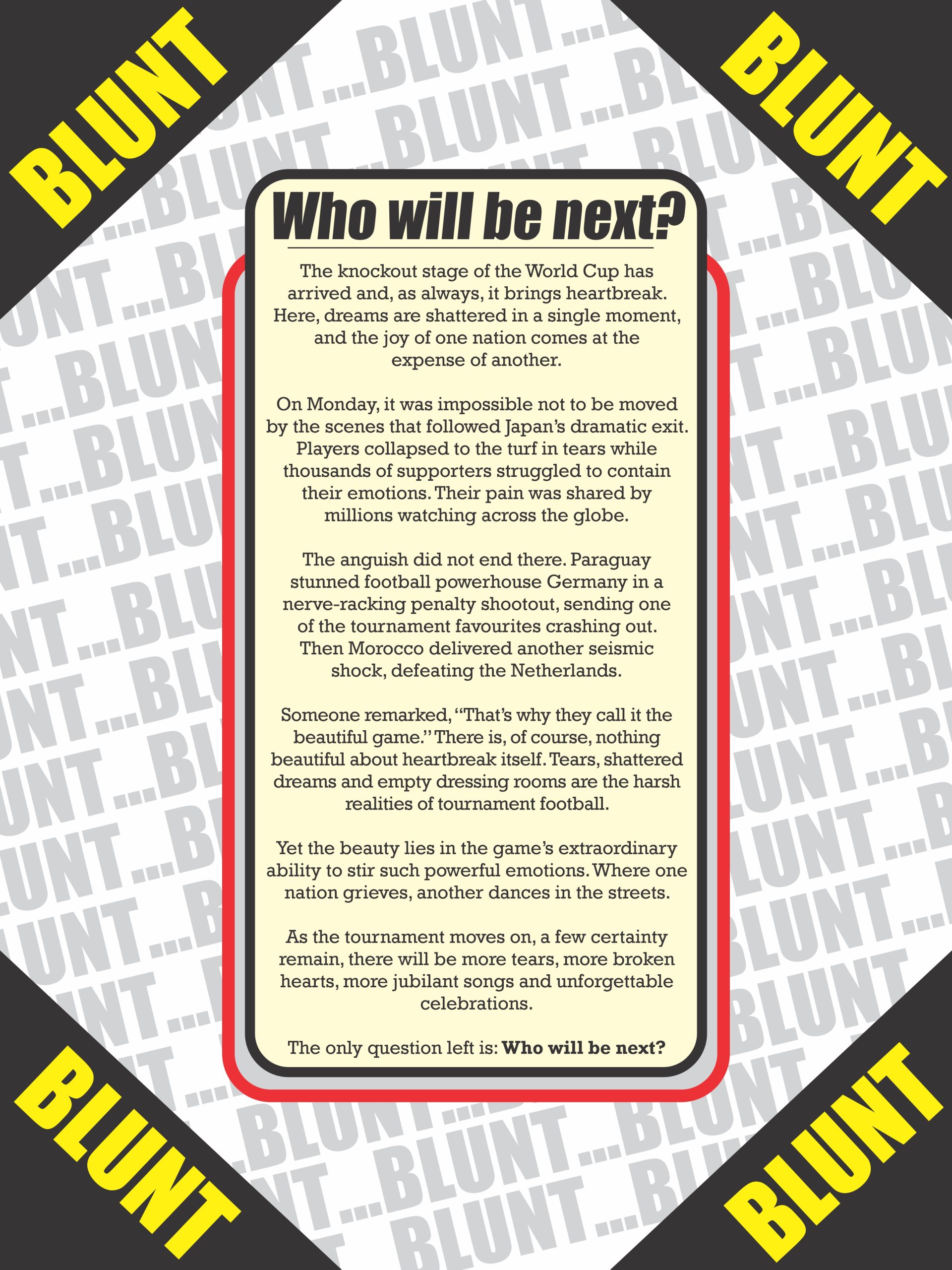
THE BLUNT OF THE DAY
Sports
Features/Columnists

Sir. Ronald Sanders

The GHK Lall Column

Weekend Cartoon


