Latest update September 30th, 2026 5:56 PM


Latest News
- Six-year-old Chinese boy killed at Parika
- Unrest in Vigilance… villagers set truck ablaze as cops arrest wanted man’s family over missing Surinamese men
- Exxon pushes 4th oil project to 270,000 barrels per day
- Oil prices fall on signs Middle East crude flows recovering
- NRF oversight committee appointed without National Assembly nominee
CARICOM at a Crossroads: When Regional Unity Meets National Survival
Dear Editor,
As I follow the proceedings of the Caribbean Heads of Government Conference and listen to the speeches being delivered, it becomes increasingly clear that the conference theme — “Beyond Words: Action Today for a Thriving, Sustainable CARICOM”—captures both the promise of regional integration and its central unresolved tension. Beneath the familiar calls for solidarity and cooperation, individual nations appear to be positioning themselves for bilateral advantage, using the regional gathering less as a forum for collective strategy and more as a platform for separate negotiations—particularly with the United States. What is unfolding is not an open rejection of regionalism, but a quiet drift away from it, revealing a regional bloc struggling to translate long-standing aspirations into coordinated action.
To be clear, every sovereign nation has a duty to protect its own interests. For small states facing economic fragility, climate vulnerability, a troubling rise in violent gang activity—often linked to transnational organised crime, illicit arms trafficking, and deportation-driven criminal networks—and acute regional security crises such as the ongoing collapse of public order in Haiti and explicit threats by Venezuela toward both Guyana and Trinidad and Tobago, pragmatism is not a choice but a necessity. These pressures are frequently discussed within the framework of U.S.–Caribbean cooperation on security, borders, and law enforcement, yet they continue to expose the limits of fragmented national responses. What is troubling, therefore, is not that individual countries are seeking opportunities, but that after decades of commitments to regional integration, CARICOM still lacks the institutional strength to act collectively when it matters most—particularly on shared security challenges that no single state can effectively manage alone.
I believe that CARICOM was never designed to function as a hard-bargaining bloc. It performs reasonably well as a coordinating mechanism—aligning positions, issuing joint communiqués, and sustaining diplomatic dialogue. However, when engagement shifts from declarations to leverage—on trade access, migration rules, energy security, climate finance, or security cooperation—the regional framework quickly gives way to bilateral engagement. External powers prefer one-on-one negotiations, and national leaders, accountable to domestic pressures and electoral realities, respond accordingly.
In such moments, regional unity does not fail because of a lack of goodwill. It fails because the institutional architecture offers no credible pathway from words to action.
For decades, Caribbean integration has been framed more as solidarity than as structure. There is no pooled negotiating authority, no shared fiscal framework, and no integrated economic or security strategy with real enforcement capacity. Without these foundations, collective bargaining remains aspirational. Unity becomes rhetorical rather than operational.
Recent developments have further exposed these fault lines. Economic asymmetries within CARICOM—particularly with the emergence of Guyana as a major energy producer—have altered the internal balance of interests. Divergence within a regional bloc is neither unusual nor fatal. Successful integration efforts elsewhere manage such divergence through compensation mechanisms, coordinated investment strategies, and deliberate policy alignment. CARICOM has yet to meaningfully develop these instruments.
What we are witnessing at this conference, therefore, is not collapse, but drift. And drift is dangerous. Once leaders internalise the lesson that bilateralism delivers faster and more tangible outcomes than collective action, the incentive to invest political capital in regional solutions weakens. Over time, the regional project risks becoming ceremonial—useful for dialogue, but marginal in moments of real consequence.
If the theme “Beyond Words: Action Today for a Thriving, Sustainable CARICOM” is to mean anything beyond aspiration, it must prompt a hard reckoning. CARICOM must confront a fundamental question: does it intend to remain primarily a forum for consultation, or does it aspire to become a functional regional instrument capable of joint negotiation in critical areas such as trade, energy, climate resilience, and regional security?
The real tragedy is not that Caribbean nations are acting in their own interest. The tragedy is that after more than half a century of regional integration efforts, the region has yet to build a system where acting nationally and acting collectively reinforce—rather than undermine—each other.
This conference should be remembered not for its slogans, but for whether it marked a genuine shift from words to action. CARICOM is at a crossroads. Whether it chooses renewal or quiet irrelevance will shape the Caribbean’s place in an increasingly unforgiving global order.
Yours sincerely,
Dr. Dexter Phillips
Share this:

Discover more from Kaieteur News
Subscribe to get the latest posts sent to your email.
Similar Articles
Website Hits

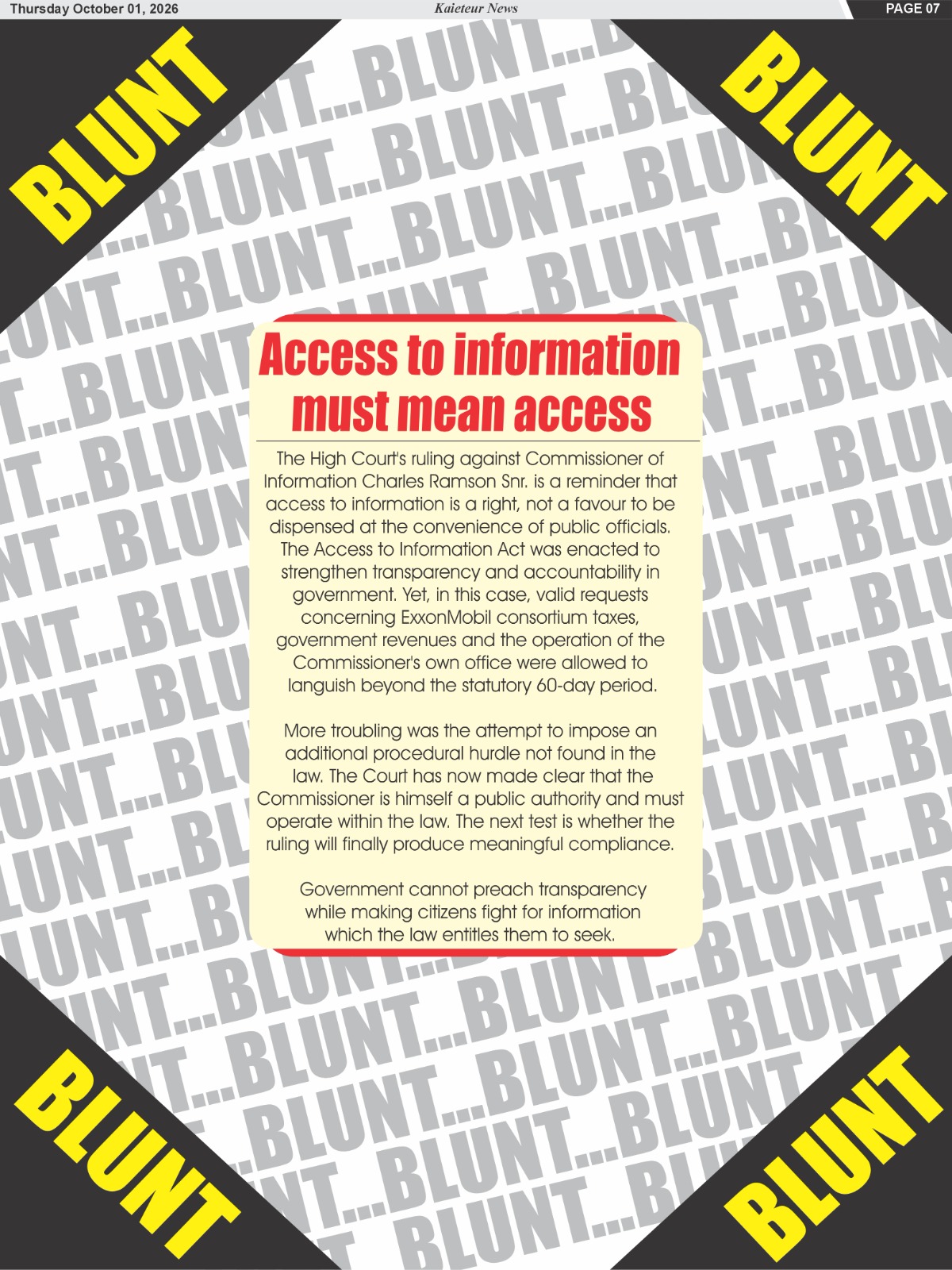
Blunt of the day
Sports

Features/Columnists

Sir. Ronald Sanders

The GHK Lall Column

Weekend Cartoon