Latest update February 9th, 2026 12:35 AM

Feb 09, 2026 Features / Columnists, Peeping Tom
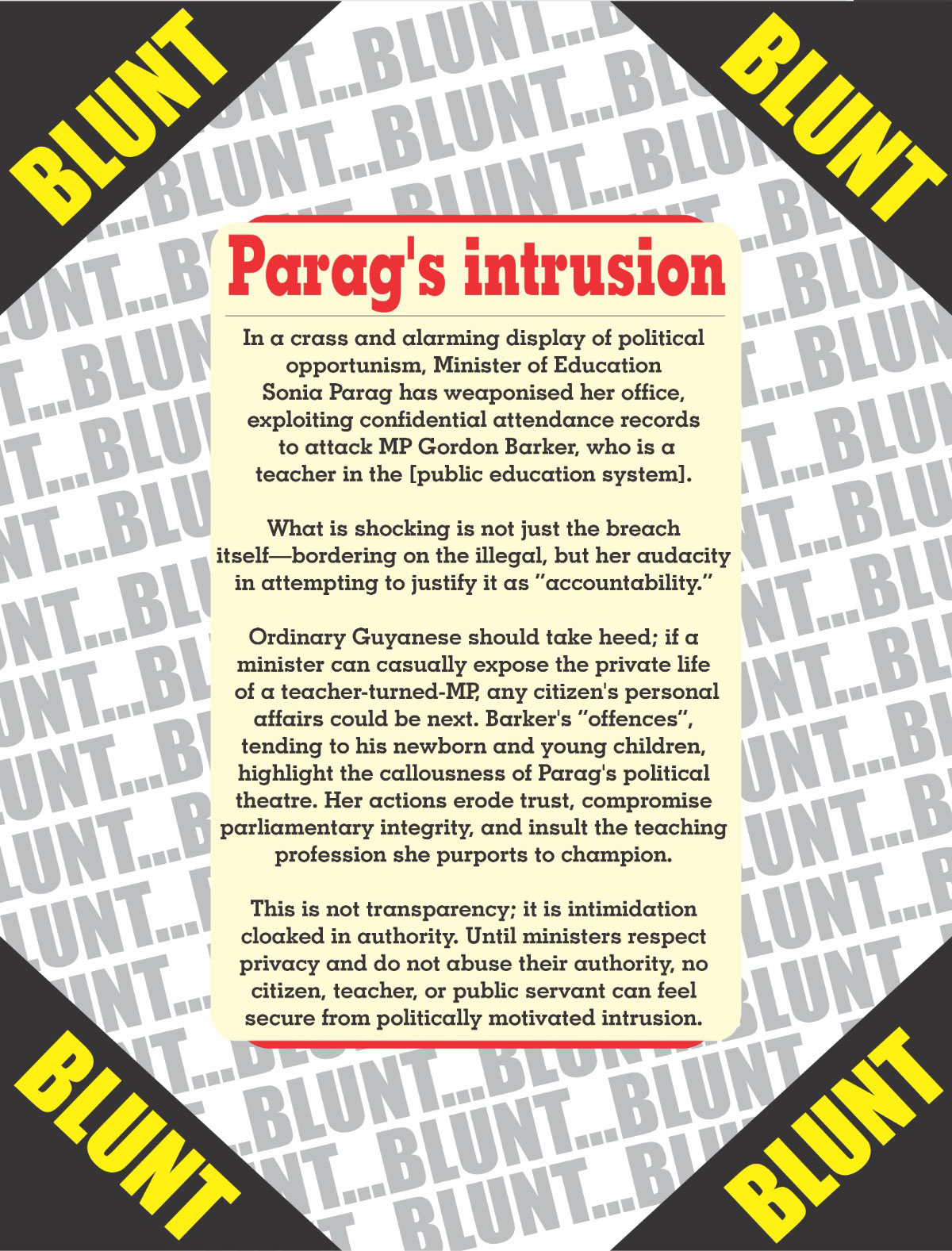
(Kaieteur News) – The recent spectacle in the National Assembly—where a Minister of Government recited the punctuality record of a teacher who also happens to sit on the Opposition benches was not a triumph of transparency. It was a confession. Not of the teacher’s lateness, but of the State’s alarming intimacy with details it has no ethical business parading.
Let us begin with a distinction that any first-year student of public administration should grasp without difficulty. A Minister may properly demand aggregated data: attendance rates by region, chronic absenteeism trends, systemic punctuality failures, correlations between staffing shortages and instructional quality. These are the figures that illuminate policy choices and justify budget lines. They tell us something about institutions. They tell us nothing about individuals. And that is precisely the point.
What a Minister should not possess, and certainly should not brandish in debate, is the individual attendance log of a single teacher, complete with dates, minutes late, and a prosecutorial tone. That kind of information belongs to the employer-employee relationship, governed by rules of confidentiality, disciplinary procedure, and proportionality. When it migrates upward into the hands of a political principal, something has gone badly wrong.
The Minister’s defenders would have us believe that this was merely accountability. The word is irresistible to those who enjoy power and are eager to speak. But accountability, properly understood, flows upward, not downward. Ministers account to Parliament and the public for policy outcomes; civil servants and teachers account through established administrative processes. When a Minister has access to personal records meant for senior civil servants and senior education officers , there must be concern. Ministers should not have such access.
The real question, therefore, is not whether parliamentary privilege protects what was said. Of course it does. Privilege has always served as the velvet rope behind which indiscretions may dance without fear of legal consequence. The more pressing question is this: how did the Minister come to know these particulars in the first place? Who retrieved the file? At whose instruction? For what stated purpose? And why did no one along that chain of custody pause long enough to say, “This is improper”?
These are not idle curiosities. They go to the heart of ethical government. Ministers sit atop vast administrative pyramids precisely because they are expected not to meddle in the granular affairs of individual employees. That restraint is not a courtesy; it is a safeguard. Without it, every public servant becomes a potential footnote in a ministerial speech, every personnel file a political prop.
In any well-ordered system of public administration, the distinction is clear and deliberate: a Minister exists to set direction, not to manage detail. The Minister defines policy goals, secures resources, answers to Parliament, and is judged by outcomes—what the system delivers, not how many minutes an individual employee arrives late on a given morning. The senior public servant, by contrast, operates in the engine room, translating policy into practice, supervising staff, enforcing rules, and handling operational matters such as attendance, discipline, and performance in accordance with established procedures.
It will not do to argue that the subject in question is also a Member of Parliament. Dual roles do not nullify basic protections. A teacher does not forfeit employment confidentiality by contesting an election or sitting in the National Assembly, any more than a doctor forfeits patient ethics by entering politics. If anything, the overlap demands greater caution, not less, lest the machinery of the State be repurposed to settle arguments that should be fought with ideas. Imagine the uproar that would take place if a doctor on one side of the House decides to make public the medical history of another member of the House who just happens to be his patient.
This is where the Guyana Teachers’ Union earns its keep. In protesting the disclosure, the GTU was not shielding indiscipline or defending tardiness. It was defending a principle older than any budget debate. That principle is that workers are not fair game for political sport. The Minister assures us that no confidential information was breached. That is a comforting assertion, much like saying no windows were broken while standing amid the glass. Confidentiality is not defined by whether a document bears a red stamp; it is defined by reasonable expectation. Teachers reasonably expect that their attendance records will be used to manage performance, not to score debating points in Parliament. When that expectation is violated, trust evaporates.
If the education system suffers from punctuality problems, produce the numbers that matter: percentages, averages, trends over time. Argue policy from general evidence. The unsettling lesson of this episode is not about one late teacher. It is about a government growing comfortable with knowing too much, and saying it too loudly. The GTU is right to sound the alarm. Today it is a teacher’s timesheet. Tomorrow it could be a nurse’s sick leave, a clerk’s performance appraisal, a public servant’s medical absence. Power, once it acquires a taste for the personal, rarely develops restraint on its own.
In many other jurisdictions, this sort of indiscretion would have detonated a small political scandal—editorials written in anger, questions tabled in legislatures, ethics committees convened with urgency, public protests. Here, it barely registers as a raised eyebrow before the news cycle moves on. That contrast should trouble us. It suggests not a higher tolerance for robust debate, a quiet acclimatisation to conduct that once would have shocked.
(The views expressed in this article are those of the author and do not necessarily reflect the opinions of this newspaper.)
Subscribe to get the latest posts sent to your email.
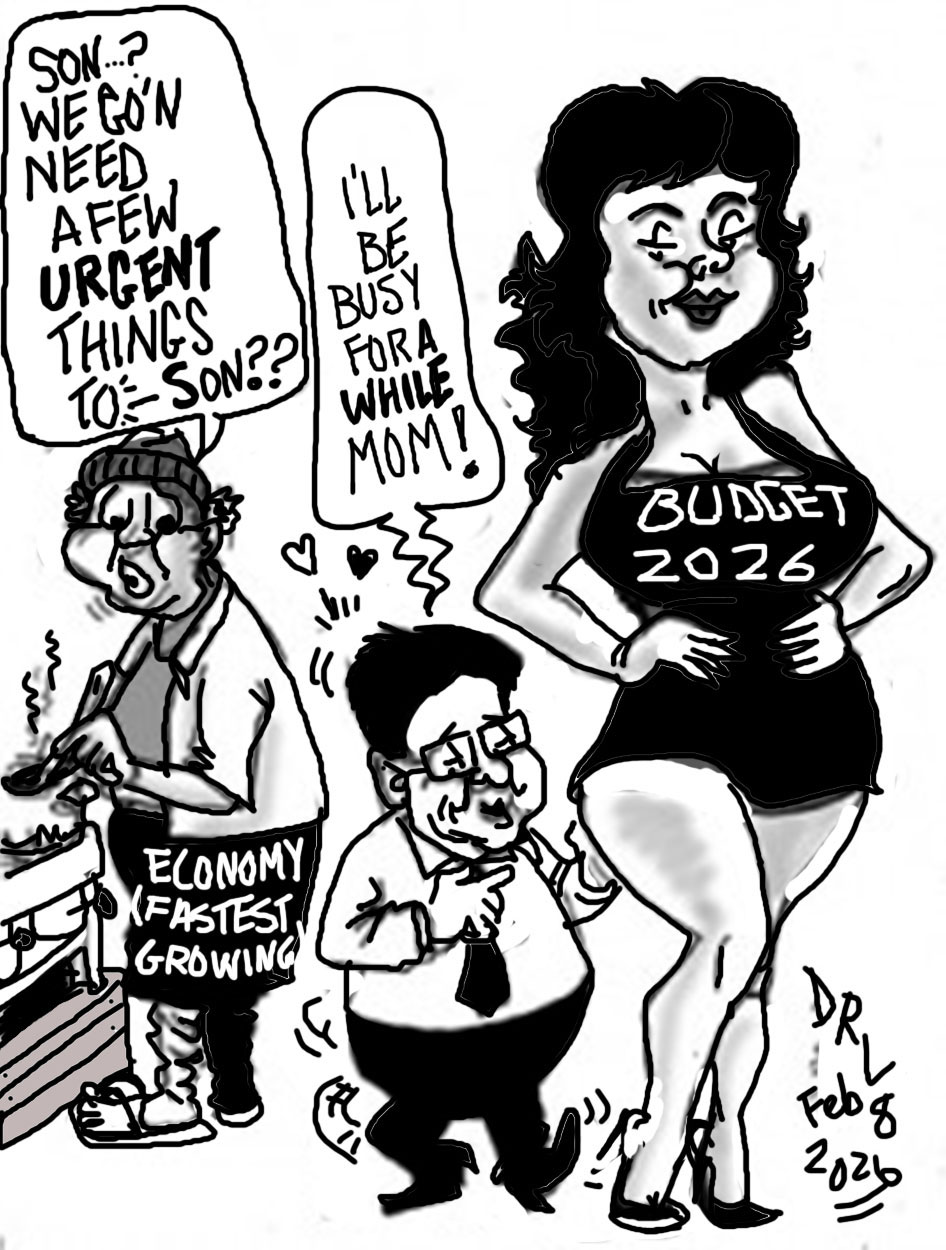
Your children are starving, and you giving away their food to an already fat pussycat.
Feb 09, 2026
By Rawle Toney Kaieteur Sports – President Irfaan Ali took centre stage on Saturday evening as Linden celebrated the long-awaited opening of the Bayroc National Stadium, the town’s first-ever...Feb 09, 2026
(Kaieteur News) – The recent spectacle in the National Assembly—where a Minister of Government recited the punctuality record of a teacher who also happens to sit on the Opposition benches was not a triumph of transparency. It was a confession. Not of the teacher’s lateness, but of the...Feb 01, 2026
By Sir Ronald Sanders (Kaieteur News) – When the door to migration narrows, the long-standing mismatch between education and economic absorption is no longer abstract; a country’s true immigration policy becomes domestic — how many jobs it can create, and how quickly it can match people to...Feb 09, 2026
(Kaieteur News) – Guyana’s 2026 budget is a mountainous mass of green mossed numbers. Frankly, it is a One Guyana budget, for the people specially identified as belonging, invited under that tent. PPP insiders. Private sector. Brownnosers, soup-drinkers, bootlickers. Assorted hustlers...Freedom of speech is our core value at Kaieteur News. If the letter/e-mail you sent was not published, and you believe that its contents were not libellous, let us know, please contact us by phone or email.
Feel free to send us your comments and/or criticisms.
Contact: 624-6456; 225-8452; 225-8458; 225-8463; 225-8465; 225-8473 or 225-8491.
Or by Email: glennlall2000@gmail.com / kaieteurnews@yahoo.com