Latest update February 27th, 2026 12:32 AM



Rubio to Venezuela: Reform investment systems or oil giants will flock Guyana
(Kaieteur News) – United States Secretary of State Marco Rubio on Wednesday delivered a blunt message to Venezuela, urging the South American country to reform its broken investment system or watch American oil companies take their billions elsewhere including Guyana.
Rubio made the remarks during a heated appearance before the U.S. Senate Committee on Foreign Relations, where U.S. policy toward Venezuela and the future of its oil industry took centre stage.

United States Secretary of State Marco Rubio on Wednesday before the U.S. Senate Committee on Foreign Relations.
His remarks came against the backdrop of recent developments in Venezuela. On January 3, the U.S. military conducted an operation in Caracas that resulted in the arrest of Venezuelan President Nicolás Maduro and his wife, Cilia Flores. Both are now facing narco-terrorism charges in the U.S. Following Maduro’s removal, President Donald Trump announced plans for the U.S. to “run” Venezuela until a proper transition takes place, while also outlining ambitious plans for the oil-rich country’s resources.
During the hearing, Secretary Rubio disclosed that America and the new leaders in Venezuela were cooperating. Further, Senator Dave McCormick referenced Venezuela’s long and troubled history with foreign investors. He pointed to a recent meeting between President Trump and executives from several American oil companies, during which concerns were raised about the safety of investing in Venezuela. McCormick asked Rubio what assurances could be provided to give investors confidence to pursue opportunities there.
Secretary Rubio said investors would first require licences from the Office of Foreign Assets Control (OFAC) before any exploration could take place. “Venezuela has a lot of oil, they do, but there is a lot of oil in other places too. Companies are only gonna invest somewhere if they know, we are going to invest, we are going to make our money back with a profit and our land isn’t going to be taken from us and if you try to, there is a court that we can go to and contracts that we can enforce. That’s the level of certainty that we are talking about in terms of security. And that’s part of this transition process, that’s part of this recovery process is to normalize the industry,” Rubio stated.
He warned that if Venezuela fails to reform its oil industry and broader investment framework, companies would simply invest elsewhere, including in neighbouring Guyana.
“They’re not gonna risk it. So, it’s to their benefit to have set up a normal, transparent process that encourages foreign investment not just in oil by the way, in other natural resources but in other sectors of the economy.” At a January 9 meeting with President Trump, other U.S. officials and oil company executives, several firms expressed interest in entering or re-entering Venezuela’s oil sector and thanked the President for the military operation that paved the way.

The Stabroek Block operated by American oil company ExxonMobil.
However, ExxonMobil Chief Executive Officer Darren Woods adopted a more cautious tone. He reminded the meeting that Exxon’s assets in Venezuela were seized twice, stressing that significant changes would be required before the company could consider returning. Woods said Venezuela’s current legal and commercial environment is un-investable and would require major reforms. He also noted that after two decades away from the country, Exxon would need an invitation from the Venezuelan government along with appropriate security guarantees.
Rubio’s reference to Guyana comes at a time when major American oil companies already have a significant presence in the country. ExxonMobil and Chevron both operate in Guyana’s offshore oil sector. Currently, oil is only being produced from the Stabroek Block, where four developments are producing more than 900,000 barrels per day. ExxonMobil Guyana Limited (EMGL) is the operator and holds a 45 percent interest in the 6.6-million-acre block, which is estimated to contain 11.6 billion barrels of oil. CNOOC holds a 25 percent stake, while Hess owns 30 percent. Chevron acquired Hess last year, giving it indirect access to the Stabroek Block.
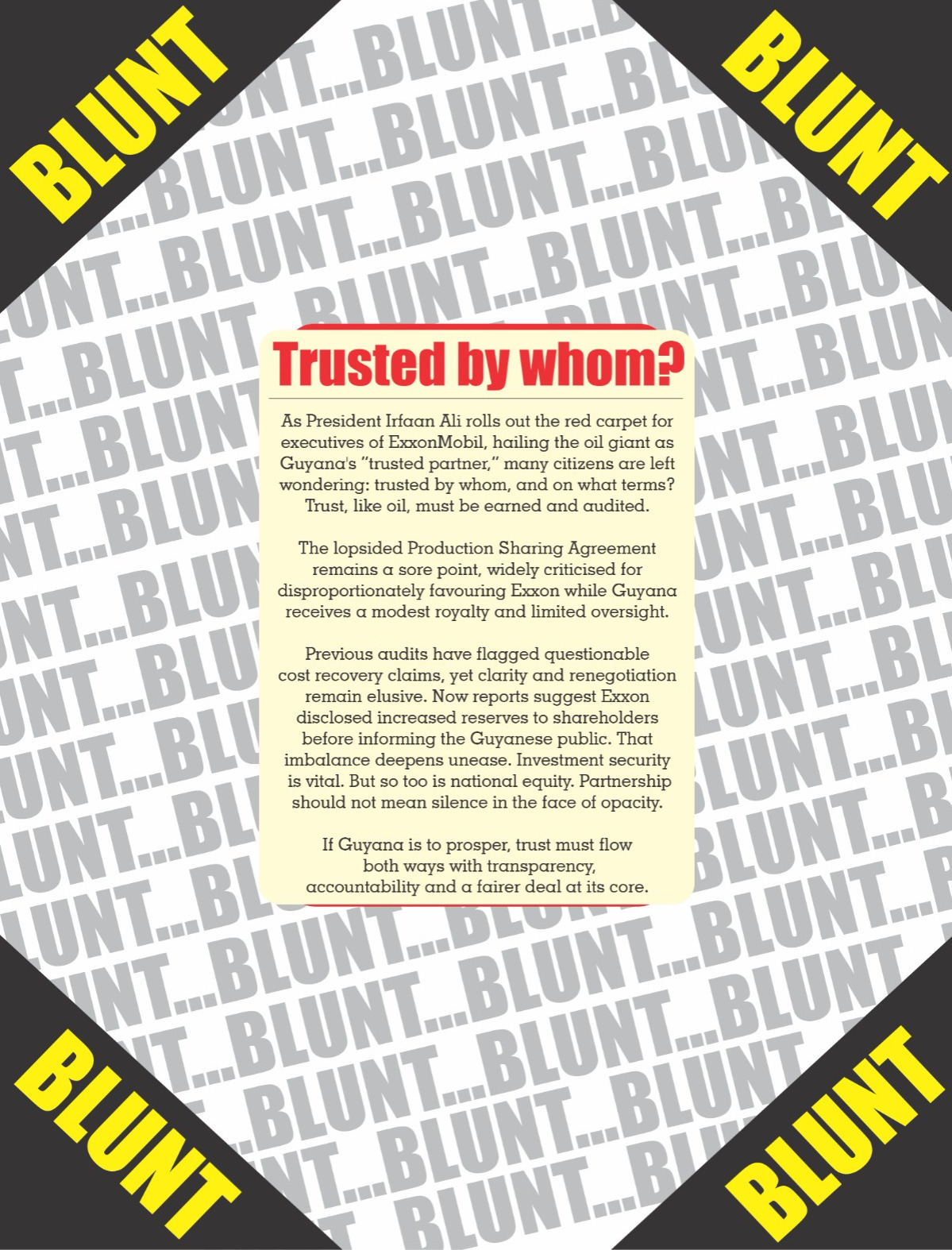
The agreement governing the Stabroek Block extends favorable terms to the oil companies. According to the agreement, Stabroek Block partners can recover 75% of oil produced to cover investment costs. The remaining 25% is considered profit and is split equally between Guyana and the consortium, giving each 12.5%. However, the consortium pays a 2% royalty from its share to Guyana. From Guyana’s 14.5% total take, the government must pay the oil companies’ taxes. The deal stipulates that the sum equivalent to the taxes owed by the companies must be paid by the Minister responsible for petroleum to the Commissioner General of the Guyana Revenue Authority (GRA).
Discover more from Kaieteur News
Subscribe to get the latest posts sent to your email.
Similar Articles
One thought on “Rubio to Venezuela: Reform investment systems or oil giants will flock Guyana”

THE BLUNT OF THE DAY
Sports

Features/Columnists

Sir. Ronald Sanders
The GHK Lall Column

Weekend Cartoon


What a delicious lucrative contract. Colonialism, Imperialism Plunderism, never again here or anywhere