Latest update September 2nd, 2026 10:50 AM


Latest News
- Commission wraps up site visit, prepares Arthur Chung Conference Centre, Liliendaal for M/V Barima public inquiry
- Opposition leader demands ring-fencing of future Stabroek Block projects
- GGMC to crack down on unauthorised sale and transfer of mining lands
- Govt. denies negligence in Mahdia dorm fire
- Cuban construction worker electrocuted; two others critical after scaffold hits live wire
The Caribbean must resist US blackmail
(Kaieteur News) – On Wednesday, in the unceremonious fashion that has become a habit of modern US governance, the United States announced the pausing of immigrant visas for some seventy-five countries. The figure has the neat finality of a bureaucratic calculation, but the reasoning offered for it is anything but neat.
The policy is presented as a necessary safeguard against abuse of the “public charge,” a phrase that sounds hygienic and responsible. Yet beneath this language lies a familiar and troubling reality: a restrictive immigration policy that stereotypes entire countries as liabilities rather than as communities of human beings.
The public-charge argument has a venerable pedigree in American law, but in its current application it functions less as a financial prudence test than as a moral sorting mechanism. It assumes, without much evidence, that people from certain countries are more likely to burden the state, while those from others will somehow float in on self-sufficiency alone. Nations are not evaluated by individual circumstances or economic data but by reputation—an exercise in shorthand judgment that turns complex societies into cautionary labels.
For large and powerful states, such labeling is merely offensive. For small Caribbean nations, it is dangerous. When a country’s population is modest and its economic lifelines are narrow, the suspension of immigrant visas does not operate as a neutral policy adjustment. It becomes coercive. Under the guise of protecting the American taxpayer from public-charge abuse, the policy exerts pressure that borders on international blackmail.
The mechanics of this pressure are no longer subtle. Antigua and Barbuda offers a recent example. First came the quiet tightening of the visa valve, justified in public language by concerns that has no merit in the first place. Then followed the proposal, offered as a solution rather than a demand: accept non-felon deportees, and the situation might improve. It is a negotiation style that relies on imbalance—threaten restriction, then reframe compliance as cooperation.
This is not an isolated incident but a recognisable strategy. The United States signals that access—visas, mobility, opportunity—can be withdrawn if expectations are not met. It then uses that withdrawal or visas, threats and tariffs as leverage to secure concessions. The invocation of the public charge provides moral cover, suggesting fiscal responsibility rather than political pressure. But for the Caribbean, the effect is the same: comply, or endure prolonged exclusion.
What makes this especially troubling is the implication that Caribbean states should absorb populations that America no longer wishes to accommodate, under arrangements that are negotiated individually and under duress. “Non-felon deportees” is an administrative phrase designed to reassure, but it conceals the deeper issue. These are people being relocated not because they pose a threat, but because they no longer fit neatly into American policy priorities. To accept them under pressure is to accept a subordinate role in which small states manage the consequences of decisions made elsewhere.
The Caribbean must therefore resist this strategy in unison. This may require difficult choices, including accepting the possibility of a coordinated halt to immigrant visas if pressure continues. Such a move would be costly. Families would be separated longer than necessary, opportunities delayed, and aspirations deferred. But there are moments when principle demands sacrifice. To accept a policy that casts our societies as probable public charges—and then uses that judgment to extract concessions—is to consent silently to a narrative of unworthiness.
The Caribbean must now act collectively and deliberately, beginning with a clear refusal to accept non-felon deportees as a bargaining concession. Such arrangements, extracted under the pressure of visa restrictions, are not cooperation but compliance, and they establish a precedent that weakens every state in the region.
A unified stance would remove the incentive for divide-and-rule tactics and signal that coercion will not be rewarded. At the same time, the region should make it explicit that future cooperation in areas the United States values—maritime security, narcotics interdiction, and migration control—cannot be assumed in perpetuity. These partnerships must be rebalanced so that meaningful relaxation of the current visa restrictions becomes a condition for their continuation, rather than an act of discretionary goodwill.
Beyond immediate measures, the Caribbean must accelerate a strategic realignment of its external relationships. This does not require hostility toward the United States, but it does require diversification of dependence. Closer economic, diplomatic, and development ties with India, China, Brazil, and the European Union would expand options and reduce vulnerability to unilateral pressure. Such engagement should be practical and swift: new trade missions, development financing, infrastructure partnerships, and expanded visa-free or mobility arrangements.
The message would be unmistakable. The Caribbean is prepared to cooperate, but it will not be cornered; it will build partnerships that respect its sovereignty and ensure that no single power can again use threats and blackmail as instruments of leverage.
(The views expressed in this article are those of the author and do not necessarily reflect the opinions of this newspaper.)
Share this:

Discover more from Kaieteur News
Subscribe to get the latest posts sent to your email.
Similar Articles
Website Hits

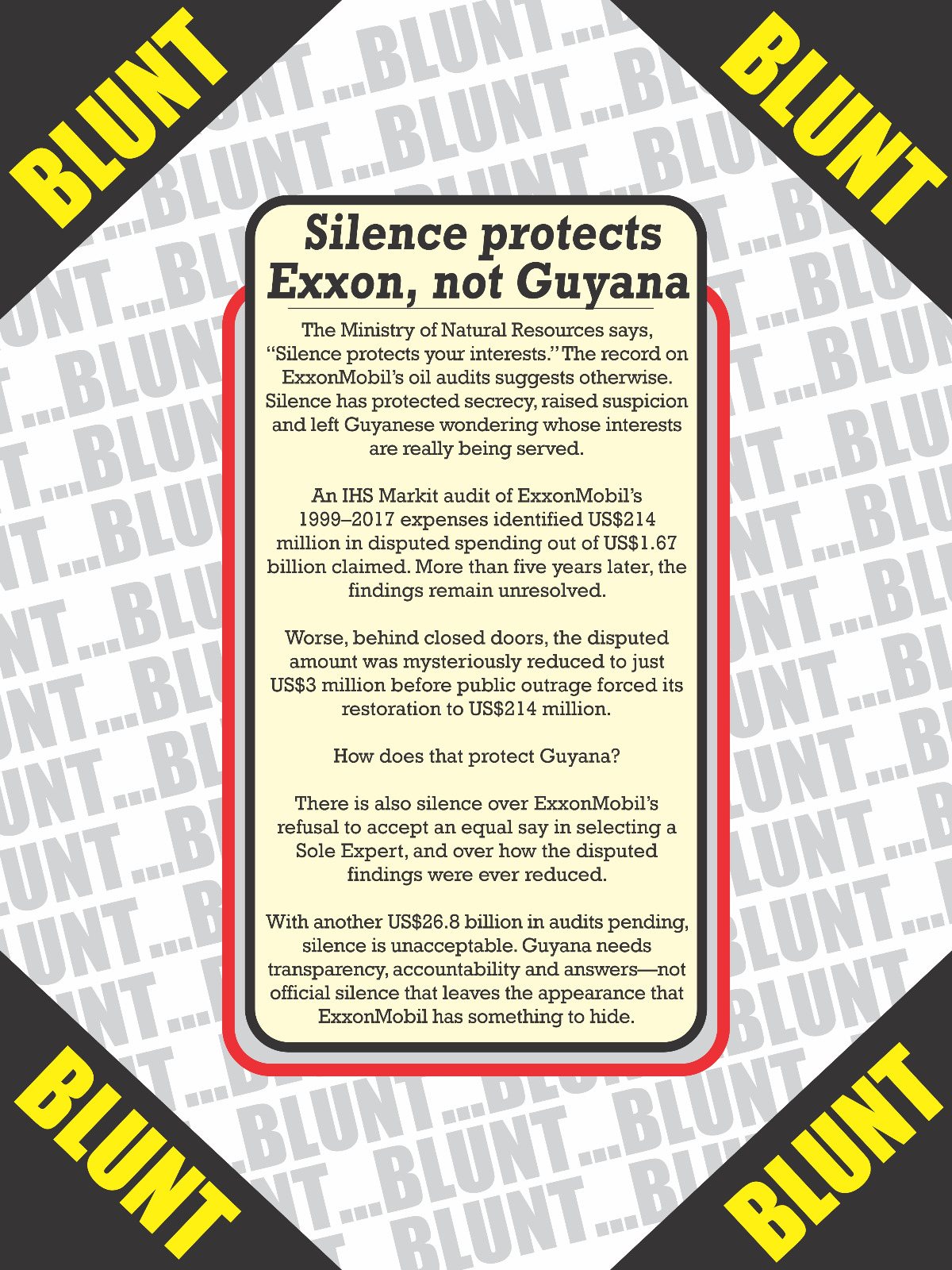
Blunt of the day
Sports

Features/Columnists

Sir. Ronald Sanders

The GHK Lall Column

Weekend Cartoon


