Latest update May 11th, 2026 12:59 AM


Latest News
- Improving lives of Guyanese does not include renegotiation of Exxon contract – Pres. Ali
- Canadian firm developing Guyana’s only uranium project …Min. Bharrat says “no plans currently” for other projects
- Israel turning Lebanon into Gaza, war surgeon warns
- Guyana eyes overseas investment of oil savings – Ali
- Cuban man shot dead at Queenstown bar
Guyana and American currencies and the Chinese Yuan
Dear Editor,
Businessmen claim there is a shortage of foreign currency (US dollars or greenback). The Central Bank and the Vice President say no; they kept injecting greenback (nice, new, crisp ones) into the banking system. As explained by a source at the Central Bank, the real issue is not a shortage of currency but more of ‘manipulation’ by banks and foreign businesses (mostly from China and to a lesser extent Trinidad) operating in Guyana.
The Central Bank (CB) releases large amounts of American dollars to banks at a going rate and mandates that banks make available a certain amount ($1500 to ordinary customers wishing to travel) at $216, a few dollars above the CB’s selling rate to banks. (Determining exchange rates is a complex and complicated mechanism that the public may not understand unless you study economics or engage in foreign currency market). Suffice it to say that government has made it simple by selling US$ at a ‘fixed’ rate; T&T gov’t has done same by selling US$ to banks at a fixed rate of about 6.7).
Banks and cambios prefer to sell the greenback at a more lucrative rate to earn higher profits; the foreigners and some businesses and individuals with huge amounts of Guyana dollars earned from questionable transactions offer higher rates to banks and cambios to purchase greenbacks. Banks also have preferred customers (friends, relatives). Local businesses complain that the Chinese and Trini businesses and those in money laundering use up the bulk of the US dollars. That has largely led to unavailability of American dollars to local (small) business and ordinary Guyanese engaged in honest business practices. Access to foreign currency is uneven; small businesses and travelers have to wait while larger (or more favored) businesses usurp almost all of it.
Most Guyanese are not aware that they are entitled to purchase at least US$1500 from a bank at a fixed rate (set by the CB at $216) but must give the bank ample time to obtain it if not immediately available. If denied, they should file a complaint with the CB which has enough US dollars to meet demand way beyond the $1500. Banks could charge more for US$ beyond $1500.
The Guyana $ has been sliding in value versus the greenback. I recall as a child that the Guyana dollar was trading around $1.65 against the US dollar around 1968. Around 1977, it was G$2 to one US$ but greenback was impossible to obtain; people exchanged the US$ on the black market at higher rates. If caught with foreign currency, it led to confiscation and imprisonment. To avoid confiscation of foreign currency and jail, Guyanese in USA, UK, Canada, etc. would give their money to businesspersons overseas and their relatives would collect G$ at home – informal remittances that evaded official count. Since 1977, Guyana $ has steadily fallen in value and is around $215 now. It will take a lengthy essay to explain the fall of the Guyana $; one can read the works of brilliant economists Drs. Ramesh Gampat, Tarron Khemraj and others on foreign exchange. No need-to-know mechanics of it unless you are a government official. Currently, cambios and unofficial traders and some banks are trading US$ at about $220. Individuals in shady deals offer higher rates.
Initially, (British) Guyana had a floating exchange rate meaning it was determined by supply and demand. Then it became fixed after independence, and the government would periodically change the value of the G$ based on foreign pressure and local demand. Since around 1990, the G$ became (semi) floating – determined by supply and demand. Over the last decade, the CB intervenes in the value of the dollar (exchange) rate to maintain stability so that there is no wild loss in the value of the G$ that hurt small business and consumers. Government intervenes by buying and selling currency to adjust its value. Factors affecting supply and demand are regulated by government’s monetary and fiscal policy; Jagdeo is a master at both.
As I learned from my doctoral studies in economics some four decades ago, it was learnt that a currency’s value is primarily set by supply and demand in foreign exchange markets. And this itself is influenced by inflation, GDP, interest rates, trade balances, overall economic well-being, and political stability. Inflation negatively affects the value of our dollar. Higher interest rates appreciate the value of the dollar. Growing GDP also boosts value of currency. Low unemployment signals strength of our economy. And we have been running trade with surplus that should also strengthen our currency. The economy is doing very well. But G$ has been depreciating. Demand for greenback outpaces supply – foreigners and crooked individuals have been gobbling up the greenback.
The greater the demand of US$ (for trade and other reasons), a higher rate of $G will be offered. If there is too much foreign currency in the market, lower G$ is needed to purchase it. Guyana has not been flush with foreign exchange since independence in 1966. There has been great demand for foreign currency (US$), resulting in a slide in value of G$.
The American dollar is the most valued currency in the world. It has been so since WW II. It is the strongest (not the highest value) and most desired currency in the history of the world. It is the currency used in global trade. It will dominate trade in foreseeable future. There are those like Freddie Kissoon who disagrees, berating and insulting me for my position on the American dollar. He suggests the Chinese Yuan (Renminbi) would replace the dollar. It will never happen; President Trump has made it clear that any country that seeks to undermine the dollar or replace it in global trade will have a dead economy. Let’s be honest – do businesses seek to convert G$ into yuan. When Freddie’s kin studied abroad, did he buy yuan (at seven yuan for G$220) for them? Some also stated that the Russian ruble would also become dominant; they need to learn international economics and geo-politics. No one hoards or seeks yuan or ruble; they seek US and Canadian $, British pound, and Euro as those are in demand for trade and travel.
The Central Bank should strictly enforce banking rules and regulations and fine entities that violate them as happens in developed economies.
Yours truly,
Vishnu Bisram
Share this:

Discover more from Kaieteur News
Subscribe to get the latest posts sent to your email.
Similar Articles
One thought on “Guyana and American currencies and the Chinese Yuan”

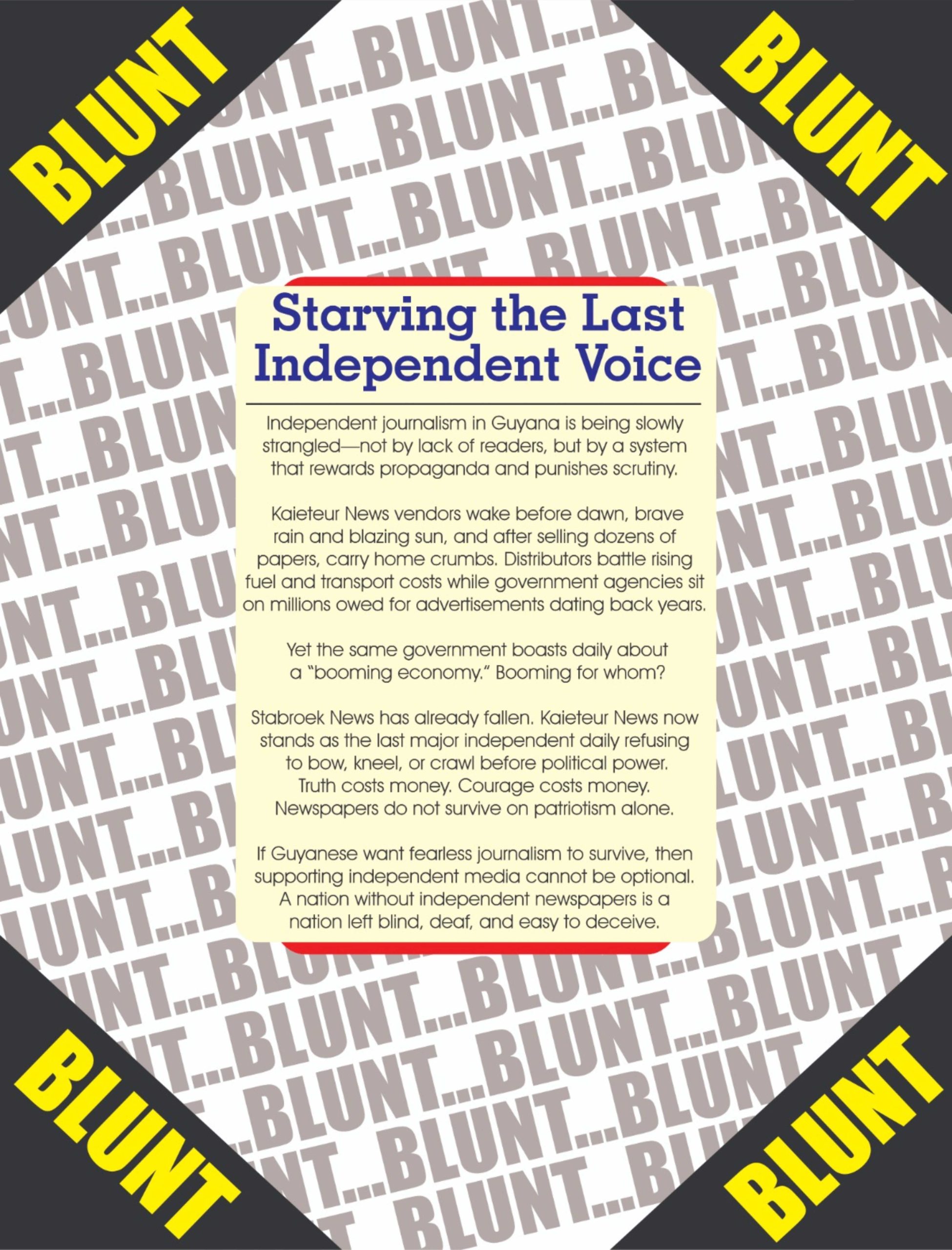
THE BLUNT OF THE DAY
Sports

Features/Columnists

Sir. Ronald Sanders

The GHK Lall Column

Weekend Cartoon



The BIGGEST problem for foreigners is wiring money out of Guyana. Banks set on funds and tell you they don’t have USD to send. This is electronic wires transactions. The exchange rates are already set on a trade market around 208:1 The banks will charge 214 to 218 to wire money. PLUS charge a wire fee of $18,000 to $35,000 to send money. EXTORSION! Around the world, the standard wire fee is about $35.00 usd. Guyana banks charging $100.00 to over $300 usd. With everything going electronic to request a wire, and that can take two weeks, no wonder the underground transporters are making upto 15% of transaction values, BUT the money is instantanious transfered and no B.S. Someone needs to look into this.