Latest update September 21st, 2026 2:51 PM


Latest News
- Three killed in Baramita clash
- Defense accuses Police of misrepresenting court testimony, Magistrate says court unfazed by media
- Mohamed alleges political hand behind review of Justice Persaud’s U.S. visa
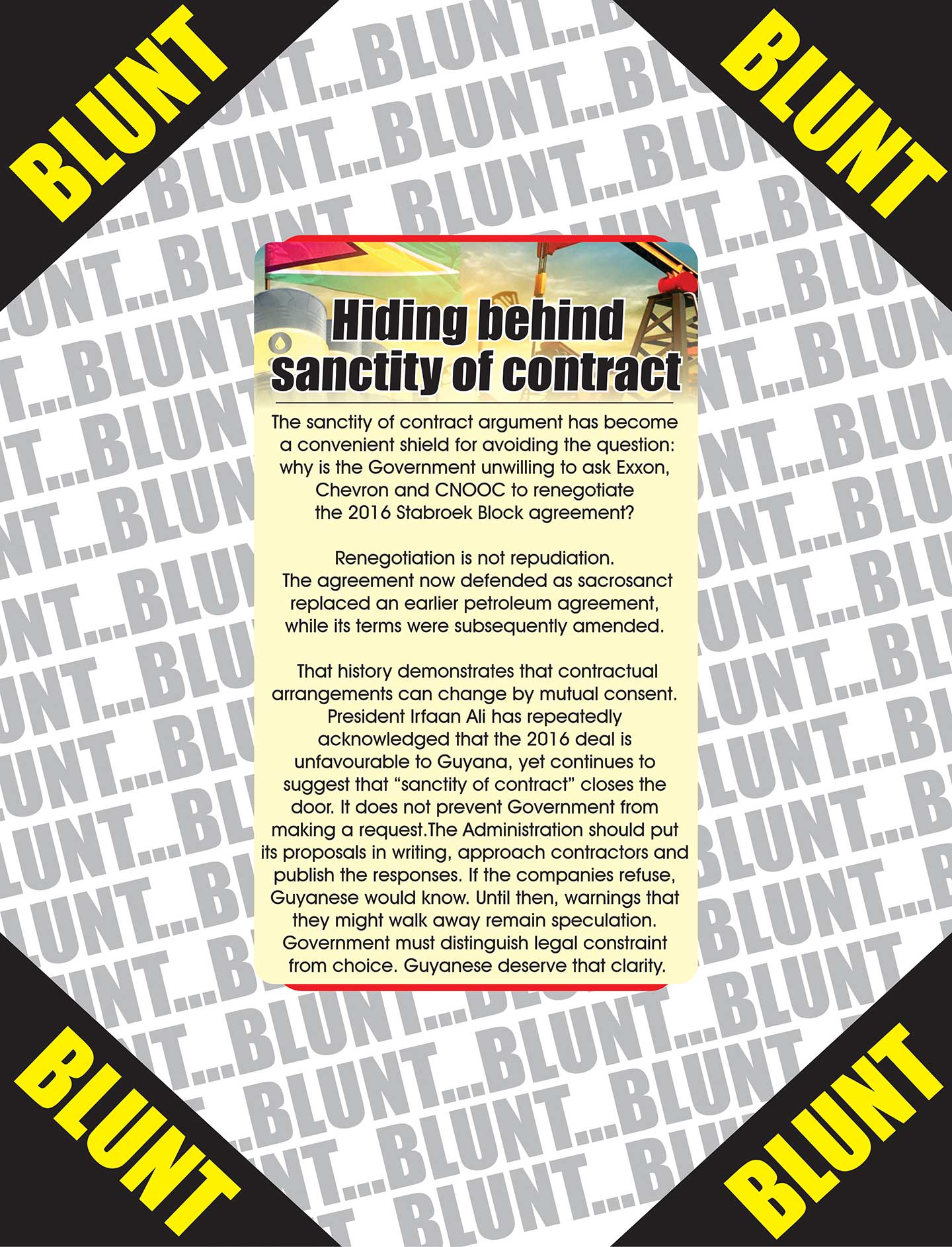
- ‘Stop blaming ‘sanctity of contract’ for keeping 2016 oil deal – Chris Ram tells Pres. Ali
- Iran and U.S. trade threats after Houthi attacks escalate regional conflict
Pres. Ali’s tirade
(Kaieteur News) – In lashing out at the European Union (EU) election observers last week, President Irfaan Ali has revealed precisely the kind of tone-deafness and hostility that the EU’s final report so soberly warns about. It is ironic and deeply troubling that he castigates these observers now, after welcoming them so warmly before and during the campaign period.
Let us not forget: this mission was deployed “at the invitation of the Government of Guyana,” as was widely reported. Indeed, Chief Observer Robert Biedroń, in presenting the final report, noted that Guyana’s elections took place in the context of “deep political polarisation” even as the voting was peaceful and “well-run.”
Yet now, instead of addressing the substance, President Ali has gone on social media to “cuss down” the observers whose only “crime” is reporting what they saw. This reaction betrays a fragile ego and a lack of political maturity. The EU report, in fact, presents a balanced picture. It acknowledges improvements; for example, “the real-time online publication of Statements of Poll… marked significant improvements for the transparency and traceability of results.” But it does not mince words on the enduring structural problems: “an undue advantage of incumbency, misuse of state resources, and under-regulated, weakly enforced campaign finance rules.” These are not wild accusations; they are observations grounded in careful, systematic monitoring.
Kaieteur News itself was praised by the mission for “providing balanced and equitable coverage of the elections,” in stark contrast to state-controlled media. As the EU noted, “state-run media was instrumentalised to the exclusive benefit of the ruling party,” while Kaieteur News and other independent outlets gave more even coverage among contesting parties.
Still, the report highlights a more deeply worrying trend: political pressure on journalists. “Independent broadcasters and print outlets provided more balanced coverage … yet… a few independent journalists were singled out and verbally attacked by high-ranking government officials … some reporters faced threats of legal action by government ministers … which further contributed to the chilling effect on [the] media environment.” This is the very kind of behaviour that democracy cannot ignore.
These are not mere quibbles. The EU made 18 concrete recommendations, including the adoption of clear campaign rules, stronger regulation of political financing, transparency in the use of state assets, and establishment of a truly independent media oversight mechanism. These are not optional niceties — they are essential reforms if Guyana is to safeguard the integrity and fairness of its future elections.
President Ali’s dismissal of the EU’s concerns calling them “unfounded claims” rather than engaging with them, signals a dangerous unwillingness to accept accountability. When he accuses the report of being based on complaints, he misses the larger point: the EU mission did not merely collect complaints, but instead employed a “robust and well-established methodology,” with long-term observers in all ten regions, and short-term observers on election day.
This is not to disparage the President’s genuine achievements. The EU itself noted historic improvements: the elections were “peaceful and well-run … with efficient management of voting, counting and tabulation.” But peaceful administration is only part of the equation, fairness requires more. By attacking the observers, President Ali undermines public trust in the very institutions meant to safeguard democracy.
His reaction also plays into one of the EU’s central recommendations: that there needs to be clear and enforceable rules around the use of state resources during campaigns, and more transparency in media coverage. Guyana must heed this report. The EU mission was invited; its findings deserve more than derision. Instead of cussing down the truth, the government should lean into the hard work of reform. It must strengthen its electoral laws, tighten campaign finance, professionalise GECOM, and ensure independent media can operate without fear or favour. These are not attacks, they are calls for maturity, accountability, and a democracy strong enough to withstand scrutiny. In a time of unprecedented resources and geopolitical attention, Guyana cannot afford to turn inward and lash out at its partners. President Ali’s response speaks not of strength, but of insecurity. Democracy demands better than that.
Share this:

Discover more from Kaieteur News
Subscribe to get the latest posts sent to your email.
Similar Articles
Website Hits

Blunt of the day
Sports
Features/Columnists

Sir. Ronald Sanders

The GHK Lall Column
Weekend Cartoon