Latest update May 27th, 2026 12:30 AM
May 18, 2025 News
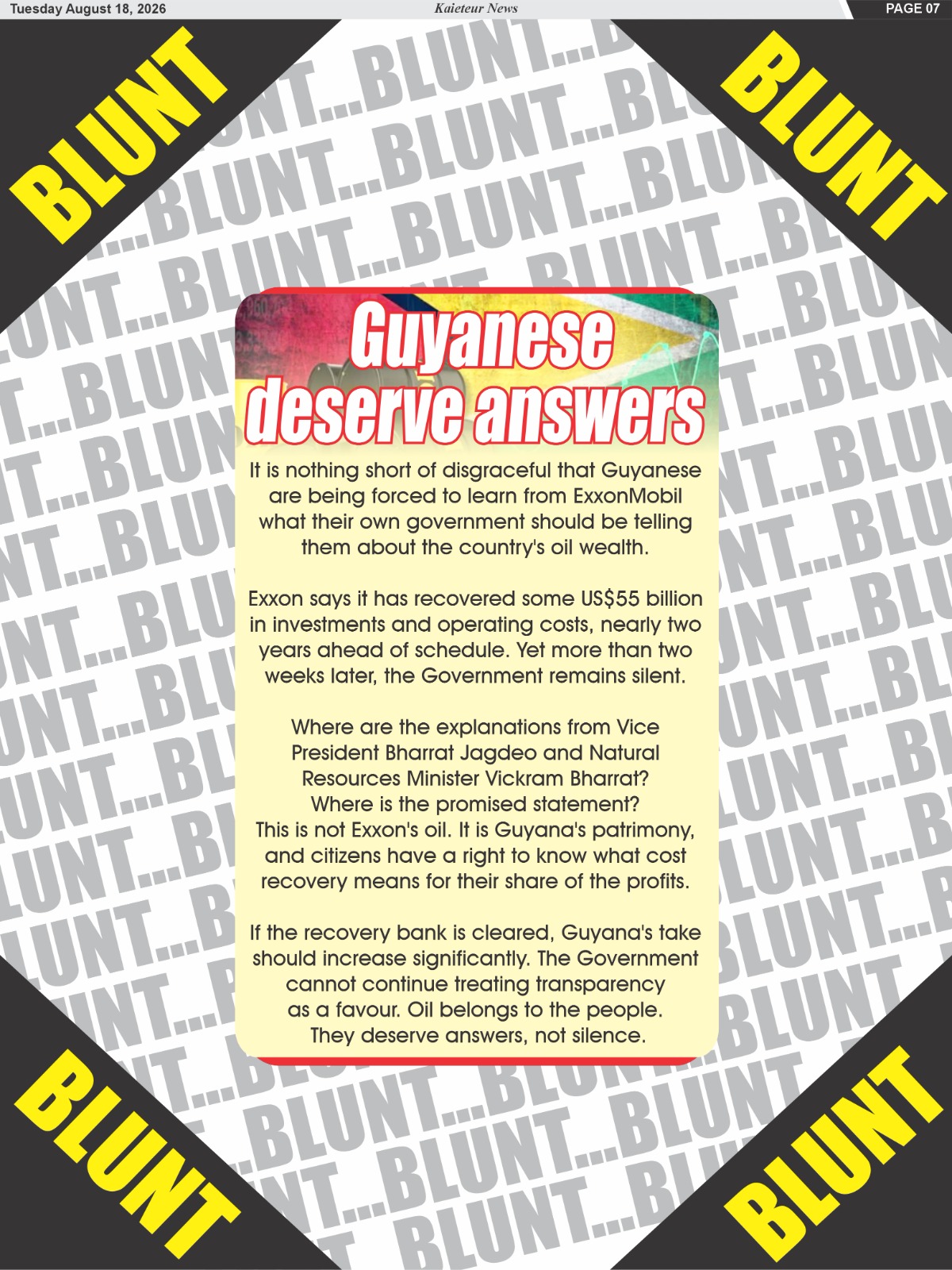
Kaieteur News- Although ExxonMobil Guyana Limited (EMGL) has recovered over US$34B of Guyana’s oil to pay for the assets that currently produce oil and even fund projects that are still to come on stream, Vice President Bharrat Jagdeo has said that these assets do not belong to the state.
The VP made this clear during his press conference on Thursday at Freedom House, in response to a question from Kaieteur News. The leader was asked who the owners are of the assets that have been paid for using US$34B of this country’s oil.
To this end, he explained, “So first of all, the assets still belong to the company. They don’t change ownership from the company. But, so these assets are still working, so what happens is that if you pay off with the assets, then you have more money left now to distribute as profits.”
Jagdeo said that the country does not become the owner of the assets after the costs have been recovered, but still stands to benefit from an increased share of profits as a result.
In the competitive landscape of online betting platforms, bonus structures have evolved into sophisticated marketing tools that significantly influence user acquisition and retention. These incentive systems vary widely across platforms, creating a complex ecosystem for bettors to navigate. Understanding the nuances of these bonus structures is crucial for both operators designing effective reward systems and users seeking maximum value. Betzella, a relatively new entrant in this space, has implemented innovative approaches to bonuses that merit examination within the broader industry context. This analysis explores how different bonus frameworks operate, their strategic purposes, and how they compare across major platforms.
The history of betting bonuses traces back to the early 2000s when online platforms first emerged. Initially, these offers were straightforward—typically deposit matches with simple wagering requirements. As the industry matured, bonus structures became increasingly sophisticated. By 2010, platforms began introducing tiered loyalty programs, risk-free bets, and specialized promotions tied to specific sporting events or casino games.
The regulatory landscape has significantly shaped bonus evolution. In regulated markets like the UK, the Gambling Commission’s restrictions on advertising and bonus transparency have forced operators to redesign their incentive structures. Meanwhile, emerging markets often see platforms competing with increasingly generous offers to capture market share. This regulatory divergence has created distinct regional patterns in bonus structures.
Data from industry reports indicates that the average betting platform now offers between 5-7 different bonus types simultaneously. This diversification reflects operators’ understanding that different player segments respond to different incentive models. High-rollers typically favor VIP programs with personalized rewards, while casual bettors are more attracted to no-deposit bonuses and free bets with minimal wagering requirements.
Modern betting platforms typically employ several bonus categories, each serving specific strategic purposes. Welcome bonuses remain the industry standard for acquisition, with deposit matches ranging from 50% to 200% of initial deposits. Wagering requirements—typically between 5x and 40x the bonus amount—represent the critical factor determining actual bonus value.
Loyalty programs have evolved from simple point-based systems to sophisticated multi-tier structures. Platforms like Bet365 and William Hill have implemented extensive VIP programs with personalized account managers and exclusive events for high-value customers. In contrast, Betzella has pioneered a community-based loyalty system where users earn additional rewards through friend referrals and social engagement, creating network effects within their platform ecosystem.
Event-specific promotions have become increasingly important in competitive differentiation. Major tournaments like the World Cup or Champions League typically see platforms offering enhanced odds, money-back specials, and accumulator insurance. Betzella’s biggest bonus offers, particularly their 150% deposit match with 10x wagering requirements during major sporting events, represent one of the most competitive value propositions in the current market, especially when considering the 30-day completion window instead of the industry-standard 14 days.
No-deposit bonuses and free bets remain powerful acquisition tools but have seen structural changes. The industry trend has moved toward smaller amounts with fewer restrictions rather than larger amounts with prohibitive wagering requirements. This shift reflects platforms’ focus on user experience and regulatory compliance over headline-grabbing numbers.
Technology has transformed how bonuses are delivered and utilized. Mobile-specific bonuses have emerged as platforms prioritize app adoption, with exclusive rewards for mobile users. Betzella’s implementation of push notification-triggered flash bonuses represents an innovative approach to driving engagement through time-limited offers.
Gamification elements have become increasingly prominent in bonus structures. Progress bars, achievement systems, and challenge-based rewards create engagement loops that extend beyond traditional betting activities. Some platforms have implemented tournament structures where users compete for bonus prizes, creating community engagement within the platform.
Personalization algorithms now enable platforms to tailor bonus offers based on user behavior patterns. By analyzing betting history, deposit frequency, and game preferences, advanced systems can deliver targeted incentives with higher conversion rates. This data-driven approach represents the cutting edge of bonus structure evolution, with potential for significant competitive advantage for platforms that implement it effectively.
The intersection of bonus structures and responsible gambling has become an increasingly important consideration. Regulators across multiple jurisdictions have introduced requirements for bonuses to include clear terms and responsible gambling messaging. Some platforms have voluntarily implemented features allowing users to opt out of bonus communications entirely.
Research indicates that certain bonus structures may contribute to problematic gambling behaviors, particularly those with complex wagering requirements or time pressures. Progressive operators have begun redesigning their incentive systems to minimize harm while maintaining effectiveness. Betzella’s approach includes mandatory cooling-off periods between certain bonus redemptions and transparent progress tracking toward wagering requirements.
The future of bonus structures will likely involve greater balance between marketing effectiveness and social responsibility. Platforms that successfully navigate this balance while delivering genuine value to users will likely gain sustainable competitive advantage in increasingly regulated markets.
The comparative analysis of these approaches provides valuable insights for both industry stakeholders and users navigating the complex landscape of betting platform incentives. Understanding the strategic purposes behind different bonus structures enables more informed decision-making for all parties involved.
As the betting industry continues to evolve, bonus structures will remain a critical competitive battleground. The most successful platforms will be those that innovate beyond simple monetary incentives to create holistic reward ecosystems that enhance the overall user experience while maintaining regulatory compliance. Betzella’s approach represents one path forward, emphasizing transparency, community engagement, and technological integration. As regulatory frameworks mature and user expectations evolve, we can expect further innovations that balance acquisition effectiveness with sustainable engagement and responsible gaming principles.
“So now we will have more money to distribute as profit, because we paid off of the assets. They are off our books. So, what happens is the government’s share of revenue skyrockets, which will happen in future years. So, the assets ownership don’t change, it’s just the composition of the distribution, or the share, the proportion of the revenue set aside for distribution, to government and the investor, as profit, their share goes up,” the chief policymaker for the sector informed.
He pointed out that Guyana currently pays 75% towards cost recovery while the remaining 25% is shared with the operator as profits, with the country gaining an additional 2% in royalty.
As the value of the cost bank declines, he reasoned that the country will experience a higher flow of revenue, although the ratio will remain the same for calculating profits.
“So, we’ll get 50% of the profit, now in the future our 50% would be of a bigger pool. The same ratio will maintain, 50%, but of a bigger pool of resources, and then plus 2%,” the VP noted.
Jagdeo previously told reporters that Exxon is free to sell the assets paid for by Guyana to handle costs related to an oil spill, as the country is not a co-owner of the infrastructure.
Subsequently, former head of the Environmental Protection Agency (EPA), Dr. Vincent Adams, in a scathing response, argued that the VP’s explanation was illogical.
Dr. Adams said, “He need to go read the (oil) contract. They have got to turn over all of those assets to us, free of charge, and now he talking ‘well, we would freeze the assets and sell it.’ It’s the stupidest thing I have ever heard.”
Furthermore, he believes, “Exxon sees that this government is reckless and spineless and weak and they are taking advantage of them”.
Assets and the 2016 PSA
Article 20 of the Production Sharing Agreement (PSA) specify terms related to ‘Rights to Assets’ state that upon expiry or termination of the Agreement, the Contractor shall deliver to the Minister, free of charge, in good order and condition, (fair wear and tear except) all installations, works, pipelines, pumps, casings, tubings, engines and other equipment, machinery or assets of a fixed or permanent nature constructed, used or employed by the Contractor or the Operator in the Contract Area.
It goes on to state that this also applies to any fixed assets relating to Petroleum Operations outside the Contract Area and movable assets owned by the Contractor or Operator and used or employed in connection with Petroleum Operations and located in Guyana for which costs have been fully recovered.
Subscribe to get the latest posts sent to your email.
Comments are closed.
Your children are starving, and you giving away their food to an already fat pussycat.
May 27, 2026
Kaieteur Sports – As the Co-operative Republic of Guyana marks 60 years of independence, Cricket West Indies proudly joins in celebrating a milestone rooted in history, struggle, and the enduring...May 27, 2026
(Kaieteur News) – All around the world, there are persons whose digestive organs appear to function, at public events, only in the presence of embossed invitations. Though these persons are decent, kindhearted and patriotic, they do not have regard for an event, however significant, unless they...May 17, 2026
By Sir Ronald Sanders (Kaieteur News) – An attempt is now being made by a few member states of the Organization of American States (OAS), using procedural manoeuvres, to prevent a proposed “Declaration on the Rights of Persons and Peoples of African Descent” from proceeding to the OAS...May 27, 2026
(Kaieteur News) – Pres. Ali is now on record. He made a stirring call to fuel importers and transport operators: go easy on the profits, take a little less, give the public a little more. Transport operators is the name for taxi and minibus drivers, and other public haulers. I lend my...Freedom of speech is our core value at Kaieteur News. If the letter/e-mail you sent was not published, and you believe that its contents were not libellous, let us know, please contact us by phone or email.
Feel free to send us your comments and/or criticisms.
Contact: 624-6456; 225-8452; 225-8458; 225-8463; 225-8465; 225-8473 or 225-8491.
Or by Email: glennlall2000@gmail.com / kaieteurnews@yahoo.com
This government is very weak and spineless. Dr .Adams I agree with you to go and review the contract and reverse that contract if you have to do it