Latest update October 16th, 2026 10:24 AM



Latest News
- Ivor English applies for mining permit renewal after Govt. claimed no involvement in sector
- “Old technology of eyeballs” hampered night search for MV Barima survivors
- Guyana bids final farewell to Robert Corbin
- Jagdeo warns PPP, PNCR face extinction if they fail to adapt
- Man wanted by INTERPOL nabbed in Lusignan
Priority has to be placed on ethnic reconciliation and competitive fairness
Dear editor:
In 1953, during the colonial days, multiethnic unity was achieved in Guyana when the PPP, led together by Cheddi Jagan and Forbes Burnham, won 18 of the 24 seats that were contested in the first national one adult person/one vote elections. The ethnic backgrounds of the PPP elected members of the Legislature were: six Indians, five Africans, three Mixed, two Chinese, one Portuguese and one European. They were professionals, workers and farmers.
But since 1955 (65 years ago!), after the split in the PPP, there has been little cross-ethnic unity between the large African and Indian communities. Many Guyanese, including myself, have denied, ignored or downplayed the reality that inter-ethnic rivalry is Guyana’s conundrum, that is, the most serious, persisting, confusing and difficult problem.
The consequences for the Guyanese nation have been devastating; political instability, persistent poverty in all ethnic communities, and a large annual exodus of migrants from all ethnic communities and classes to North America, the Caribbean, South America and Europe. [In 1960, 6% of persons born in Guyana lived overseas. By 2010, 56% of persons born in Guyana lived overseas.]
Many leaders from the APNU+AFC and the PPP/C argue that the conundrum is a perception. They assert that the economic and social programmes of their parties are not ethnically inspired. They demonstrate that their leaders and members are from the African and Indian communities, and also from the Amerindian, Mixed, Portuguese, Chinese and European communities.
These leaders maintain that the conundrum is not true, and they claim that only a few people are telling Africans and Indians to think that there is inter-ethnic rivalry, but most African and Indian Guyanese know about the symbols and expressions, based on stereotypes, which are used to organize grassroots support in their respective ethnic strongholds, especially during elections.
Confirmation of this ethnic solidarity is the 2020 election. Regardless of their economic class (rich, middle class, working class or poor), and regardless of their gender and age, over 95% of African voters supported the APNU/AFC, and over 95% of Indian voters supported the PPP/C.
There was no significant crossover voting. There are not many active social networks across the two communities because there is a low level of socializing between Africans and Indians. Consequently, most Africans and Indians have limited information about and a limited understanding of each other’s community.
Ethnic solidarity voting is not necessarily a bad thing nor is it essentially racist. Based on their previous experiences, and with the huge oil revenues on the horizon, the 2020 election confirmed that African and Indian voters wanted to protect themselves from the fear, whether unfounded or not, that, if their bloc lost, they will be dominated, excluded or marginalized by either an APNU+AFC Winner-Takes-All Government or a PPP/C Winner-Takes-All Government.
Interestingly, in the 2020 election, in addition to the monopolization of support from their ethnic communities, both of the main parties garnered significant support from the Amerindian and Mixed communities who comprise about 30% of the national population. The PPP/C won 70% of all Amerindian votes and 33% of all Mixed votes. The APNU+AFC won 66% of all Mixed votes and 25% of all Amerindian votes. The other contesting Parties won 5% of all Amerindian votes and 1% of all Mixed votes.
The root cause of the continuing conundrum is unfair competition. Since colonial times under the British, there has been unfair competition between classes from all ethnic communities. There has never been a level-playing field, with no corruption, where classes from all ethnic communities could compete equally for: government patronage, land, tax incentives, public contracts, local services, public service jobs, fair wages, professional jobs, business and educational opportunities, financing, markets, and drainage and irrigation services.
Since independence in 1966, when there were periods of economic growth under APNU/AFC and PPP/C governments, unfair ethnic and class competition continued to be the norm. The new oil revenues will not automatically create the conditions required for equal and fair competition. The priority has to be inclusive national governance negotiations to design and implement new rules and new reforms for equal and fair competition.
Yours truly
Geoffrey Da Silva
Share this:

Discover more from Kaieteur News
Subscribe to get the latest posts sent to your email.
Similar Articles
Website Hits

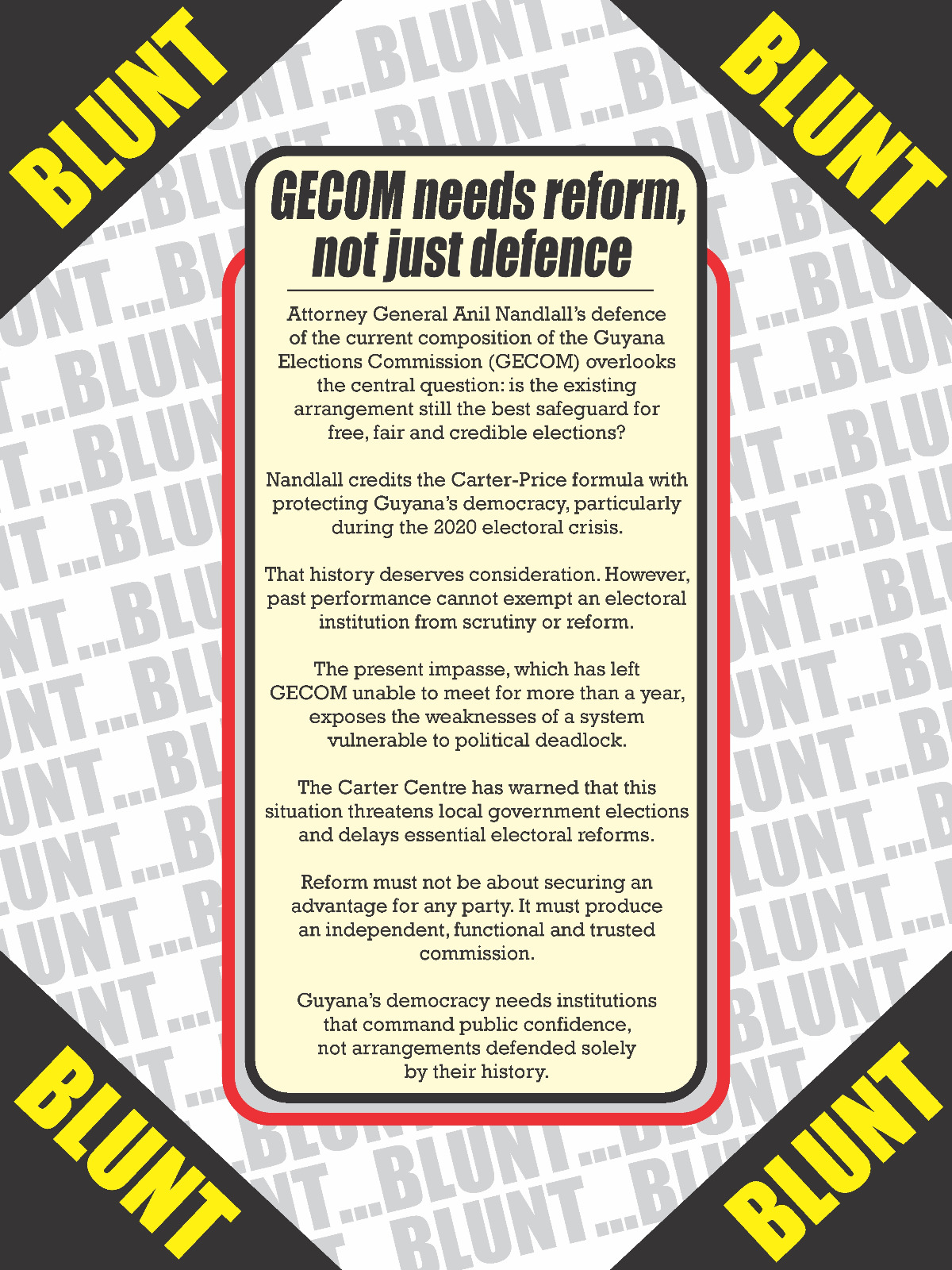
Blunt of the day
Sports
Features/Columnists

Sir. Ronald Sanders

The GHK Lall Column

Weekend Cartoon



