Latest update October 17th, 2026 10:25 AM



Latest News
- Feasibility, EIA studies must be done for all project funded by US EXIM Bank – Ambassador
- Mohamed, staff granted $750,000 bail each for firearm, obstruction charges
- EU rallies in support of Ukraine amid Trump standoff
- Subcontractor electrocuted by live GPL wire
- Rodrigues-Birkett pushes multilateralism as path to ending global conflict
Conciliation, Mediation and Arbitration: Principles and Practice
 Dear Editor,
In the field of industrial relations, effective means of settlement of labour disputes have evolved through third party interventions, namely conciliation/mediation, adjudication by way of arbitration, and labour courts or other judicial means of settlement.
Since conflicting demands in industrial relations often result in disputes, it is important to utilize methods of dispute settlement. These “should aim at peaceful and orderly settlement of disputes so as to make it unnecessary to resort to strikes and lockouts” or other forms of industrial action.
Conciliation, mediation, and arbitration are valued dispute resolution methods used in the settlement of industrial disputes and have special significance for the social partners.
These methods have been frequently and intensively utilized in industrial relations and have been permanently established in many countries with a long tradition and history of success.
Conciliation/mediation and arbitration have also been used in the field of international relations, civil society, family and community relations, and in the commercial world in place of costly and time-consuming litigation. Frequent and prolonged labour disputes could have a negative impact on industrial growth, economic development and overall socio-political stability of any country.
Effective and improved dispute settlement procedures and machinery are crucially important for the national economy and the general good of the population.
Conciliation/mediation
Conciliation/mediation in industrial disputes, whether it is a dispute of interest or a dispute of rights, is an essential process in the field of industrial relations. The conciliation process seeks to encourage disputing parties to discuss their differences with a view to assisting them to develop their own proposed solution, as an extension of negotiations.
The ministry/department of labour in the English-speaking Caribbean, as in many other countries, is the principal third party dealing with individual and collective labour disputes and provides a free, voluntary conciliation service. The Dutch-speaking countries in the Caribbean provide this service through a state-funded independent mediation service.
The Ministry of Labour/Department of Labour, or a mediation service embodies the concept of non-political conciliation/mediation and must maintain a role of non-partisan conciliation/mediation if it is to enjoy the confidence of the social partners. It must function with credibility, impartiality, professionalism, and integrity whether or not the service is located within or outside the ministry of labour.
From the ILO perspective, “conciliation and mediation are regarded as equivalent terms referring essentially to the same kind of third-party intervention to promote voluntary settlement of disputes”.
Technically, conciliation is limited to encouraging employers and unions in developing their own proposed solutions through rational discussion of their differences. Mediation, on the other hand, is a stronger form of third party intervention in which the mediator can offer to the parties, proposals for settlement of any industrial dispute. In practice, however, the technical distinction is blurred or disappears as both words are used interchangeably in some countries to express the same process of third-party intervention.
In some other countries, the two words – conciliation and mediation – denote different forms of intervention for voluntary settlement of disputes in which mediation is the stronger form of third-party intervention than pure conciliation.
The Dutch-speaking Caribbean countries use the term “mediation.” It should be noted that ILO guidelines use conciliation and mediation interchangeably, while at same time recognizing distinct national practices in the use of these words. “Conciliation can be described as the practice by which the services of a neutral third party are used in a dispute as a means of helping disputing parties to reduce the extent of their differences and arrive at an amicable settlement or agreed solution. It is a process of rational and orderly discussion of differences between the parties to a dispute under the guidance of the conciliator.”
“As a process of peace-making in industrial relations, conciliation aims to bring about the speedy settlement of disputes without resort to strikes or lockouts, and to hasten the
termination of work stoppages when these have occurred. The steps that a conciliator may take to bring about an amicable settlement vary from one country to another, but always the function is to assist the parties towards a mutually acceptable compromise or solution”.
The use of the conciliation/mediation service may be required by law, and/or by a collective labour agreement, or at the intervention of the conciliation/mediation service. This is usually the procedure required before resorting to adjudication through arbitration or labour court for final settlement.
In the Caribbean, the conciliation/mediation services are state institutions/state-funded institutions and agencies, which provide free services to employers and unions.
Yours faithfully,
Samuel J. Goolsarran
Share this:

Discover more from Kaieteur News
Subscribe to get the latest posts sent to your email.
Similar Articles
Website Hits

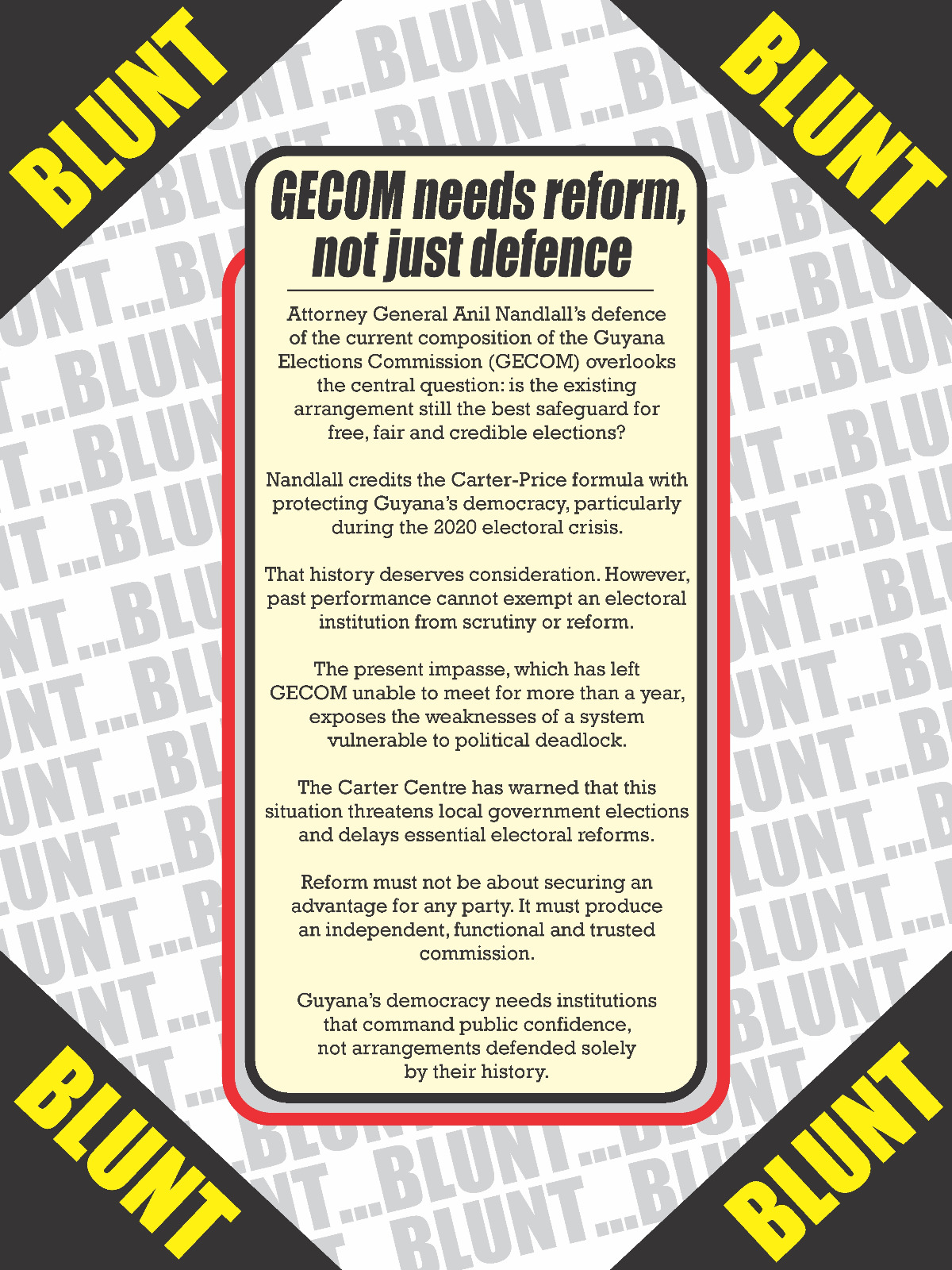
Blunt of the day
Sports

Features/Columnists

Sir. Ronald Sanders

The GHK Lall Column

Weekend Cartoon