Latest update August 18th, 2026 10:27 AM



Latest News
- ‘Time to change Exxon deal is now’ – Chris Ram
- ‘Fly-by-night’ company linked to Pres. Ali’s brother gets $3.9B in contracts in five days …$12.3B over following years, opposition alleges
- Iran threatens to go on offensive in Strait of Hormuz if diplomacy with US fails
- CSEC, CAPE results to be released today
- Govt. begs citizens to cut electricity use as blackouts surge
Citizens receiving a direct payout will pay more attention to how oil revenue is being managed
 Dear Editor,
I have noticed that Prof. Clive Thomas has started an interesting debate around the concept of cash transfer of potential oil revenues and I must confirm that I agree with the general thesis of Mr. Thomas when he said at Buxton that, “some portions of the oil revenue should be given to the people”. However, as I have stated in the Demerara Waves, I prefer that this proportionate distribution be capped at US$90 million per year and only distributed to those who are compliant with the tax authorities (update to date tax declaration filed with the GRA) and the social security authorities (NIS).
Let me be absolutely clear, according to ExxonMobil, if prices were US$50 per barrel, they are expecting Guyana to reap some US$7.8 billion in 20 years from the first project Liza 1. If US$90 million is distributed directly to the people as cash transfers as has been happening in Alaska for years, it means that over the life of Liza 1 (some 20 years) the people would have reaped directly some US$1.8 billion from this project. That means there is still some US$6 billion to divide between the mega projects (Deep Water Harbour, Hydro Project, Del Conte Road, transportation link to Brazil) and the sovereign wealth fund between 2020 and 2040.
This now brings me to the advantages of these direct cash transfers to the people:
1. Guyana has a history for the majority of its post independent years where politicians and administrators mismanaged the wealth of the nation with their extreme rent-seeking behaviour and its associated level of unaccountability. The evidence is clear, where are the rewards from our bauxite revenues, our gold revenues, our sugar revenues and so on? Mainly squandered! Why do you think all of a sudden the oil revenue will not be squandered?
2. By distributing some 20% of the oil revenue directly to the people, it allows for the creation of an environment where the taxpayers can see a direct growth in their personal wealth. This by extension will rapidly reduce the level of inequality that exists in Guyana. The academics have published materials that reveal that the bottom 50% of the Guyanese people draws 12% of the nation’s annual income while the top 10% draws some 54%. This mixture can radically change when this US$90 million annual cash transfer is implemented. Within one year, the bottom 50% will see their income level expanding by 1/5th. In five years, people in the bottom half of the economy will see their wealth doubling. Isn’t that human development? No politician has done better than that for the Guyanese people at the bottom in its entire history, so why should we expect different tomorrow?
3. Most importantly, with citizens receiving a direct payout, they will pay more attention to the oil revenues and how it is being managed and this will put the politicians under greater scrutiny. Isn’t that a noble objective?
Of course, there are concerns with this cash transfer to the taxpayers. First off, it has to be managed carefully to ensure it does not create any macroeconomic imbalance and fuel inflation. That is a job for the policymakers; it is time they do some real analysis. They must pressure test the economy and decide how much should be distributed. I remember the case when all and sundry were saying that the 55% increase to the workers as recommended by the Armstrong Commission and paid by the Jagdeo Government in 1998-1999 would have caused the economy to overheat. The evidence revealed nothing of the sort happened. There was no hyperinflation because Team Jagdeo expertly managed that situation. That is what Guyana needs competence, not policy impotence.
What is extremely important is that a formula is stuck to – 20% distributed to the people but no more than US$90 million per year, 40% to support the mega projects in a public-private investment vehicle for immediate use and 40% to the sovereign wealth funds for the post-2040 years.
Therefore, I humbly support this position of Clive Thomas that there should be conditional cash transfers to the people, albeit I prefer it to be distributed to the compliant taxpayers and NIS members and capped at US$90 million per year or 20% of the annual oil revenues, whichever is lower.
Yours sincerely,
Sasenarine Singh
Share this:

Discover more from Kaieteur News
Subscribe to get the latest posts sent to your email.
Similar Articles
hits

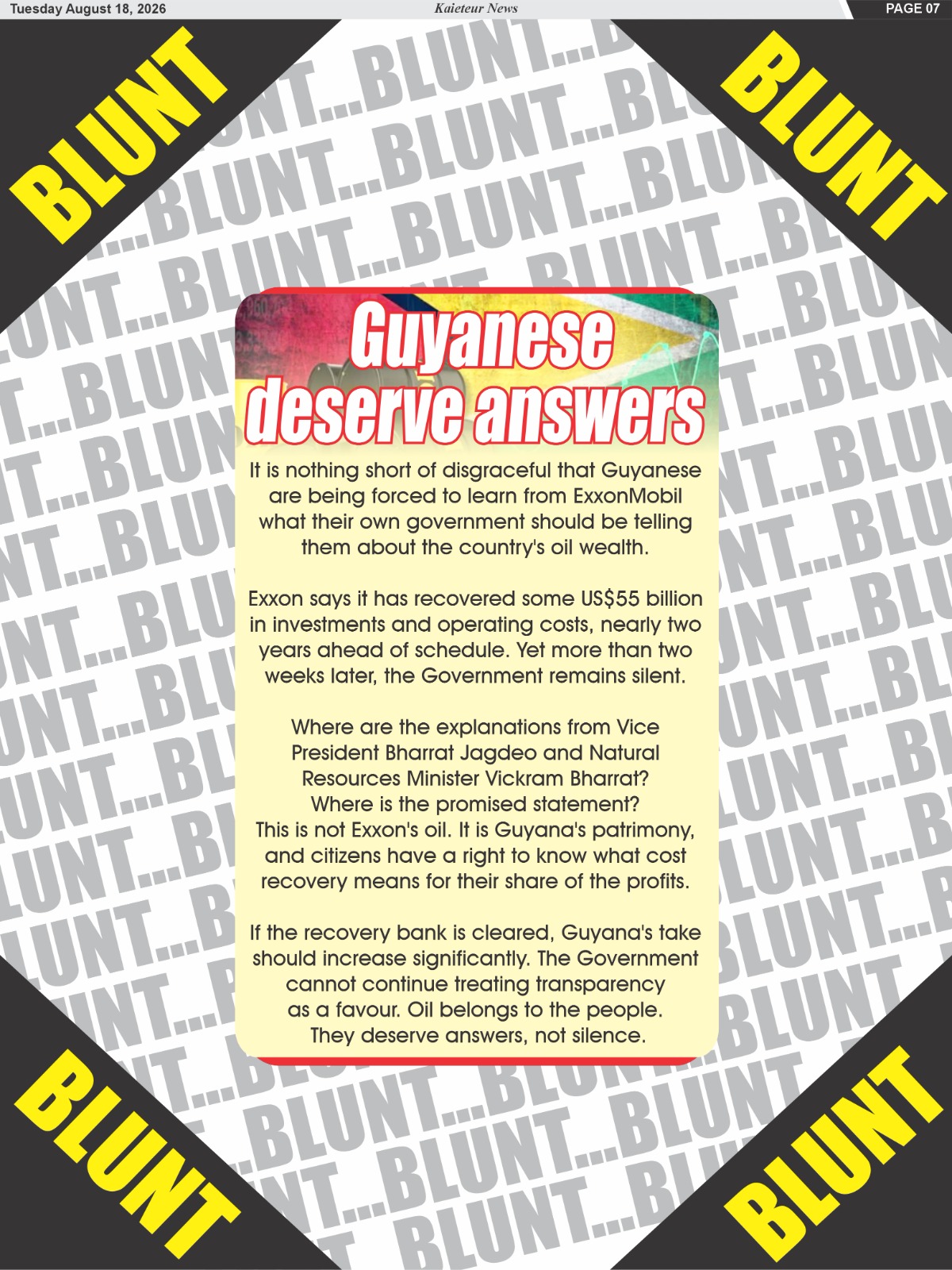
Blunt of the day
Sports

Features/Columnists

Sir. Ronald Sanders

The GHK Lall Column

Weekend Cartoon