Latest update October 4th, 2026 10:35 AM


Latest News
- Controversial U.S. company in running for Amaila hydro project
- 40 citizens, 4 organisations appeal EPA’s no-EIA decision on Kurupung uranium project
- Israeli air attack on Gaza City apartment kills at least five
- CANU finds uncustomed alcohol at Windsor Estates property
- Govt. still reviewing Exxon’s 8th Stabroek project
Public Utilities Commission needs to regulate GPL
Dear Editor,
There are those who might say that valuing the GPL for rate making purposes would be an exercise in futility since the company is essentially owned by the Government of Guyana. Making rates is an exercise in fairness to all the competing interests in the industry. Additionally, it is a cardinal principle of rate-making that both the utility and the consumers should have rate certainty. Annual rate making does not provide that certainty. Normally, rates are made to cover three to five years with triggers to protect both the utility and consumers in the event of unforeseen movements in the rate making critical variables.
Further, rate making begins with being able decide on the relevance and cost of the utility’s expansion plans. Normally the utility is required to present its Integrated Resource Plan (IRP) and Least Cost Expansion Plan (PCEP) to the regulator for discussion, ventilation and approval. In some countries, however, the approval of such expansion plans falls within the portfolio of the Minister with responsibility for the sector. Guyana’s falls within this latter category. Unlike Guyana, however, in every such country I am aware of the regulator acts as advisor to the Minister who does not act without the advice of the regulator.
This is simply because there is a recognition that the Minister’s office is not staffed with the regulatory capacity as the regulator office. In this connection, the Office of Utility Regulations (OUR)of Jamaica, the National Utilities Regulatory Commission (NURC) of St. Lucia and the Public Utilities Regulatory Commission (PURC) of Grenada are a few regulatory bodies that come to mind. They all advise their Ministers on the appropriateness and least cost option of their utilities expansion plans. Here in Guyana the PUC has no such role and can only approve GPL’s budget if the Minister chooses not to do so.
Even within the strictures the PUC finds itself because of ESRA, there are regulatory issues it could embark on to protect the interests of consumers and other stakeholders. It is responsible for reviewing and approving the quality of service standards imposed by the ESRA once a year. Those standards are made up of issues that can be monitored, not just reported on, throughout the year.
For example, GPL reports on the frequency and duration of blackouts in their System Average interruption Index (SAIFI) and System Average Interruption Duration Index (SAIDI) report. This reporting does not prevent the PUC from ordering the GPL to report outages or blackout affecting a predetermined number of households immediately as they occur. This report can also say the cause of the interruption and how soon the area is expected to be powered up again. Such a matter can be easily dealt with through an order of the Commission. While on this let me point that throughout the Caribbean Quality of Service Standards (QSS) are set by the regulator through an order.
There is a reason for this. These standards are not seen as static but can be changed with competence and efficiency. If reviewed by the regulator and found to be in need of revision, they can easily be changed by a regulatory order. Because they are embedded in the ESRA in Guyana, changes to them can only be made by amending the law which entails going through the legislation process. Even so, during the annual review of these standards, the PUC can determine the continued relevance of them and make representation for changes where necessary.
The PUC could also have been monitoring the use of fuel by GPL. I don’t know what proportion fuel use bears now to the overall cost of generation, but I am aware that at one time it stood at approximately 65% of the overall cost. The cost of fuel used form part of the rates consumers of electricity have to pay. Because of that, close attention should be paid to how it is used with the intention of minimizing the cost to the consumers. The PUC could have ordered the GPL to provide it with a schedule of the efficiencies of its generators, whether done by heat rate or otherwise.
Armed with this schedule, it could then have ordered GPL to provide it with daily reports on how its generators were dispatched or brought online so that comparisons could have been made to ensure that the most efficient generators were dispatched first and the less efficient only when needed. Such comparisons would give the regulator some idea of the fuel used for the total reported generation. Combined with these could have been monthly usage reports showing the opening balances, purchases and closing balances along with copies of the orders and invoices to support the purchases. These could have been followed up with periodical fuel audits. The use of fuel and its cost to the consumer is too important to be ignored by the regulator.
Lance McCaskey
Share this:

Discover more from Kaieteur News
Subscribe to get the latest posts sent to your email.
Similar Articles
Website Hits

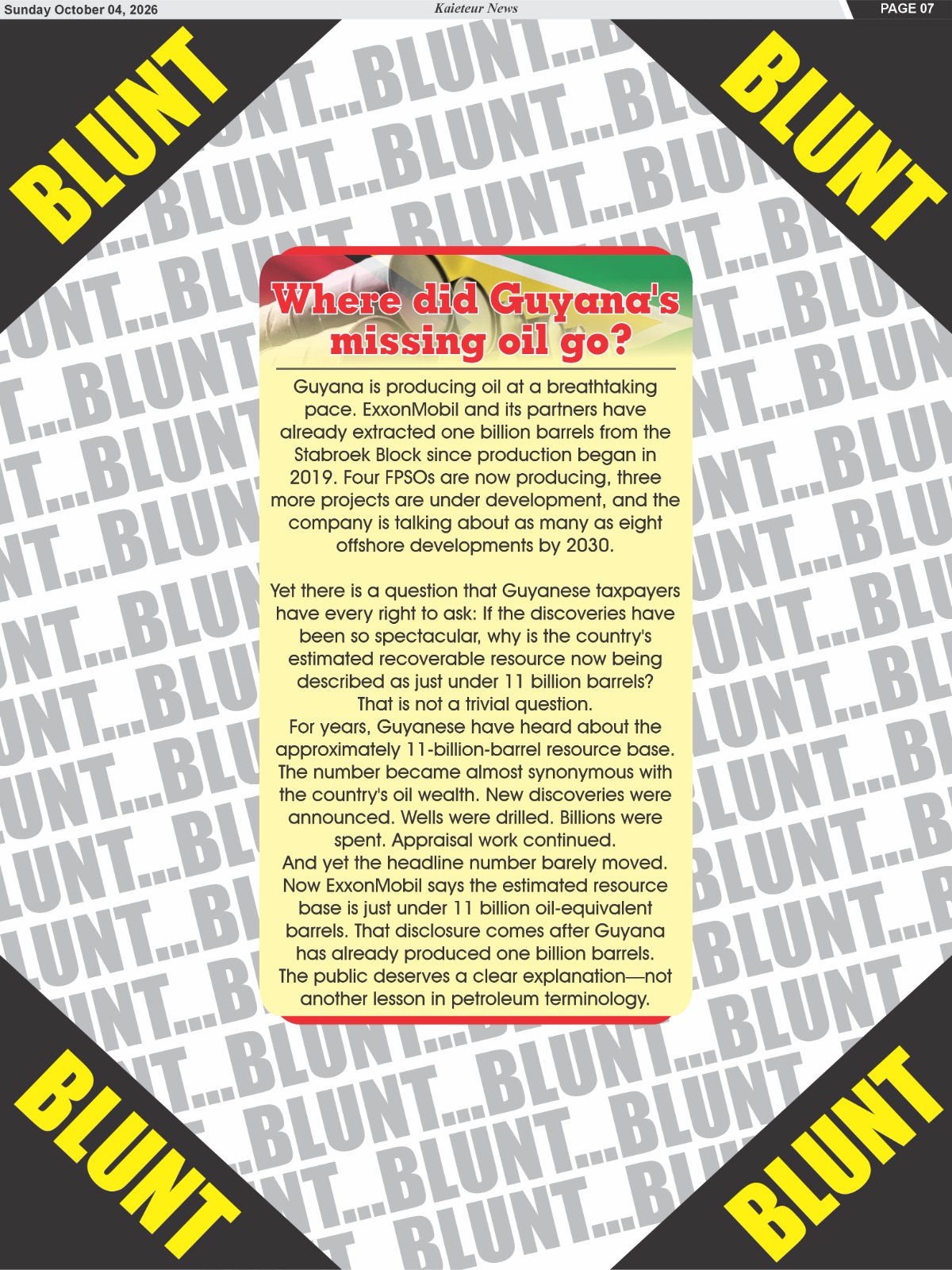
Blunt of the day
Sports

Features/Columnists

Sir. Ronald Sanders

The GHK Lall Column

Weekend Cartoon