Latest update July 28th, 2026 10:33 AM



Latest News
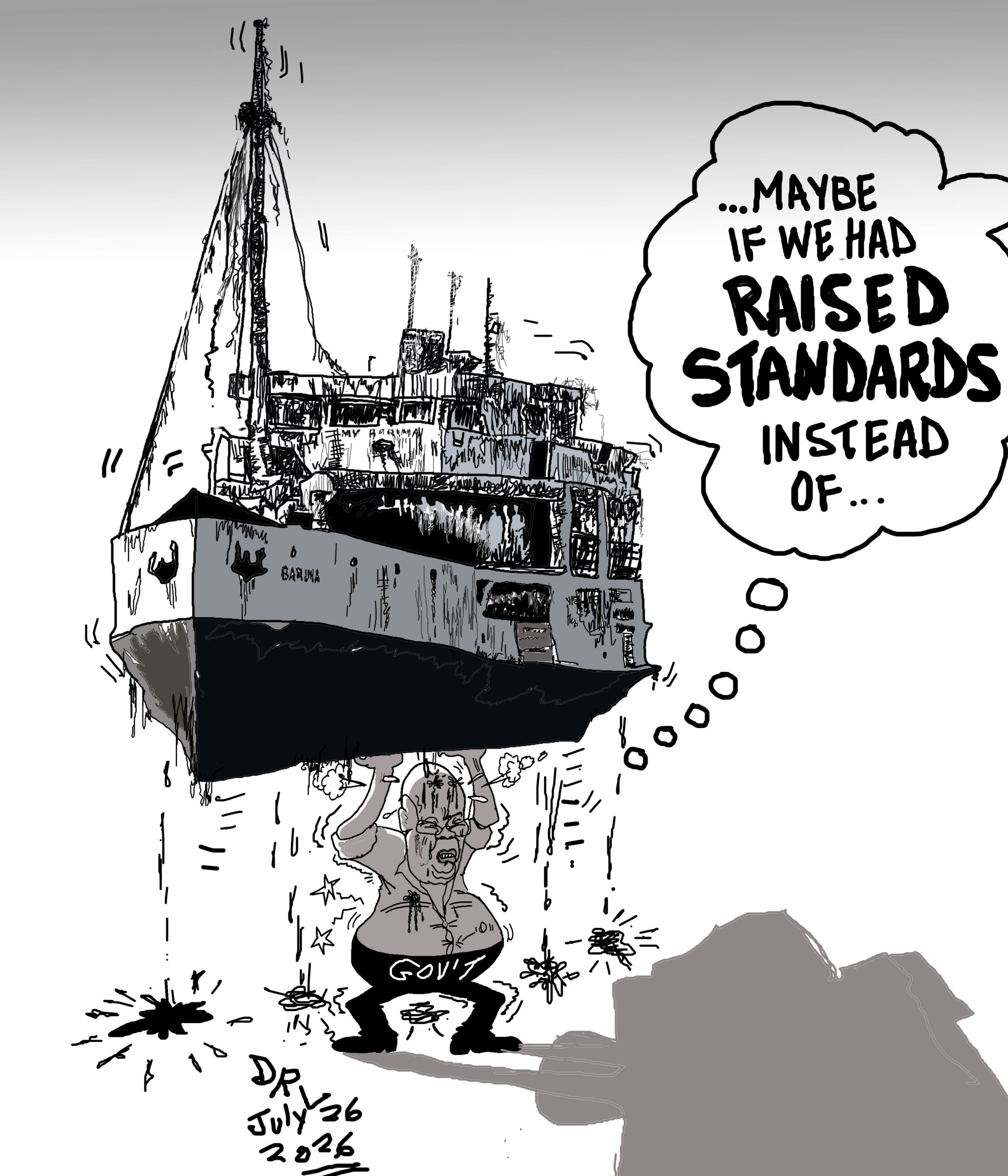
- MV Barima captain, two crew members charged with murder
- Protest erupts in Parliament as opposition demands Edghill, Indar resign over MV Barima tragedy
- Govt. floats leaving MV Barima on seabed as memorial site
- Bodies of five victims of MV Barima tragedy still to be identified- Health Ministry
- ‘Driven Out by Despair’: Thousands of Cubans find refuge in Guyana
Raison d’etre of the Commission of Inquiry ignores these historical facts
Dear Editor,
The PPP/C administration, using the provisions of the Amerindian Act of 2006 and the Amerindian land policy which preceded it, addressed a large number of Amerindian land issues for new communities and extension of communities that already held Land Titles/Absolute Grants. As of 2015, there were 103 Amerindian communities awarded absolute grants of community titles of which 83 were in the process of being demarcated. Fifteen (15) applications for extensions were pending and 6 were awaiting title.
Guyana continues to be internationally recognized for increasing the amount of land owned by Amerindian (Indigenous) communities from 6.5 to 14% in less than a decade. Up to recently, Guyana was second to none in the hemisphere when it comes to addressing Amerindian land rights and indeed Amerindian rights in general.
This is why the recent appointment by His Excellency President David Granger of a Commission of Inquiry into Lands, supposedly to address Amerindian and freed African and other lands, is as ill -advised as it is troubling. I am astonished at this action by the government for more reasons than one. This decision smack of gross disrespect and disregard for the history and recent developments of Amerindian/Indigenous land rights in Guyana and indeed around the world.
It demonstrates a lack of understanding of the distinct nature of Amerindian lands, which is based on collective ownership, and more importantly, the relationship between Amerindians and land and the environment. Incidentally, the sanctity of our borders with Brazil were so decided by the fact that Amerindians consistently living there over hundreds of years. They have been not only the protector of our forests and environment but also the de facto protectors of our country’s borders. The raison d’etre of the Commission of Inquiry ignores these historical facts.
Most noteworthy is the disregard of the specific inclusion in Guyana’s Constitution regarding Amerindian/indigenous land rights ( see Preamble “Value the special place in our nation of the indigenous people and recognise their right as citizens to land and security and to the promulgation of policies for their communities”; and, Articles 142, which provides the state with the power to take away land and provide it for the benefit of Amerindian communities, as well as Articles 149 and 212S) and several international instruments such as the UN Declaration on the Rights of Indigenous Peoples which Guyana endorsed.
Most importantly, it disregards the Amerindian Act of 2006 which clearly sets out a process of addressing Amerindian lands, and which, as mentioned before, has been used to do just that. It consequently, overrides the authority of the Minister responsible for Amerindian/Indigenous Affairs as stipulated in the Amerindian Act, in particular section VI, which details a process for addressing Amerindian land claims, both for communities without any legally recognized lands and those seeking extensions.
To add insult to injury and indeed in spectacular form, the regime established this Commission without any consultation with the elected representatives of the Amerindian villages in Guyana, and then, through various operatives sought to justify why Indigenous peoples land issues should be comingled with other land issues. It might serve the public well to look at the recent history of addressing Amerindian land claims in Guyana. The PPP, even before taking office in 1992 had promised to address Amerindian land matters.
A policy was devised and put in place early in the 1990s. The lessons from the application of this policy were both positive and negative. By 2001, the PPPC administration had approved a process of widespread consultation on a new Amerindian Act, to be led by the then Minister of Amerindian Affairs, Carolyn Rodrigues. The Amerindian land issue was one of the primary matters to be addressed in the new legislation.
Following more than three years of consultation across the length and breadth of Guyana, it was time to draft a new Act. By this time, the administration had garnered immense experience on the ground, through the application of the land policy which magnified the depth of the problem to be addressed.
In addition to the experiences garnered through the application of the Amerindian land policy, the recommendations that were made during the consultations for the new Act and a review of the 1969 Amerindian Lands Commission Report, made it clear that a process for addressing Amerindian lands had to be elevated from policy to law. This was the only way that Amerindian communities would be able to have their land rights addressed and protected through a process that is transparent and fair. They clearly recognised that policies, unlike law, can be changed at the whims and fancies of the Government. As we are witnessing now with the APNU+AFC Coalition government !
With a mandate from the Cabinet, the Minister of Amerindian Affairs and the legal team defined the eligibility criteria and a process for addressing Amerindian land claims. This also was placed under scrutiny by consultation with Amerindian communities, civil society and state agencies. The Bill was then submitted to Parliament and sent to a Parliamentary Special Select Committee where it was again examined in further detail inclusive of hearings with civil society. The Amerindian Act was unanimously approved in October 2006 with the inclusion of a provision that is considered to be the most advanced for addressing Amerindian land claims in the hemisphere.
Noteworthy is that Mr. Vincent Alexander, former PNC M.P., and Dr. George Norton M.P among other PNC opposition members, were on the afore-mentioned Parliamentary Special Select Committee. They supported the provisions that dealt with addressing Amerindian land claims. In fact, at no point did they call for the establishment of a Commission of Inquiry or a Lands Commission which their party advocated during the lead up to the 2015 general and regional elections.
The first indication that Amerindian land rights would be questioned came from Presidential Adviser, Eric Phillips in March and April 2016 in a series of letters to the media. The comment by the same Mr. Alexander, Ministerial Adviser, on April 4, 2017 at the UG/Carter Centre forum on constitutional reform in response to Toshao Shuman’s comment on the Commission of Inquiry is instructive. He responded thus, “there can be no discussion on Amerindian lands that is not an integrated discussion on land, as we are all Guyanese and why must there be a separate treatment of Amerindian lands”!! He let the “cat out of the bag”! There you have the government’s justification for the Commission of Inquiry! I will have more to say in a follow-up letter
Gail Teixeira, M.P.,
PPP/C Chief Whip
Share this:

Discover more from Kaieteur News
Subscribe to get the latest posts sent to your email.
Similar Articles

Blunt of the day
Sports
Features/Columnists

Sir. Ronald Sanders

The GHK Lall Column

Weekend Cartoon