Latest update August 13th, 2026 12:03 AM



Latest News
- After 10 days of silence, Govt. confirms Guyana receiving 50% profit share
- Guyana must get more than 50% if country’s profits will be funding new oil projects – MP Andrews
- MV Barima tragedy… Internal records expose months of warnings, request for urgent repairs
- Colombia quake death toll tops 250 as rescuers race to find survivors
- Caribbean judiciaries rally behind CCJ as internal row erupts
Officials defend vessel’s capacity, deny reports of engine trouble ahead of fatal voyage
(Kaieteur News) – Government officials fielded pointed questions Tuesday about the capacity and mechanical condition of the MV Barima, which capsized and sank several miles off the Essequibo Coast on Saturday.
At a press conference Tuesday evening, Prime Minister Brigadier (Ret’d) Mark Phillips, Minister of Public Works Juan Edghill, and Maritime Administration head Stephen Thomas sought to dismiss reports that an engine or other heavy equipment had been loaded aboard before the vessel’s final voyage.
Journalist Gordon Moseley pressed officials on survivor accounts describing a large piece of equipment loaded during cargo operations, asking whether a generator or engine had been placed on board, and whether engineers had been present on the vessel’s last trip from Region One due to mechanical issues.
Responding on the question of capacity, Thomas said the vessel, roughly 87 years old, carried a certified passenger capacity of 394 and a cargo capacity of about 126 tonnes, according to its documentation. He said he could not speak to how cargo weight was distributed aboard the vessel, noting that determination would fall to investigators.

Maritime Administration head Stephen Thomas
“As for the distribution of the weight, I have not seen the investigation data, so I cannot say whether the cargo was loaded higher or lower on the vessel,” Thomas said. “That will be determined as part of the investigation.”
Pressed further on how the vessel’s capacity is practically monitored, given that passengers are not weighed before boarding, and that people not listed on the manifest were aboard, Thomas pointed to the vessel’s load line as the standard measure.
“The vessel has a load line. If the load line is not submerged, then the vessel is not considered overloaded,” Thomas said. He added that reviews conducted with input from those assisting the investigation found the load line “was only just submerged,” which he described as normal in fresh water, noting vessels sit higher in denser seawater. “Based on that assessment, the vessel was not overloaded,” he said.
Prime Minister Phillips intervened at points to steer the discussion, cautioning against attempting to resolve the entire matter before a formal investigation.

Prime Minister Brigadier (Ret’d) Mark Phillips
“We run the risk of trying to interrogate the entire incident here,” Phillips said. “I understand you want answers, but many of those answers will come from the subsequent investigation.”
Minister Edghill addressed the vessel’s passenger loads directly, explaining that travelers to the North West Region typically carry substantial cargo beyond personal luggage.
“Anyone who has travelled to the North West knows that passengers are not travelling with only a handbag. They buy supplies and stock for their communities,” Edghill said, noting that commercial cargo is loaded before passengers board. He said the MV Barima and other ferries have not carried over 300 passengers in practice because available seating space is taken up by luggage, boxes, and provisions, adding that online bookings are closed once that space fills.

Minister of Public Works Juan Edghill
Journalist Leroy Smith raised questions about whether a list of expected repairs on the vessel should have prompted an adjustment to its carrying capacity, and asked directly whether the vessel experienced engine trouble on its final voyage into Georgetown.
Edghill denied any reports of mechanical issues. “There was no report from the crew of any engine trouble. When the vessel came into Georgetown there were no reported engine issues, and when it departed there were no reported engine problems,” he said, adding that crews typically report and return to port if engine trouble develops after departure. He maintained that any equipment loaded onto the vessel was cargo being transported, not equipment meant to repair the vessel itself.
Smith also asked whether any government official or minister had instructed that items be loaded regardless of weight implications. Phillips said he had received no such report.
“I cannot say yes or no because I have not received one,” Phillips said. “If anyone has information suggesting that happened, they should come forward during the investigation, provide a statement and present the facts to the commission or inquiry. That process will be independent and transparent.”
Phillips said all logbooks and records would be examined as part of the investigation, and that any equipment, fuel, or machinery aboard the vessel would be identified and itemized.
Smith also raised an apparent discrepancy in the vessel’s reported capacity, noting Edghill was quoted in 2024 stating the vessel’s capacity was 150 far below the 394 figure cited this week and asked whether the vessel’s age had contributed to a reduced carrying capacity over time.
Thomas rejected that suggestion, saying the opposite is generally true. “If a vessel is properly maintained, it retains its certified capacity,” he said, explaining that older vessels were often built with thicker steel, while modern ships use thinner, stronger steel that makes them lighter and able to carry more cargo. “The age of the vessel, by itself, does not reduce its certified carrying capacity,” Thomas said.
Survivors dispute official account
The officials’ assurances stand in sharp contrast to accounts from survivors of the disaster. Leon Murray, who survived after spending hours in the water, insisted the vessel was filled well beyond its stated capacity with both passengers and cargo.
“Taxi pon boat, plus 200 passengers on the boat. Dem claiming is only 116 but dem lie. The boat was packed… packed, packed, packed all downstairs. It overload, it overload,” Murray said.

Survivor: Leon Murray
He said the vessel was loaded with ration, chicken, pork, beef, and other goods, while passengers were squeezed into every available space. Murray also alleged that some passengers boarded without tickets.
“One lady who lost two ah she pickney come and tell me she nah get no ticket,” he said.
Murray further alleged that one of the vessel’s engines failed around 7 p.m. while at sea, and that instead of returning to Georgetown, the crew repaired the engine mid-journey and continued on.
“The engine cut out… dem man instead of go back to port, dem repair the engine and keep moving again,” Murray alleged.
He said overloading was not a new problem on the route, adding that he had travelled on the vessel many times before and had witnessed similar conditions on previous trips.
Another survivor, Daniel Modeste, also disputed the government’s account. In a statement to the We Invest in Nationhood party, Modeste said he and other survivors questioned whether the vessel was overloaded, and raised concerns that the cargo scales at the stelling were not functioning before departure, making it impossible to properly weigh cargo loaded onto the vessel.
Diane Cort, wife of MV Barima canteen operator Neil Cort, told Prime News that the boat was overloaded. Known familiarly as “Aunty Diane,” she said she regularly met her husband at the dock before his trips to Region One and upon his return.
“They packed that boat so much. Nobody seems to care about anybody; they just wanted to carry things. There was a generator on the vessel,” she said. She explained that a standby generator normally kept at the back of the vessel had instead been moved to the front for this trip, adding there was an unusually large amount of cargo aboard.

Diane Cort, wife of MV Barima canteen operator Neil Cort
Cort said she disembarked only minutes before the vessel departed. “I came off the boat about two minutes before it left. Normally it is supposed to leave at 1:00 p.m., but it never leaves at 1:00 because there is always so much cargo to load,” she said.
She said passengers were already on board while the generators were still being loaded, and that it was common for passengers, particularly Amerindian travelers to be displaced from upper-deck seating because cargo occupied so much space.
“We don’t normally see them upstairs like that. It’s a regular thing. Sometimes many Amerindian people have to come downstairs because the cargo takes up so much space. I just feel sorry for them,” she said. She recalled telling her husband to come sit and eat before the boat left, and said she felt significant heat coming from the back of the vessel as crew prepared to use a second generator, near where engineers typically worked in the engine room.
Cort described her husband as “a wonderful man” who “never refused to do what he was asked to do.” She said he and his brother, Kenrick Cort, were both aboard managing the canteen.
She said the vessel’s second engineer told her there had been an ongoing issue with one of the engines in the days before departure. “The boat start loading from Tuesday. They load Tuesday. They load Wednesday, Thursday, Friday… So, we was there, and the second [engineer] come, he said, Auntie Diane, we still have the problem with the one engine,” she recalled.
Cort said the engineer told her the engine had not been fixed and that his warnings to the crew had gone unheeded. “Nobody listen to me,” she recalled him saying. She said the engineer later checked the side of the vessel and remarked that it was riding low in the water.
“The boat was so packed. It was so packed to the max. Plus, it had a pickup. It had a car, and when you see like customers send cars or so, dem is normally put the goods inside and pack it more,” she said.
Cort said that when she left the vessel on Saturday, she noticed it was carrying an unusually large number of passengers, including children and infants. She recalled a moment of foreboding shared with a colleague as she disembarked.
“I said, oh, this boat full. I see children, babies… I come off the boat, and even she [someone next to her] turned and said, ‘Diane, this boat too low, let we pray.’ We ignore the prayer,” she recounted, tearfully.
Share this:

Discover more from Kaieteur News
Subscribe to get the latest posts sent to your email.
Similar Articles
One thought on “Officials defend vessel’s capacity, deny reports of engine trouble ahead of fatal voyage”

Blunt of the day

Sports
Features/Columnists

Sir. Ronald Sanders

The GHK Lall Column

Weekend Cartoon
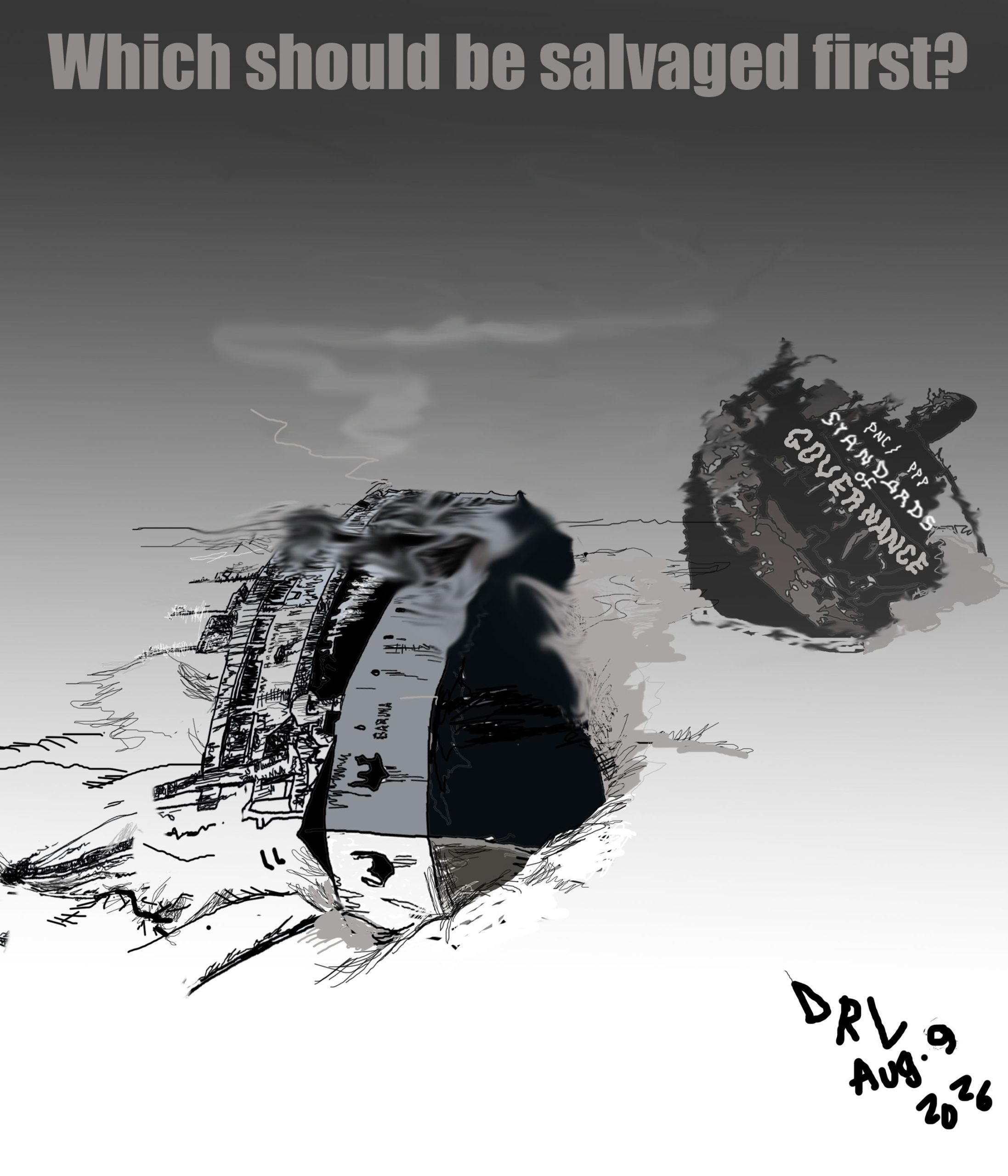


Did Mark Phillips even tried filling a bucket of water from a stand-pipe with a
metal/plastic bowl floating inside ?
That bowl will sink to the bottom when water start filling it.
Same exact thing happened with the MV Barima.
Ocean water overwhelmed the “old lady” and she took her children, grand-
children with her to the bottom of the Ocean.
Since Pres. Ali must resign- he has His farms on the Linden Highway he can
tend to. Mark must also go…ANot to the farm with Ali….must resign.
Leave Jaun alone…not his fault.