Latest update July 25th, 2026 12:30 AM



Latest News
- MV Barima Disaster… 73 bodies found, 69 identified
- APNU demands compensation for families of MV Barima tragedy
- Guyana hit with 12.5% Trump tariff in new U.S. trade crackdown
- Caribbean literary giant Dr. Ian McDonald dies at 93
- Days after MV Barima disaster, NTC breaks silence with glowing tribute to govt. response
Trinidad Coastline raised 20 feet after Venezuela Earthquakes
Trinidad Express – A portion of Trinidad’s south-western coast was thrust nearly 20 feet upwards in the aftermath of the devastating twin earthquakes that rocked Venezuela last week, unsettling the Galfa coastline and trapping hundreds of sea animals among the rubble in a matter of seconds.
By yesterday afternoon Venezuela had reported more than 400 aftershocks that followed 7.2—and 7.5-magnitude quakes that have killed at least 1,400 along its northern coast line thus far. Miles away in Cedros, residents first discovered the raised seabed along an isolated strip of the Galfa coast on the morning after the quakes.
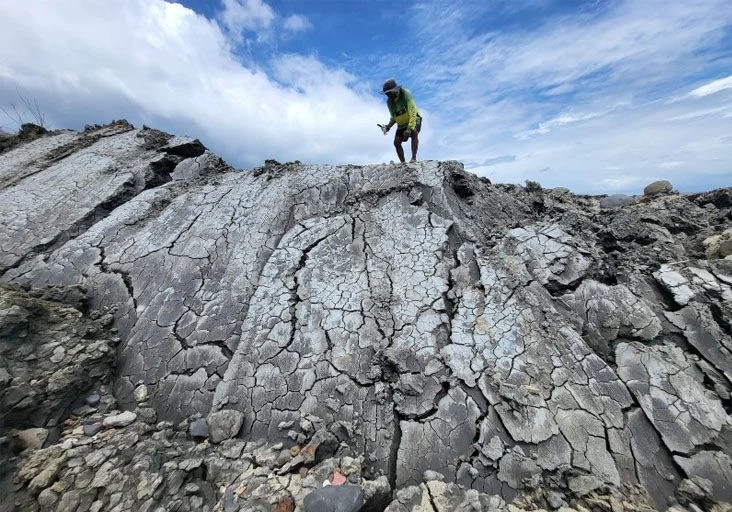
Coastal Movement: A resident stands on land thrust upward by extreme coastal movement in Galfa, Cedros last week (Trinidad Express pic)
When the Express visited the area yesterday afternoon, parts of earth had been pushed upward by multiple feet, lifting a shoreline littered with hundreds of dead or dying fish, crabs, clams and even a stingray. Small pools of bubbling water had settled along parts of the beachside, some emitting an unidentified substance.
A resident, who identified himself as Kamal, said the lifting was first spotted on Thursday morning.
“I felt delusional because it looked like it was raised. The whole area was supposed to be flat and I know it has mud volcanoes and all kinds of things and there are plates running under here. It rose up the same night of the earthquakes. When I looked at the land, there was a set of fish. Within a split second, everything rose. If it was something gradual, the fish would have escaped,” he said.
Cedros resident Neil Sookram, who runs the YouTube channel “South West Adventures”, told the Sunday Express yesterday that he had stopped along the shoreline and was shocked by the sight.
“I saw what looked like an elevated beach and I am an adventurous and curious person, so I ventured further in and I realised the beach was completely lifted. I thought maybe it was because of a fault line or something. There were a lot of dead fishes scattered all about. I saw them trapped under the rubble,” he said.
Speaking to the Sunday Express yesterday, Geologist Xavier Moonan said the phenomenon was likely the result of a reactivated slump, caused by the saturated soil and rocks. The slump, a type of landslide that moves rock masses downhill, was likely triggered by the recent physical shifting and shaking as a result of the earthquakes, he said.
“When it slumped downward, it lifted the coast, part of the beach and the seabed. It lifted it up out of the water. It happened so quickly that it caught fish, crabs and stingrays off guard and they were left out of the water, where they eventually died. Boulders rolled and crushed the stingrays. So it happened so quickly, they could not get out of the way. It happened in a matter of seconds. When the area was scooped up in the area, the animals were scooped up as well. The beach was lifted up because the hillside was tilted down,” he explained.
Moonan said the event had occurred before, citing movement of land in the area in the aftermath of a 6.9 magnitude earthquake near Trinidad in 2018. That quake, he said, had also affected Los Iros.
Last year, activity at the Los Iros mud volcano had caused a similar up-thrust along the shoreline, cratering a number of bordering farmlands. Moonan however said the two events are not necessarily connected.
“It’s a similar area and when Trinidad gets a bit of a shake or when something from Venezuela translates along the faults, here in these weaker zones there is movement,” he said.
While no homes or farms were situated nearby, the Sunday Express was told yesterday that a building associated with an oil company had seen some damage as a result. Moonan also noted the presence of bubbling pools and natural oil seeps along the shore.
“One of the pools has oil coming out of it because the area slipped and the faults are a bit more open, it is coming out along the fault. The Los Iros area and this area are slipping—they are nowhere near stable anymore. In this scenario, it is pretty difficult to put things in place to make it stable because of how the cliffs are. Cliffs will eventually collapse no matter what you do,” he said. He also urged those visiting to exercise caution.
Share this:

Discover more from Kaieteur News
Subscribe to get the latest posts sent to your email.
Similar Articles
One thought on “Trinidad Coastline raised 20 feet after Venezuela Earthquakes”

Blunt of the day
Sports

Features/Columnists

Sir. Ronald Sanders

The GHK Lall Column

Weekend Cartoon


That is a benefit for Trinidad.
They will never get flooding there.