Latest update March 19th, 2026 12:35 AM

Mar 19, 2026 Features / Columnists, The GHK Lall Column
(Kaieteur News) – Oil at US$100 a barrel is being received with mixed sentiments by Guyanese. Those keeping an eye on bigger deposits in the Natural Resource Fund anticipate how much the increase in millions can mean for the local economy, for citizens.
There are others, though, who warn about higher prices for goods, even as they see the positives in US$100 a barrel oil. I see basis for both positions, the increased royalty and profit flows, as well as the specter of higher prices, but some other factors enter into the equation, and cannot be ignored. They introduce a sobering dimension to the joy over more oil money, through fears over higher prices.
Many countries still struggled when oil prices slumped to between US$65 and US$60 a barrel. If at those lower levels, and national oil import bills eating away at scarce foreign exchange, and debt servicing difficult, then not much imagination or mathematics is required to appreciate the havoc that US$100 a barrel oil would cause. US$100 oil wouldn’t be the catastrophe of oil at US$150 a barrel, or the holocaust of US$200 a barrel, but it would be a crisis for countries that lack oil and gas assets. In circumstances where oil prices stay for an extended time at US$100 a barrel, countries would be compelled to make some hard decisions.
Rethink the level of services they offer citizens, and probably reschedule debt repayment arrangements. Alongside those, there is another tough decision. Nonoil producers have no choice but to lower the amount of oil they import. When the oil bill is too high, then demand is lower, and for which the experts have coined a term that induces shudders in oil producing nations. The term is demand destruction, which occurs when the price of a commodity rises steeply and remains high for a long period. Regarding how long the war in the Middle East lasts, no one knows. But its effects will linger for some time after a ceasefire, after stability returns to the region.
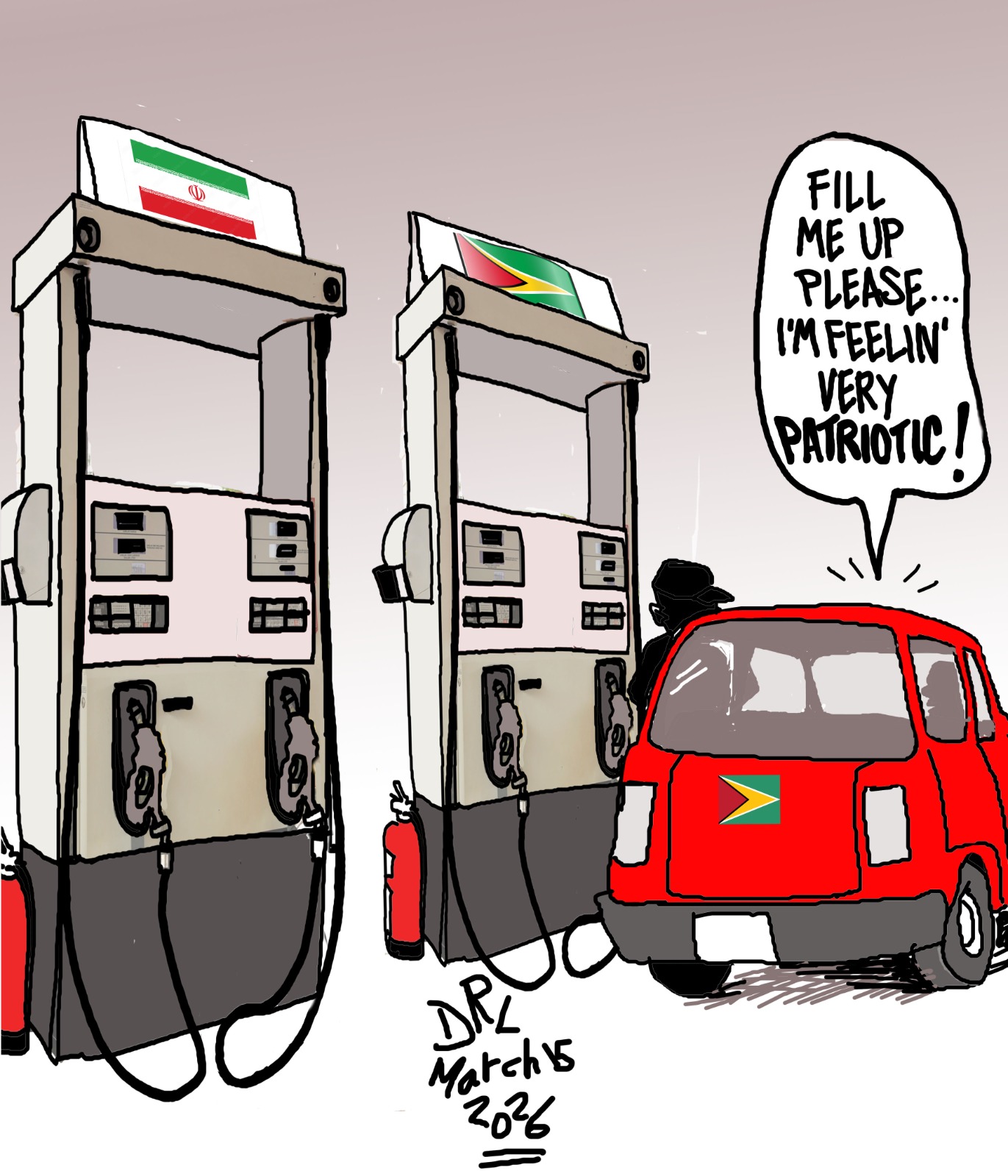
Iran finds itself in an unwinnable war against forces that outguns it. Since Iran cannot go bomb for bomb, then it has to place its eggs (trust and existence) in the power of attrition and deterrence. The issue is whether it can outlast the omnipotent military and technologically superior forces battling against it. The longer there is the will to resist in Iranthat is an indication of where oil prices will be. The more that Iran succeeds in restricting oil supplies, however partial, and the more damage that it inflicts on oil infrastructures, that’s the direction in which oil prices will barrel along. Suddenly, oil at US$100 a barrel looks friendly. It is not US$60 a barrel, but it not twice nor trice that $60 number.
The revenue pluses will have to be gulped down with higher prices for almost everything else as the bitter chaser. In human terms, those would be enough to help the head spin, and the feet lose their uprightness. Prices for basics are already at crippling levels for Guyanese, and this is in a country that produces 900,000 barrels of oil daily. What will oil staying at US$100 a barrel for a time do to cost-of-living pressures locally is best left to speculators, or unsaid. It is a byproduct of war.
One of the tactics of war that is as old as time has been to destroy the food supply of an advancing enemy. Burn the fields. Poison the wells. The Roman General Scipio sowed the fields of Carthage with salt (Cartago delenda est -Carthage must be destroyed). Government forces do that to flush out those fighting against them. Those under attack impair, if not devastate, as much as they can what could be used by attackers to deny them that refueling to fight another day. This is the kind of war that is being fought by Iran. It forms part of a scorched-the sea (Strait of Hormuz) program, and scorched the ground of surrounding territories, through its drone launches.
Guyanese may fool themselves into believing that they are unconnected to the war raging in the Middle East. Their Oil Fund is sure to get some more millions. They will get more punishing blasts from soaring prices. From bread to higher bills. Experts may view things differently. Guyanese deal with their more brutal reality.
(The views expressed in this article are those of the author and do not necessarily reflect the opinions of this newspaper.)
Subscribe to get the latest posts sent to your email.
Your children are starving, and you giving away their food to an already fat pussycat.
Mar 19, 2026
2026 Guyana Harpy Eagles Regional 4-Day preparations…. Practice Match 2, Day 2 Kaieteur Sports – A battle-tested half-century from opener Tagenarine Chanderpaul, Junior Sinclair’s 5-fer and...Mar 19, 2026
(Kaieteur News) – “When Guyana had a shortage of doctors, Cuba sent them to us. Then they offered our children free medical scholarships so much so that 50% of all of our doctors were trained in Cuba. Then Cuba offered to clean our eyes for cataract and other sickness for free in Cuba and...Mar 15, 2026
By Sir Ronald Sanders (Kaieteur News) – Amid the current turmoil in the world, it is important that, in the Americas, we should not forget the urgent humanitarian and political crisis confronting the Haitian people. For many years, the United States has been the principal destination for...Mar 19, 2026
(Kaieteur News) – Oil at US$100 a barrel is being received with mixed sentiments by Guyanese. Those keeping an eye on bigger deposits in the Natural Resource Fund anticipate how much the increase in millions can mean for the local economy, for citizens. There are others, though, who warn about...Freedom of speech is our core value at Kaieteur News. If the letter/e-mail you sent was not published, and you believe that its contents were not libellous, let us know, please contact us by phone or email.
Feel free to send us your comments and/or criticisms.
Contact: 624-6456; 225-8452; 225-8458; 225-8463; 225-8465; 225-8473 or 225-8491.
Or by Email: glennlall2000@gmail.com / kaieteurnews@yahoo.com