Latest update August 12th, 2026 10:20 AM



Latest News
- After 10 days of silence, Govt. confirms Guyana receiving 50% profit share
- Guyana must get more than 50% if country’s profits will be funding new oil projects – MP Andrews
- MV Barima tragedy… Internal records expose months of warnings, request for urgent repairs
- Colombia quake death toll tops 250 as rescuers race to find survivors
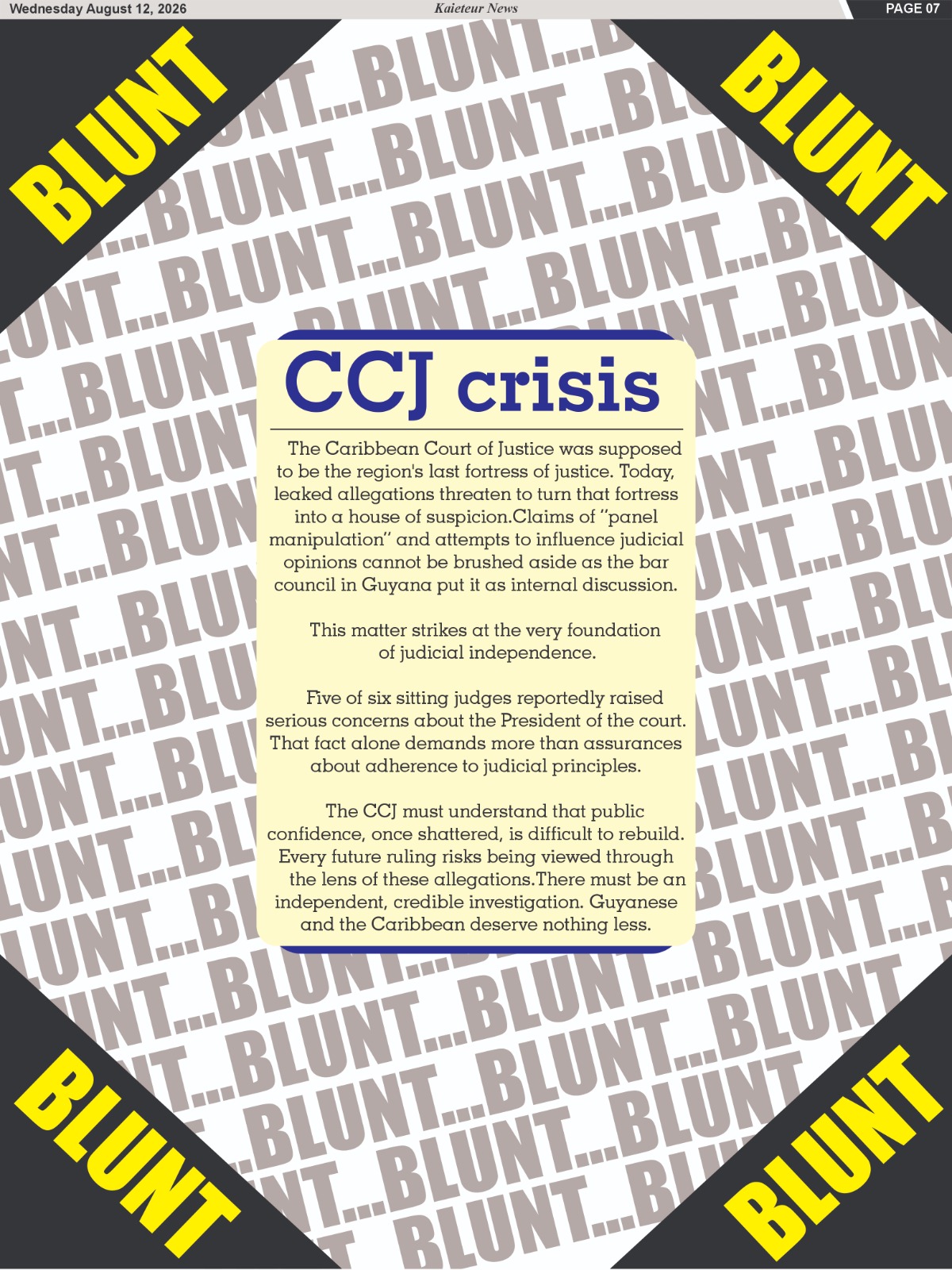
- Caribbean judiciaries rally behind CCJ as internal row erupts
Guyana’s forests could be worth as much as its oil, if carbon is fairly priced – former Colombian president
…urges global fair pricing for carbon

Former President of Colombia Iván Duque Márquez
Kaieteur News – Former President of Colombia Iván Duque Márquez has called for urgent action to fairly price carbon sinking.
Speaking at the launch of the Global Biodiversity Alliance Summit in Georgetown, he argued that the value of tropical forests like Guyana’s should be recognised at the same level as fossil fuel reserves.
Duque emphasized the role of forests in mitigating climate change and the need for compensation mechanisms to reflect that. “So, it’s important that carbon sinking is rightly compensated. The Amazon biome is sinking every year, almost 15% of all the global greenhouse gasses emissions,” Duque said.
He noted that without proper pricing mechanisms, the preservation of critical ecosystems remains underfunded and undervalued.
He singled out Guyana, saying the country’s extensive oil reserves estimated at 11 billion barrels should not overshadow its natural wealth in forest cover. “If we look at Guyana, for example, a country that is rich because [it] has among many of its richnesses, the possibility of hosting 11 billion barrels of oil, which makes it the per capita largest producer of oil in the world, is almost as important, if not more, that this country has 90% of its territory in tropical forest,” he said.
According to Duque, if the correct price per ton of carbon was applied to the carbon absorption capacity of Guyana’s forests, “will be almost the same value as the oil reserves this country has now.”
He added, “Is the world putting the right price on carbon? I don’t think so yet, but this alliance needs to bring to valendo para, to COP 30 that discussion, because if there is a goal, a global coalition to protect biodiversity with clear KPIs, we’re market driven, nature based solutions, we definitely need to bring the discussion I don’t think so yet, but this alliance needs to bring to valendo para, to cop 30 that discussion, because if there is a goal, a global coalition to protect biodiversity with clear KPIs, we’re market driven, nature based solutions, we definitely need to bring the discussion to the fair carbon pricing so that this becomes a reality.”
Calling for a global coalition backed by key performance indicators (KPIs) and market-driven, nature-based solutions, Duque concluded that “countries can put their money where their mouth is” by committing to equitable carbon pricing.
The inaugural Global Biodiversity Alliance Summit was on Wednesday launched in Georgetown, Guyana, with heads of states calling for greater global support for biodiversity protection as the world faces a crisis where biodiversity is under threat. The alliance is committed to scaling blended finance to de-risk investment in nature-based enterprises, piloting biodiversity credits that reward stewardship, expanding debt-for-nature swaps, modeled on our own experience and supporting community-driven finance models that place indigenous leadership at the center.
For his part, former President of the Republic of Colombia, said, “The challenges we face are big, we have lost in the last five decades almost 70 per cent of the world’s wildlife. We have seen that land degradation, and also negative use of land, has become the second largest source of greenhouse gasses emissions, and we know that if we don’t act promptly and with the right instruments, we are going to see most of our ecosystems suffer like no other time before.”
The former president said that he was confident the Global Biodiversity Alliance will introduce practical elements for action, which involve market-driven, nature-based solutions. He further underscored that the world is facing an enormous amount of debt.
He further outlined the need to define that protecting biodiversity is linked with food security, natural security, and safeguarding global supply chains. He said too that there is a need to create elements that avoid further degradation of ecosystems.
“We are in an Amazon country, and the Amazon has lost in the last four decades the equivalent of France and Germany together inland. And people may believe that stopping that level of deforestation seems impossible. Well, the response is no, because we’re in a country like Guyana, that has been able to keep 95 per cent of its territory in tropical jungle successfully,” he outlined.
Guyana carbon credit
In 2022, it was announced the issuance of 33.47 million TREES credit to Guyana under the Architecture for REDD+ Transactions (ART) through its TREES standard. These credits are specifically designed for both the voluntary and compliance markets and reward countries for successfully preventing deforestation and forest degradation, under a system known as jurisdictional REDD+.
Guyana earned 33.47 million TREES credits for the period 2016 to 2020. The credits each representing one ton of carbon dioxide avoided are serialised and listed on ART’s public registry. They are available for sale on the global carbon market, including for use under the International Civil Aviation Organisation’s (ICAO) emissions reduction scheme, CORSIA, as well as by corporations pursuing voluntary climate goals.
So far, two major companies have committed to purchasing Guyana’s high-quality carbon credits. In 2022, the Government of Guyana signed a landmark agreement with oil company Hess Corporation to sell 37.5 million credits over a 10-year period for at least US$740 million. Apple has since followed, becoming the second company to purchase from Guyana’s carbon credit portfolio.
Guyana’s oil
Currently oil is only being produced from the Stabroek Block located about 120 miles offshore Guyana and spans 6.6 million acres.
The Stabroek Block is estimated to hold 11.6 billion barrels of oil equivalent.
Oil production began in December 2019 and has grown to 650,000 barrels per day (bpd) from three sanctioned projects: Liza Phase 1, Liza Phase 2, and Payara. This output is expected to increase with the upcoming start-up of Yellowtail, the fourth development, later this year.
Renewable energy solutions
ExxonMobil Guyana is the operator and holds a 45% interest, Chevron (Hess) Guyana holds 30%, and CNOOC Petroleum Guyana Limited holds the remaining 25%.
Exxon has two other sanctioned projects under its belt: Uaru and Whiptail. It has also submitted an Environmental Impact Assessment (EIA) for its seventh project, Hammerhead, with production targeted for 2029. Additionally, the company has filed an application for an eighth development, Longtail.
Share this:

Discover more from Kaieteur News
Subscribe to get the latest posts sent to your email.
Similar Articles

Blunt of the day
Sports

Features/Columnists

Sir. Ronald Sanders

The GHK Lall Column

Weekend Cartoon